What's new
Every sheet we add goes here, newest first. All of them are free to print.
1 sheets
Picture sequencing for preschool
Picture sequencing now starts at preschool: two wordless stories printed out of order, and the child puts 1, 2, 3 and 4 under the pictures. Eight stories that had a missing or mismatched picture are back with new drawings, among them a morning routine, getting dressed for rain and a lost tooth, so every grade's sheet draws from more stories.
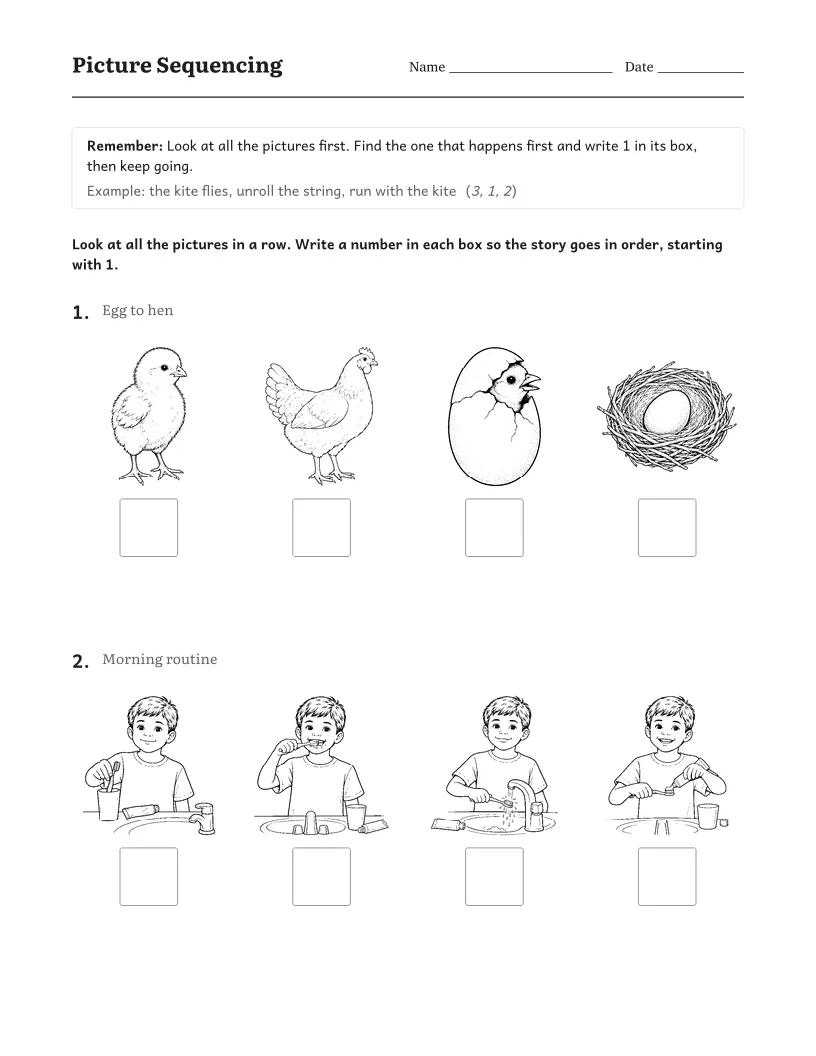
- Picture sequencing Look at all the pictures first. Find the one that happens first and write 1 in its box, then keep going.
10 sheets
Fluency passages at K, 7th and 8th, and reading skills at new grades
Timed reading now runs from kindergarten to 8th grade. Kindergarten reads tiny stories built from early sight words and times the whole read. 7th and 8th grade read passages of about 400 and 450 words, and the two grades never share one. Main idea and characters and setting now start in kindergarten, inferences start in 1st grade, and text features and problem and solution reach 1st and 5th, each sheet a passage with its questions and an answer key.
Kindergarten reading comprehension1st grade reading comprehension5th grade reading comprehension7th grade reading comprehension


Show all 10 sheetsShow fewer
Kindergarten
- Characters and setting Every story answers three questions: who is it about, where does it happen, and when? The characters are the who. The setting is the where and when.
- Main idea and details The main idea is what the whole passage is about, in one sentence. The details are the smaller facts that back it up.
- Reading fluency passages Read the passage out loud for one minute. Read it the way you would talk: smooth, at a steady pace, and with the feeling the sentences call for. Fast is not the goal; smooth and accurate is.
1st grade
- Making inferences An inference is a smart guess the writer never says out loud. You mix a clue from the text with what you already know: if a character shivers and rubs her hands, you can infer she is cold.
- Problem and solution Find what is going wrong, and find what fixes it. The best stories also show tries that failed before the fix that worked.
- Text features Text features are a book's built-in helpers: headings, bold words, the table of contents, the glossary, the index. Good readers use them before reading, not just during.
5th grade
- Problem and solution Find what is going wrong, and find what fixes it. The best stories also show tries that failed before the fix that worked.
- Text features Text features are a book's built-in helpers: headings, bold words, the table of contents, the glossary, the index. Good readers use them before reading, not just during.
7th grade
- Reading fluency passages Read the passage out loud for one minute. Read it the way you would talk: smooth, at a steady pace, and with the feeling the sentences call for. Fast is not the goal; smooth and accurate is.
8th grade
- Reading fluency passages Read the passage out loud for one minute. Read it the way you would talk: smooth, at a steady pace, and with the feeling the sentences call for. Fast is not the goal; smooth and accurate is.
3 sheets
Line tracing, CVC stories, 3rd grade picture prompts and cursive names
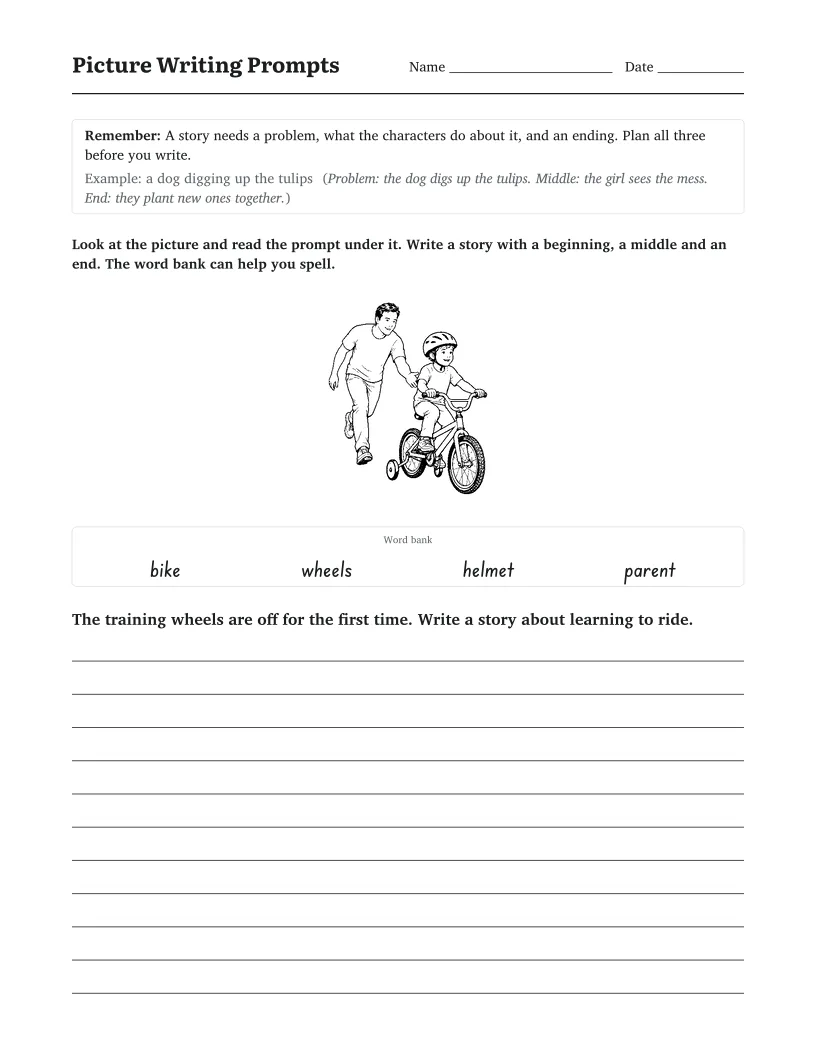
Preschoolers get a tracing page for each kind of line: straight, slanted, zigzag, wavy, curved and loops, each line drawn across the page from a dot with an arrow showing the way. Kindergarten and 1st grade get short stories a beginning reader can sound out word by word, with a page for each short vowel in 1st grade; the child answers each question by writing a word from the story. Third graders get picture prompts that ask for a whole story, and a child's name now has its own page in cursive.
Show all 3 sheetsShow fewer
Kindergarten
- CVC reading passages Say each sound, then blend the sounds into a word. Read the story, then write the word that answers each question.
1st grade
- CVC reading passages Say each sound, then blend the sounds into a word. Read the story, then write the word that answers each question.
3rd grade
- Picture writing prompts Look at the whole picture first. Say one thing that is happening, then write that sentence down.
12 sheets
Science and animal reading passages
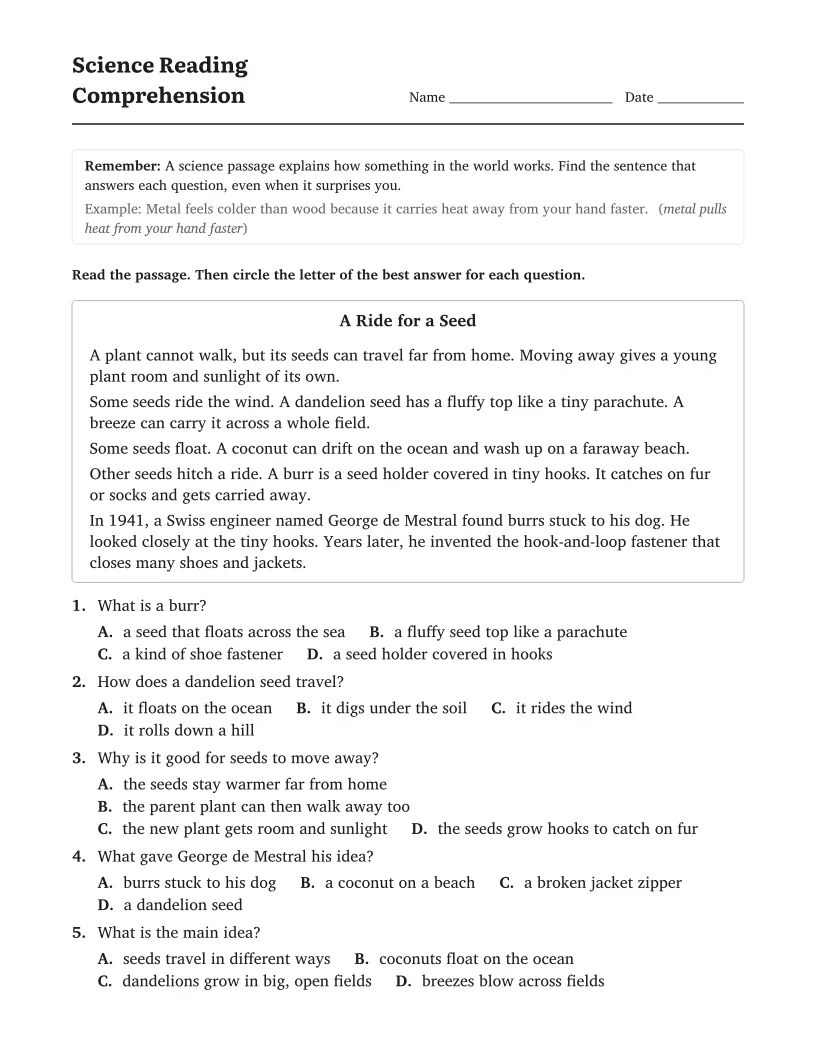
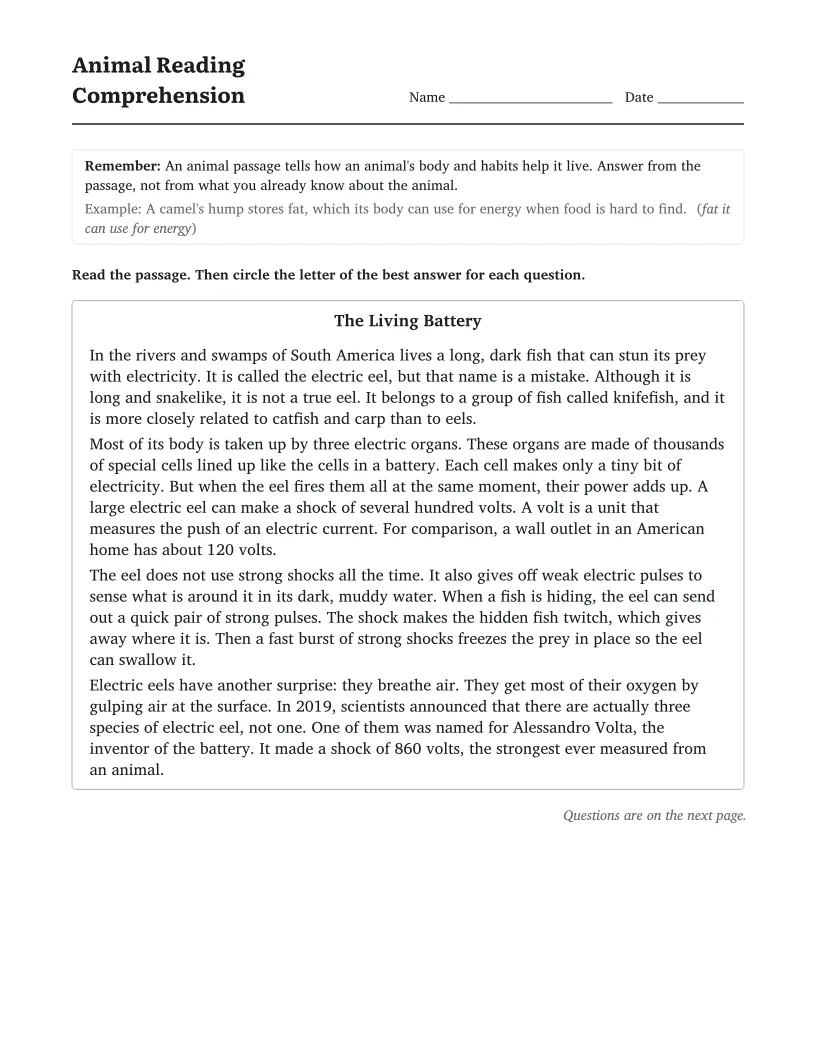
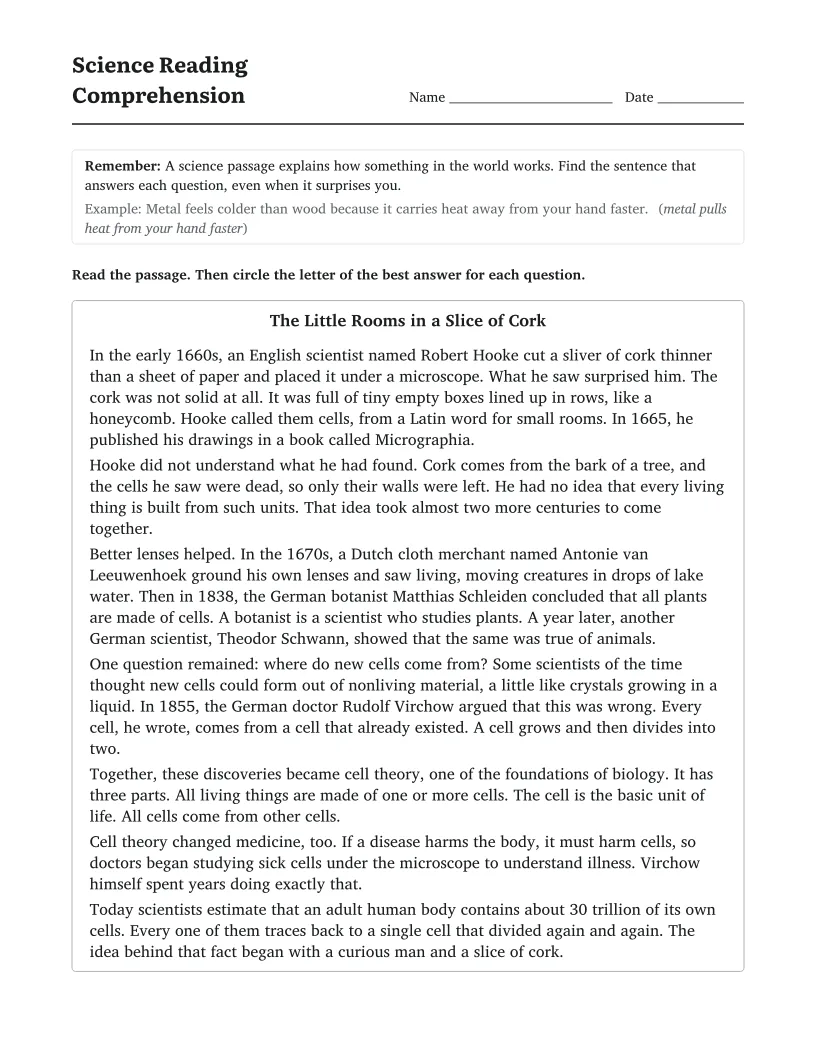
Two new reading comprehension sheets for 1st to 6th grade, sorted by topic. The science passages follow what each grade studies, from shadows and magnets in 1st grade to cells and the speed of sound in 6th. Each animal passage takes one animal and explains how its body or habits help it survive, like the axolotl that regrows a leg or the frog that lives through being frozen. Every passage has its own questions and an answer key.
1st grade reading comprehension2nd grade reading comprehension3rd grade reading comprehension4th grade reading comprehension
Show all 12 sheetsShow fewer
1st grade
- Animal reading comprehension An animal passage tells how an animal's body and habits help it live. Answer from the passage, not from what you already know about the animal.
- Science reading comprehension A science passage explains how something in the world works. Find the sentence that answers each question, even when it surprises you.
2nd grade
- Animal reading comprehension An animal passage tells how an animal's body and habits help it live. Answer from the passage, not from what you already know about the animal.
- Science reading comprehension A science passage explains how something in the world works. Find the sentence that answers each question, even when it surprises you.
3rd grade
- Animal reading comprehension An animal passage tells how an animal's body and habits help it live. Answer from the passage, not from what you already know about the animal.
- Science reading comprehension A science passage explains how something in the world works. Find the sentence that answers each question, even when it surprises you.
4th grade
- Animal reading comprehension An animal passage tells how an animal's body and habits help it live. Answer from the passage, not from what you already know about the animal.
- Science reading comprehension A science passage explains how something in the world works. Find the sentence that answers each question, even when it surprises you.
5th grade
- Animal reading comprehension An animal passage tells how an animal's body and habits help it live. Answer from the passage, not from what you already know about the animal.
- Science reading comprehension A science passage explains how something in the world works. Find the sentence that answers each question, even when it surprises you.
6th grade
- Animal reading comprehension An animal passage tells how an animal's body and habits help it live. Answer from the passage, not from what you already know about the animal.
- Science reading comprehension A science passage explains how something in the world works. Find the sentence that answers each question, even when it surprises you.
8 sheets
Missing letters, capital and small letters, shapes and patterns
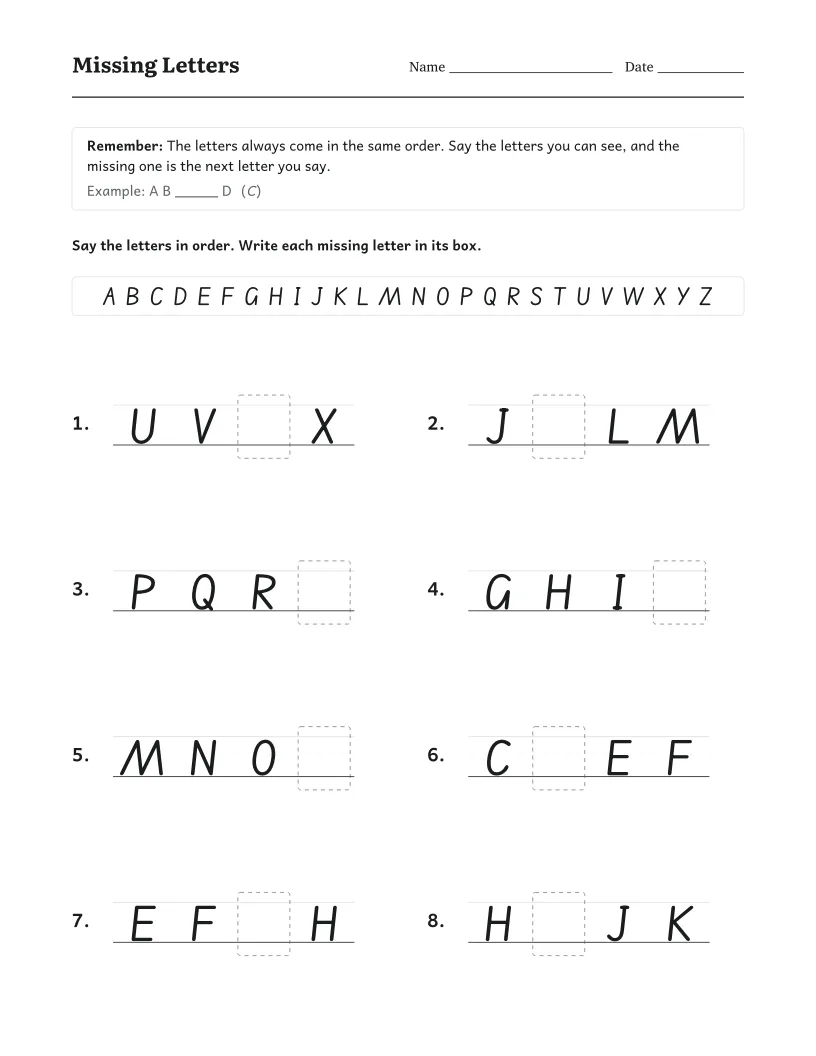
Four new kinds of sheet for preschool and kindergarten, and on every one your child writes or draws the answer: fill in the letters missing from a run of the alphabet, write the small letter that goes with each capital or the other way round, name eight shapes, and draw the shape that comes next in a pattern. Each of the eight shapes also has its own tracing page, with a dot to start on and an arrow showing which way to go.
Pre-K phonicsPre-K handwritingPre-K vocabularyKindergarten phonics

Show all 8 sheetsShow fewer
Pre-K
- Missing letters The letters always come in the same order. Say the letters you can see, and the missing one is the next letter you say.
- Shape names Every shape has a name. Look at its sides and corners, say its name, then write it.
- Shape patterns A pattern repeats. Say the shapes out loud, find the part that repeats, and draw the shape that comes next.
- Uppercase and lowercase letters Every letter has a capital and a small letter. They have the same name and make the same sound.
Kindergarten
- Missing letters The letters always come in the same order. Say the letters you can see, and the missing one is the next letter you say.
- Shape names Every shape has a name. Look at its sides and corners, say its name, then write it.
- Shape patterns A pattern repeats. Say the shapes out loud, find the part that repeats, and draw the shape that comes next.
- Uppercase and lowercase letters Every letter has a capital and a small letter. They have the same name and make the same sound.
5 sheets
Number 11 to 20, color words and cursive sentences
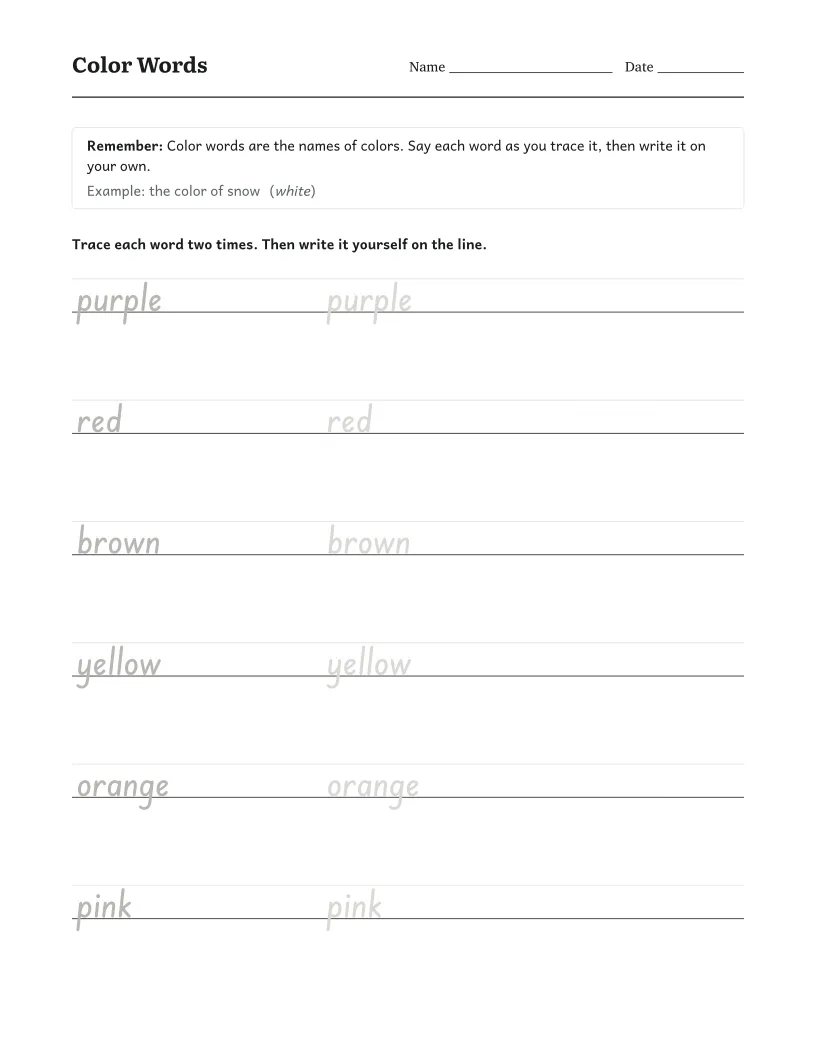
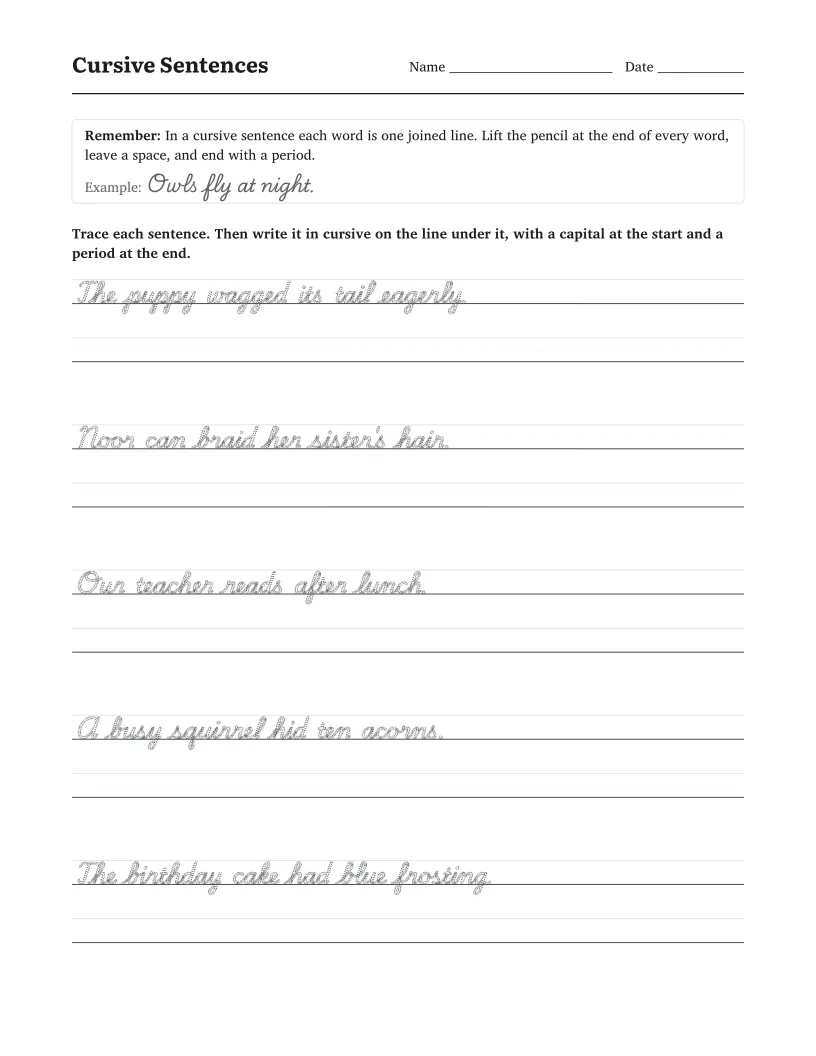
The numbers 11 to 20 each have their own kindergarten page now, with a sheet of that one numeral to trace and help with the teen mix-ups, like 41 for 14. Preschool and kindergarten get color words to trace and write, 3rd and 4th grade get whole sentences to trace and copy in cursive, and sentence tracing goes up to 2nd grade.
Pre-K handwritingKindergarten handwriting2nd grade handwriting3rd grade handwriting
Show all 5 sheetsShow fewer
Pre-K
- Color words Color words are the names of colors. Say each word as you trace it, then write it on your own.
Kindergarten
- Color words Color words are the names of colors. Say each word as you trace it, then write it on your own.
2nd grade
- Sentence tracing A telling sentence starts with a capital letter, has a space between every word, and ends with a period. Trace it, then write it yourself the same way.
3rd grade
- Cursive sentences In a cursive sentence each word is one joined line. Lift the pencil at the end of every word, leave a space, and end with a period.
4th grade
- Cursive sentences In a cursive sentence each word is one joined line. Lift the pencil at the end of every word, leave a space, and end with a period.
10 sheets
Ten frames, 3D shapes and grammar lists
Ten frames, blank for counters or filled in for 1 to 20, a 3D shapes chart that counts faces, edges and vertices, and the types of quadrilaterals with their marks. There is an equivalent fractions table too, and for reading and writing, lists of transition words, conjunctions, prepositions and adjectives, with charts of the digraphs and consonant blends.
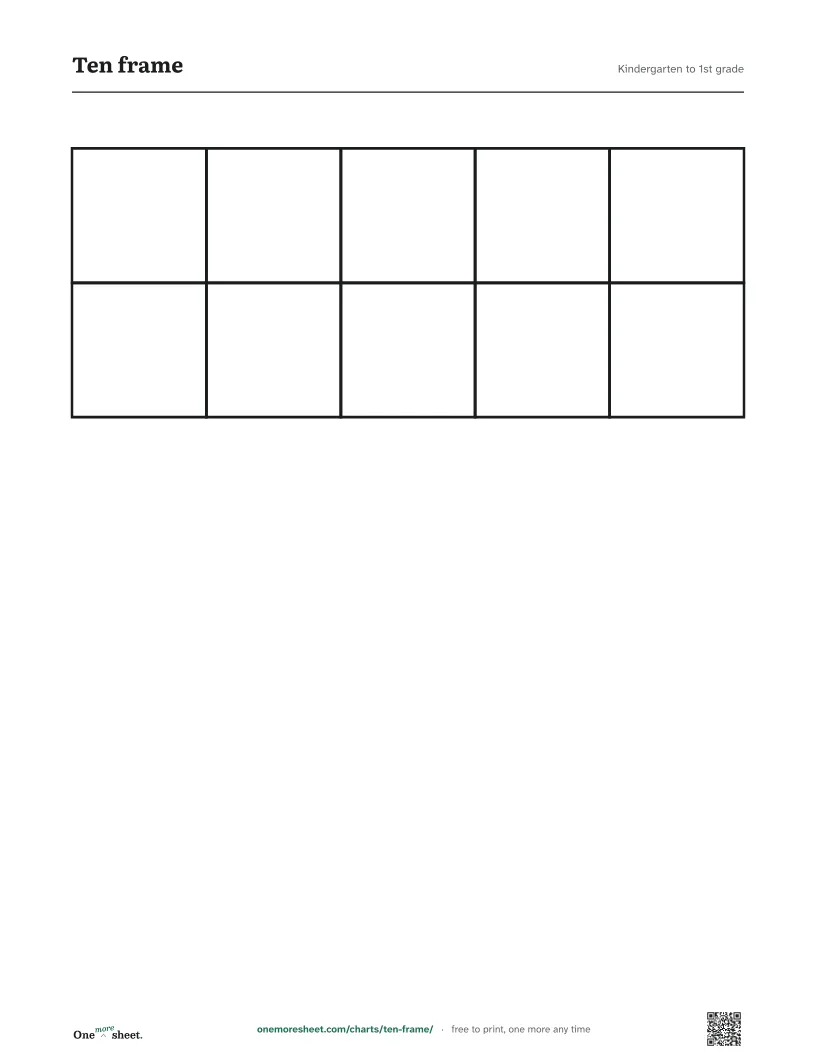
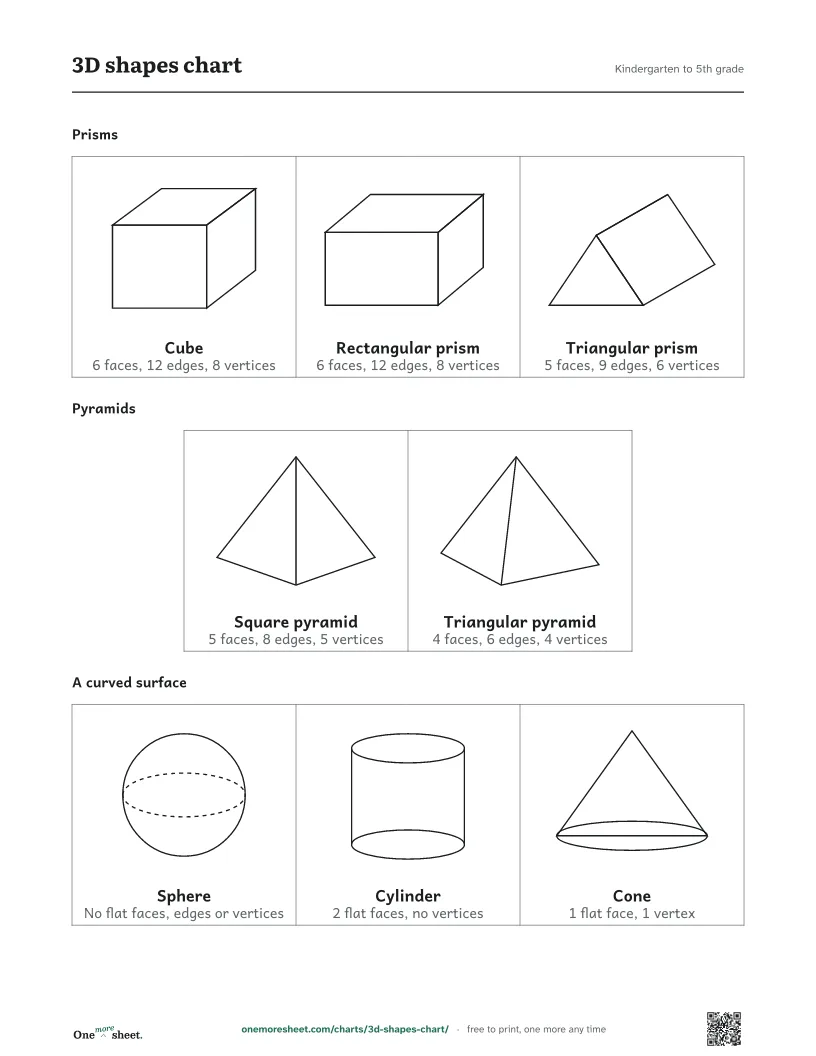
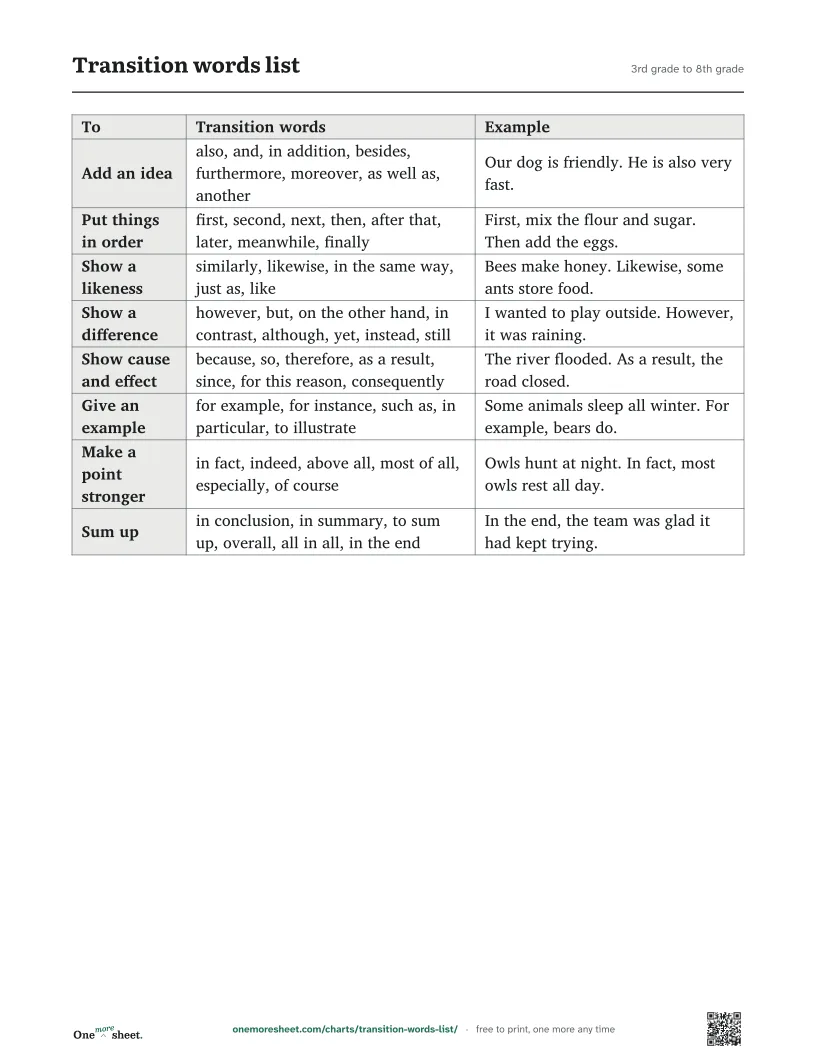
Show all 10 sheetsShow fewer
Printable charts and lists
- 3D shapes chart Kindergarten to 5th grade
- Adjectives list 1st grade to 5th grade
- Conjunctions list 2nd grade to 8th grade
- Consonant blends chart 1st grade to 2nd grade
- Digraphs chart Kindergarten to 2nd grade
- Equivalent fractions chart 3rd grade to 5th grade
- Prepositions list 1st grade to 5th grade
- Ten frame Kindergarten to 1st grade
- Transition words list 3rd grade to 8th grade
- Types of quadrilaterals chart 3rd grade to 5th grade
9 sheets
Number bonds, vowel teams and word lists
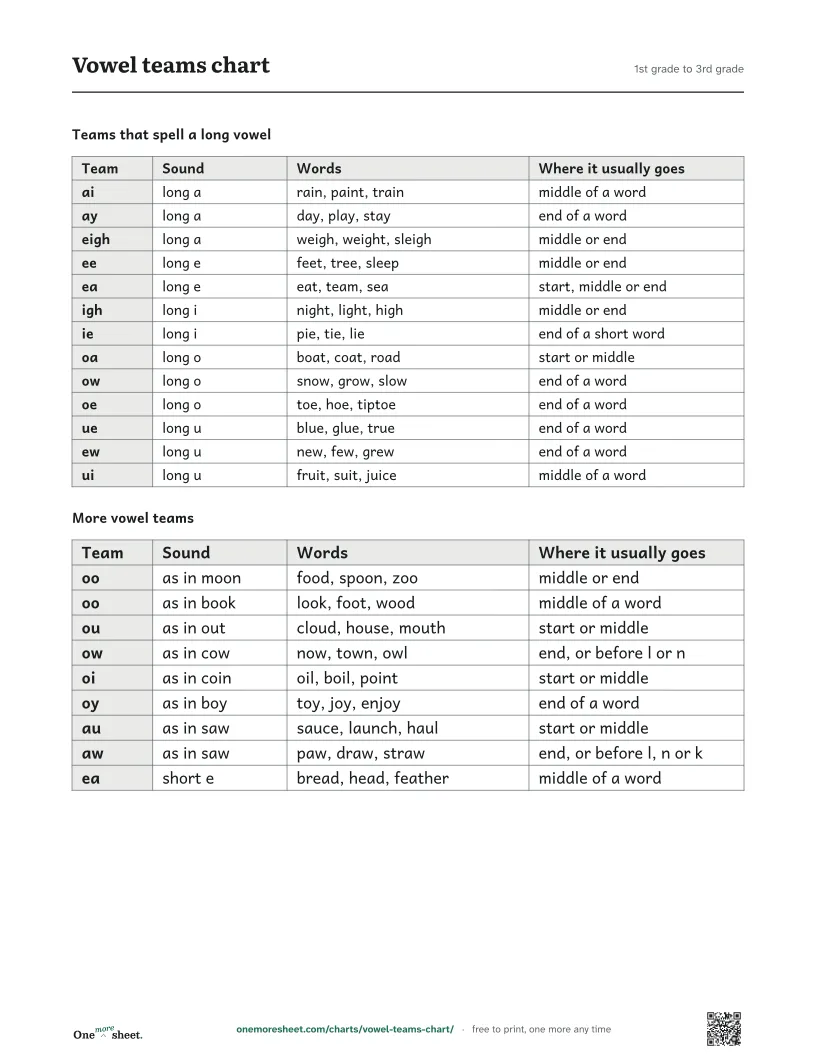
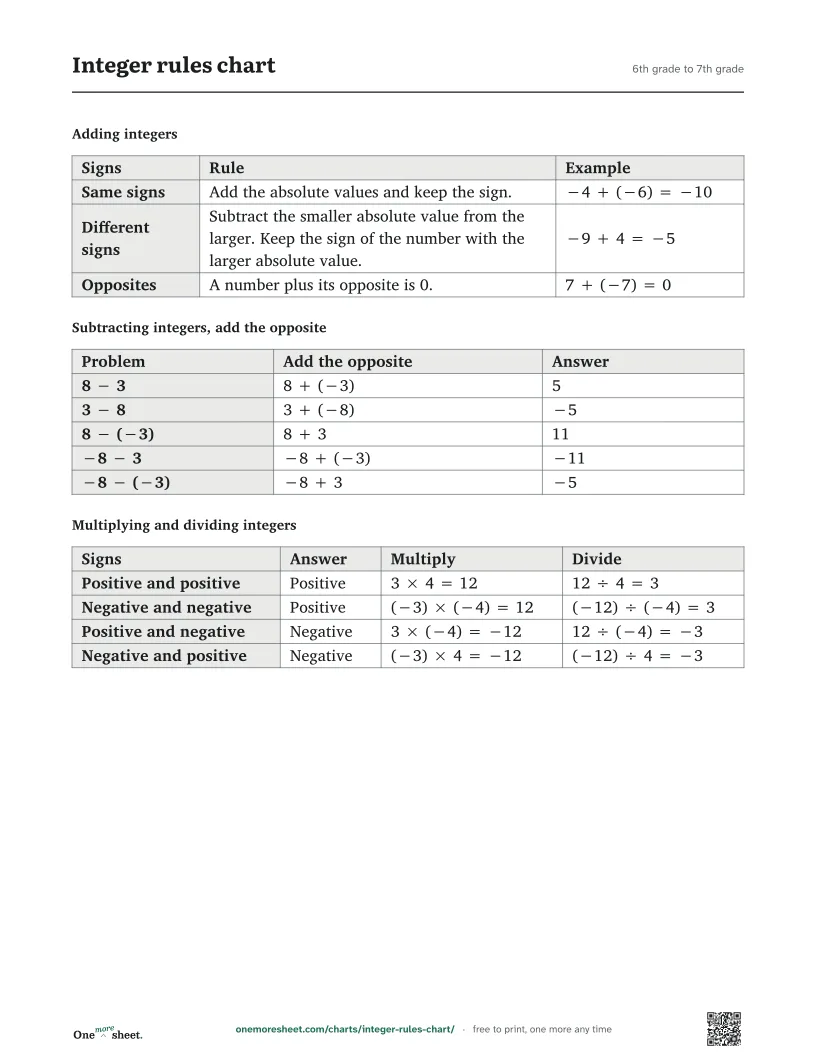
Number bond charts for every number from 5 to 10 and for 20, each bond with its addition fact, and the numbers 1 to 20 in tally marks. For phonics there are charts of the vowel teams, showing where each one goes in a word, and of the r-controlled vowels. Older children get the integer rules with worked examples and a powers of 10 chart. The word lists cover synonyms with their antonyms, compound words split into their parts, and the homophones children mix up most, each with an example.
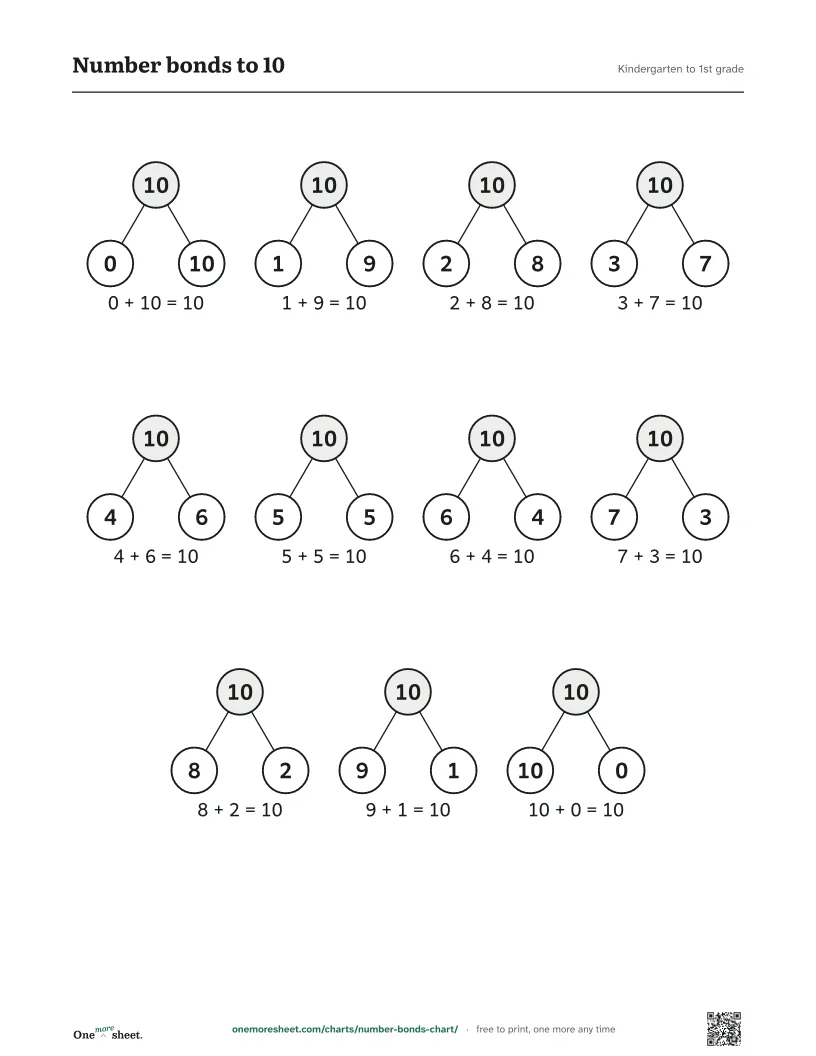
Show all 9 sheetsShow fewer
Printable charts and lists
- Compound words list 1st grade to 3rd grade
- Homophones list 2nd grade to 5th grade
- Integer rules chart 6th grade to 7th grade
- Number bonds chart Kindergarten to 1st grade
- Powers of 10 chart 5th grade to 8th grade
- R-controlled vowels chart 1st grade to 3rd grade
- Synonyms list 2nd grade to 5th grade
- Tally marks chart Kindergarten to 2nd grade
- Vowel teams chart 1st grade to 3rd grade
10 sheets
Math reference charts, coins and clock faces
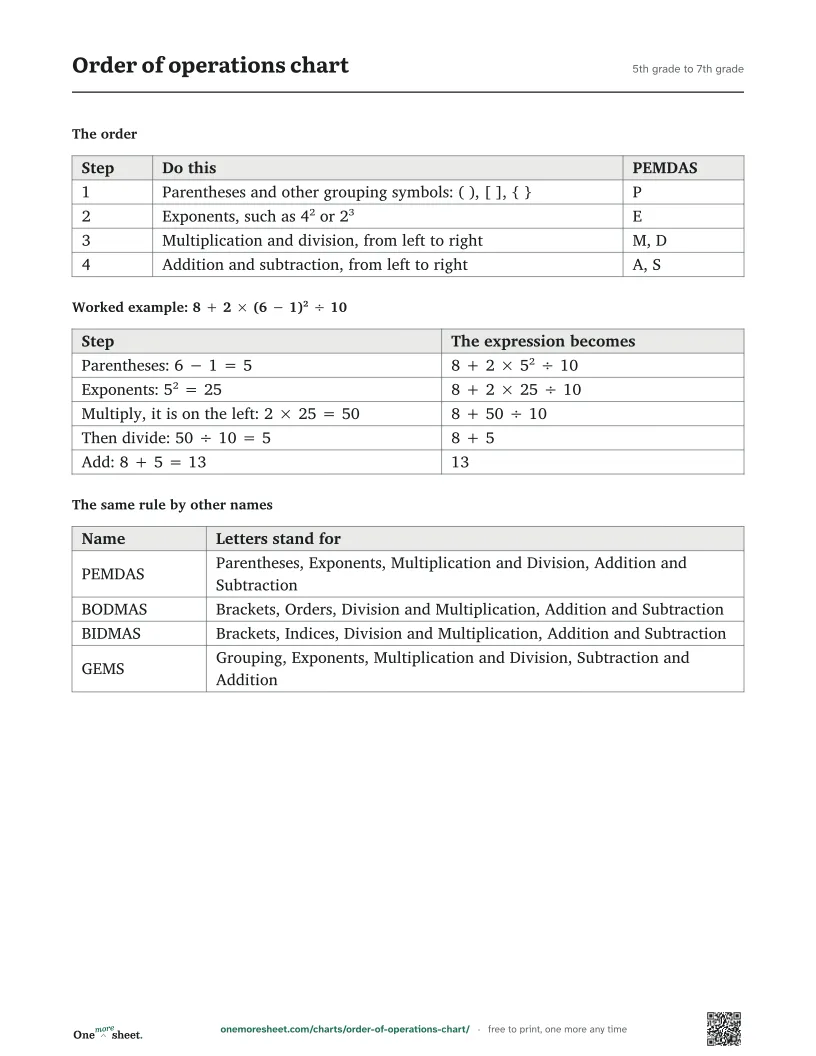
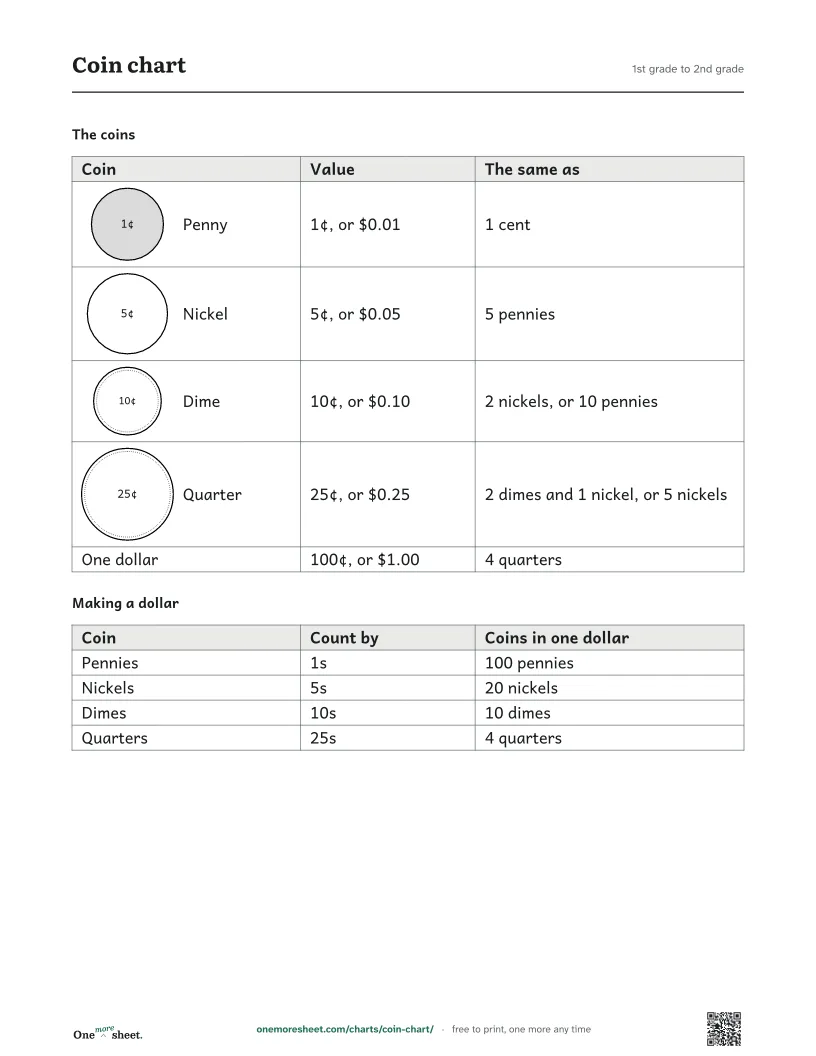
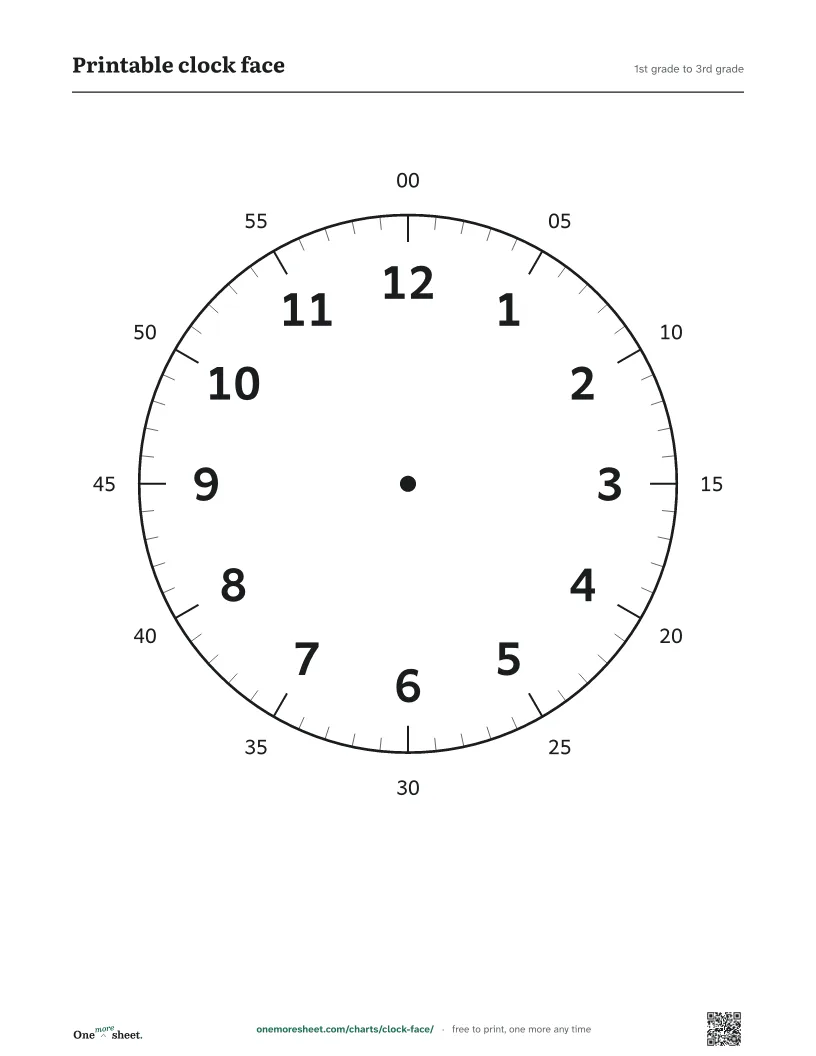
Charts for the math rules children look up: the order of operations, exponent rules, perfect squares, divisibility rules, fractions as decimals and percents, and the steps of long division worked through one problem. For younger children there is a coin chart with the coins at their real size, a clock face to print one or four to a page, ordinal numbers to 100th and the math symbols with their names.
Show all 10 sheetsShow fewer
Printable charts and lists
- Coin chart 1st grade to 2nd grade
- Divisibility rules chart 4th grade to 6th grade
- Exponent rules chart 6th grade to 8th grade
- Fraction to decimal chart 4th grade to 6th grade
- Long division steps chart 4th grade to 6th grade
- Math symbols chart 1st grade to 6th grade
- Order of operations chart 5th grade to 7th grade
- Ordinal numbers chart Kindergarten to 2nd grade
- Perfect squares chart 5th grade to 8th grade
- Printable clock face 1st grade to 3rd grade
6 sheets
Kindergarten spelling words, days and months
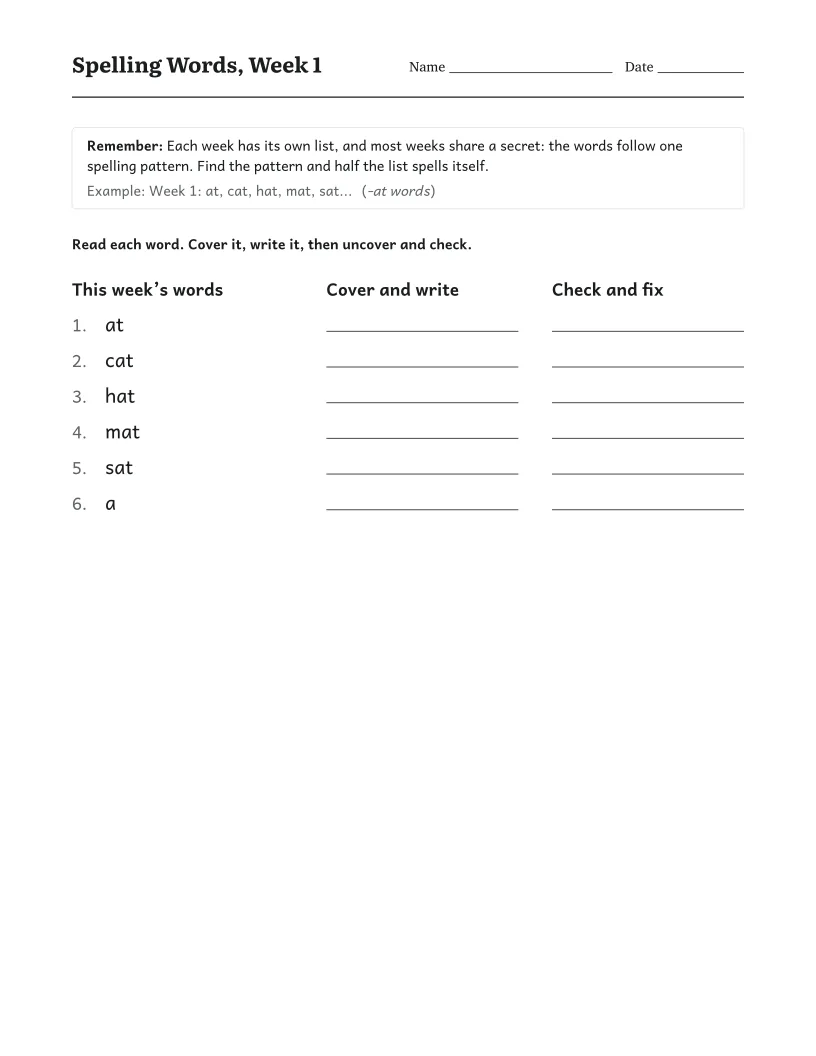
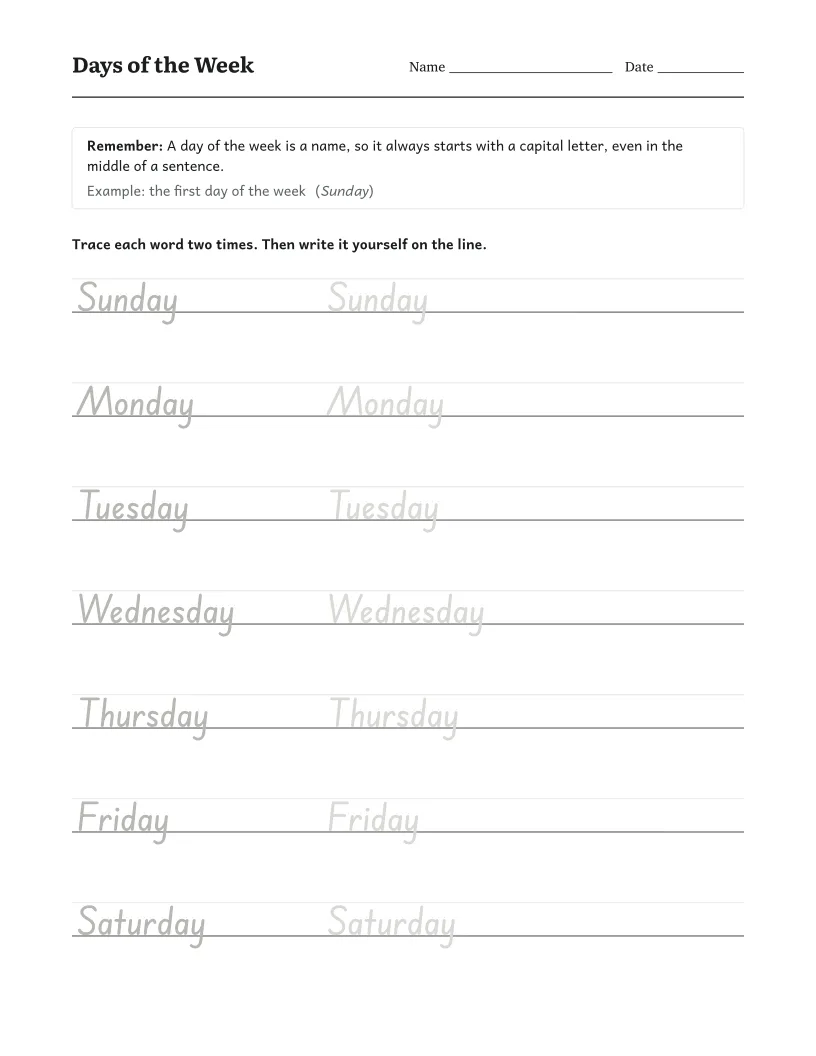
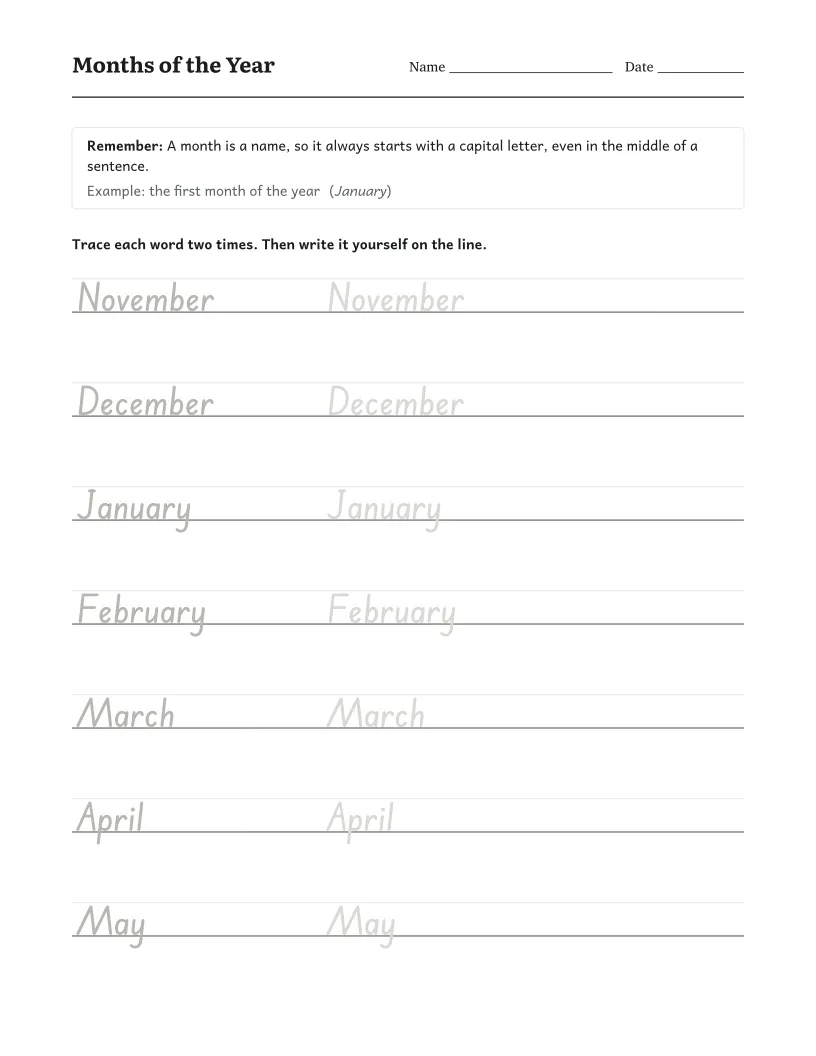
Weekly spelling lists for kindergarten, from -at and -an words through sight words to simple blends, with the whole year on one printable list. Kindergarten and 1st grade also get tracing sheets for the days of the week and the months of the year, kept in calendar order.
Kindergarten handwriting1st grade handwritingPrintable charts and lists
Show all 6 sheetsShow fewer
Kindergarten English
- Days of the week A day of the week is a name, so it always starts with a capital letter, even in the middle of a sentence.
- Months of the year A month is a name, so it always starts with a capital letter, even in the middle of a sentence.
- Spelling words Each week has its own list, and most weeks share a secret: the words follow one spelling pattern. Find the pattern and half the list spells itself.
1st grade English
- Days of the week A day of the week is a name, so it always starts with a capital letter, even in the middle of a sentence.
- Months of the year A month is a name, so it always starts with a capital letter, even in the middle of a sentence.
Printable charts and lists
- Kindergarten spelling words Kindergarten
3 sheets
Missing numbers and number words
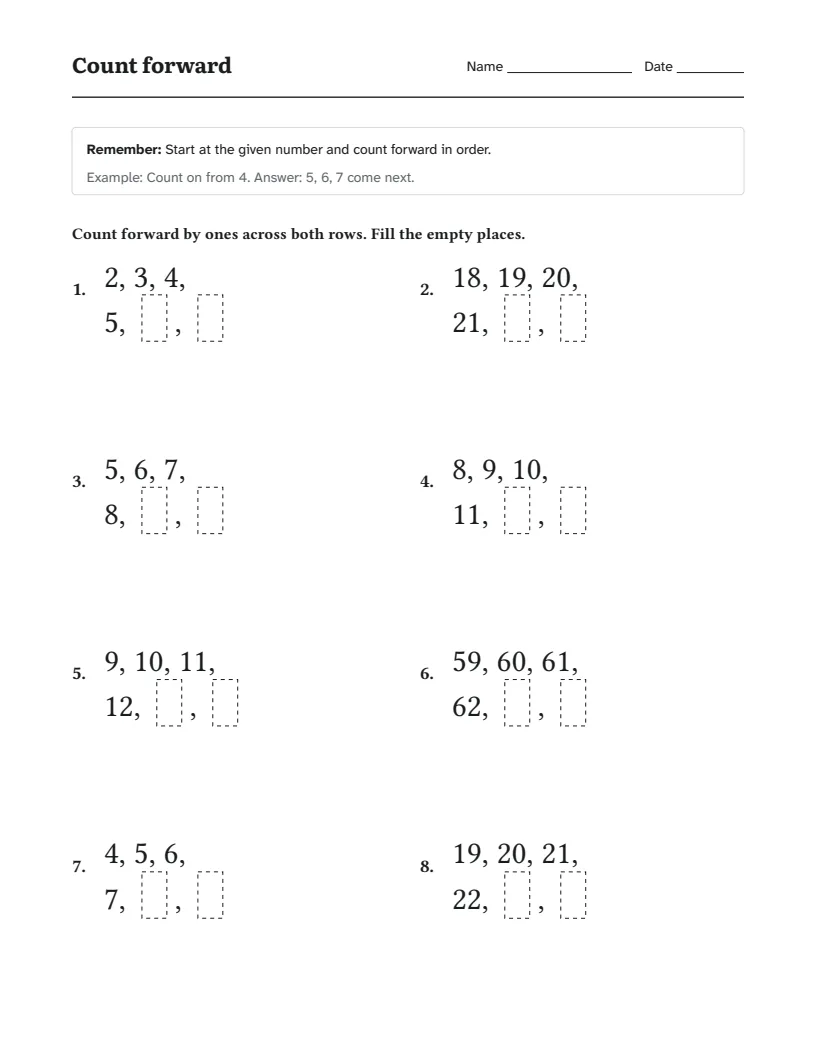
Kindergarten and 1st grade get counting rows and number charts with the gaps in the middle, so a child has to read the numbers on both sides of each box. Kindergarten also gets number words up to twenty, with writing lines long enough for seventeen.
Kindergarten counting & place value1st grade counting & place value


Show all 3 sheetsShow fewer
Kindergarten
- Missing numbers Count forward. Write the missing numbers.
- Number words Write each number as a word.
1st grade
- Missing numbers Count by ones. Write the missing numbers in the chart.
2 sheets
Graph paper and coordinate planes
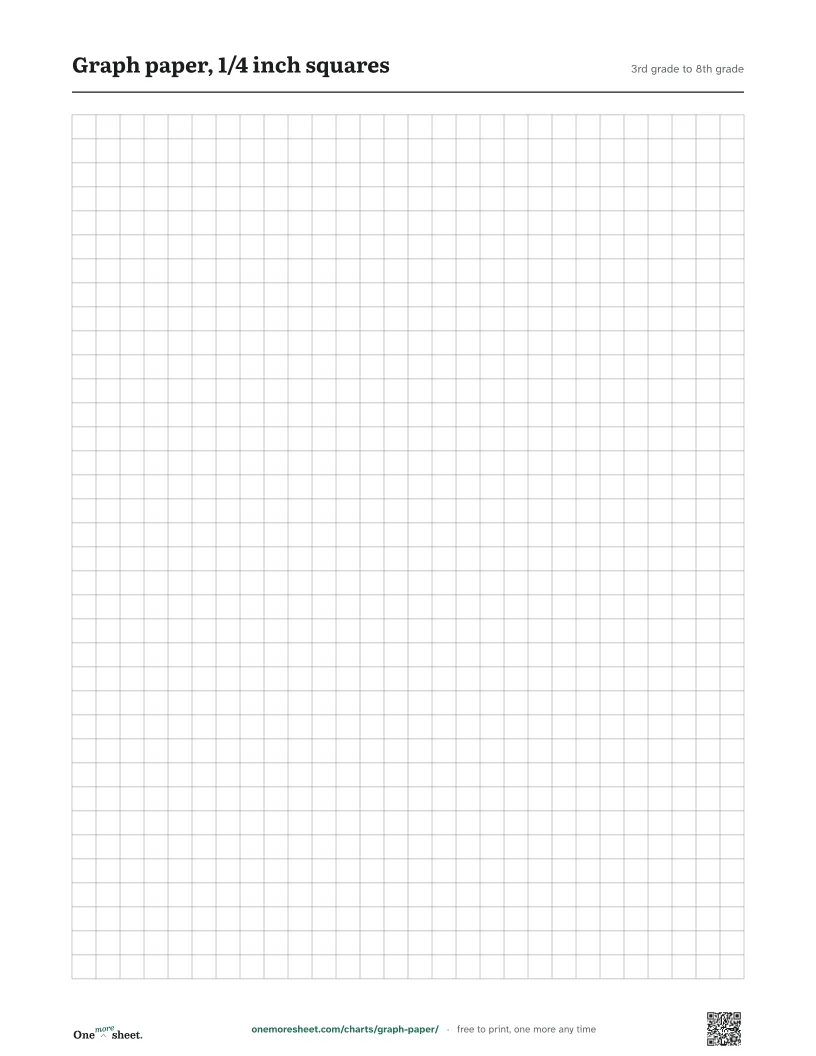
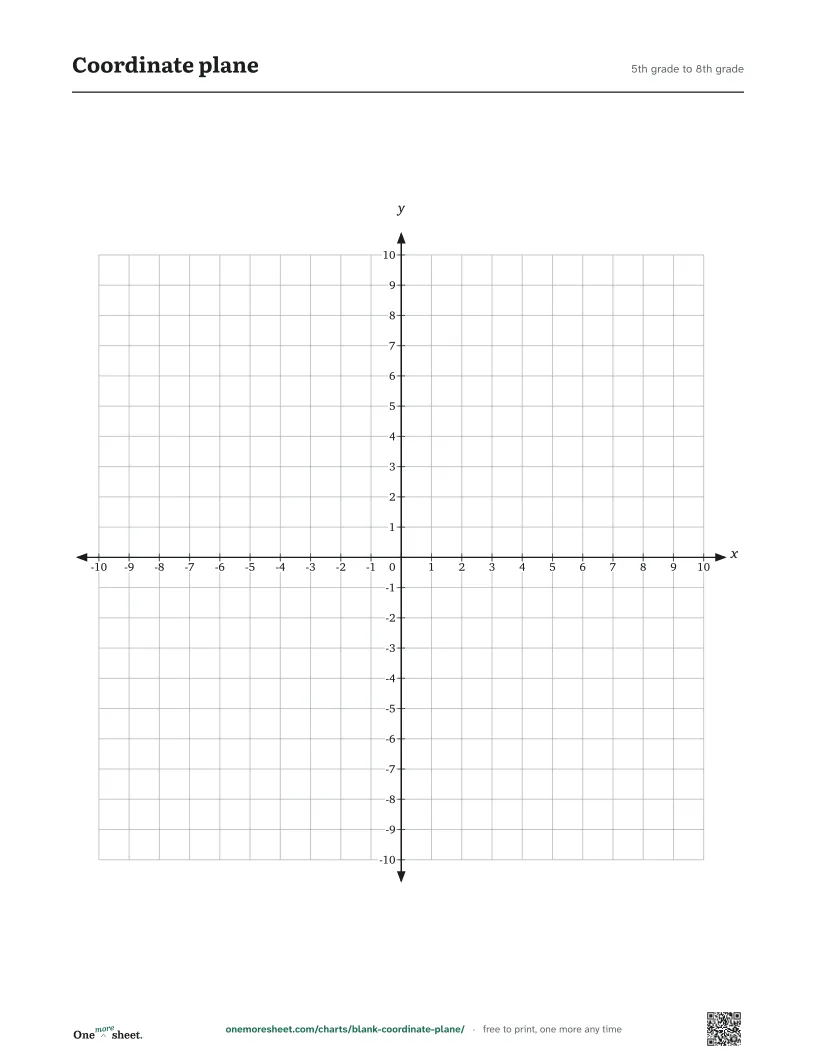
Graph paper in 1/4 inch, 1/2 inch, 1 cm and 5 mm squares, printed at true size. Blank coordinate planes come with all four quadrants (-5 to 5, -10 to 10 or -20 to 20) or the first quadrant alone, one or four to a page.
Show all 2 sheetsShow fewer
Printable charts and lists
- Printable coordinate plane 5th grade to 8th grade
- Printable graph paper 3rd grade to 8th grade
10 sheets
Fry lists to 1,000, number words and calendar charts
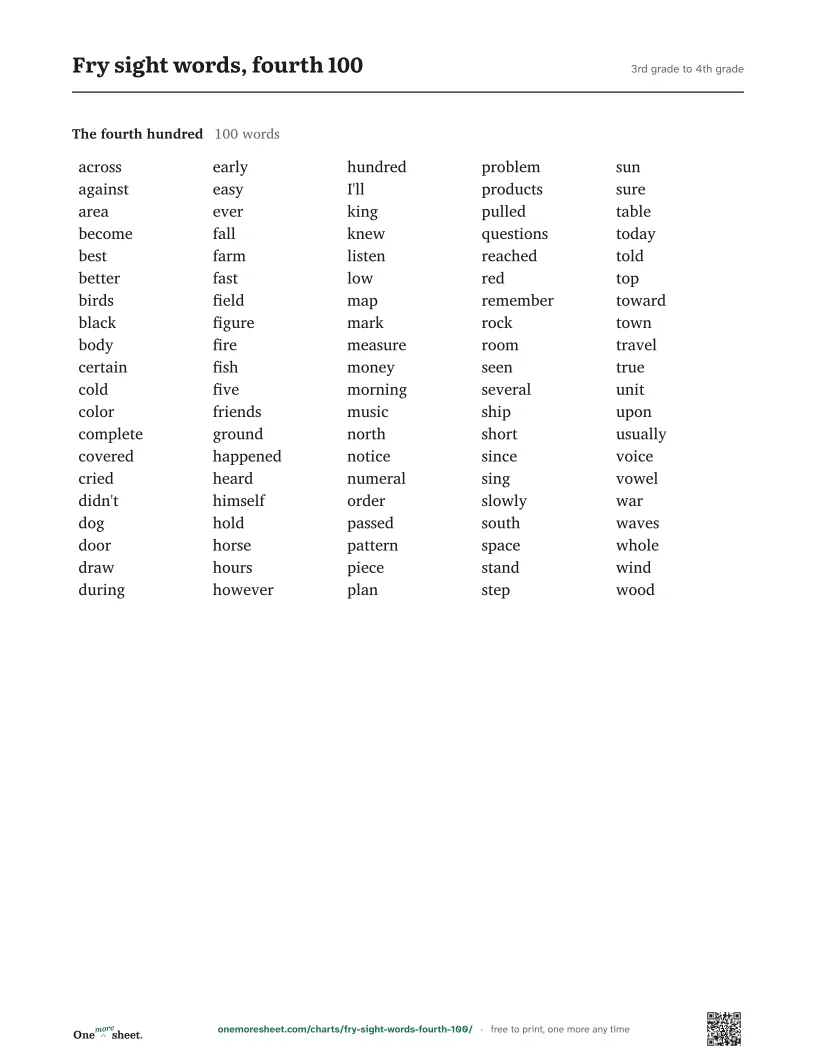
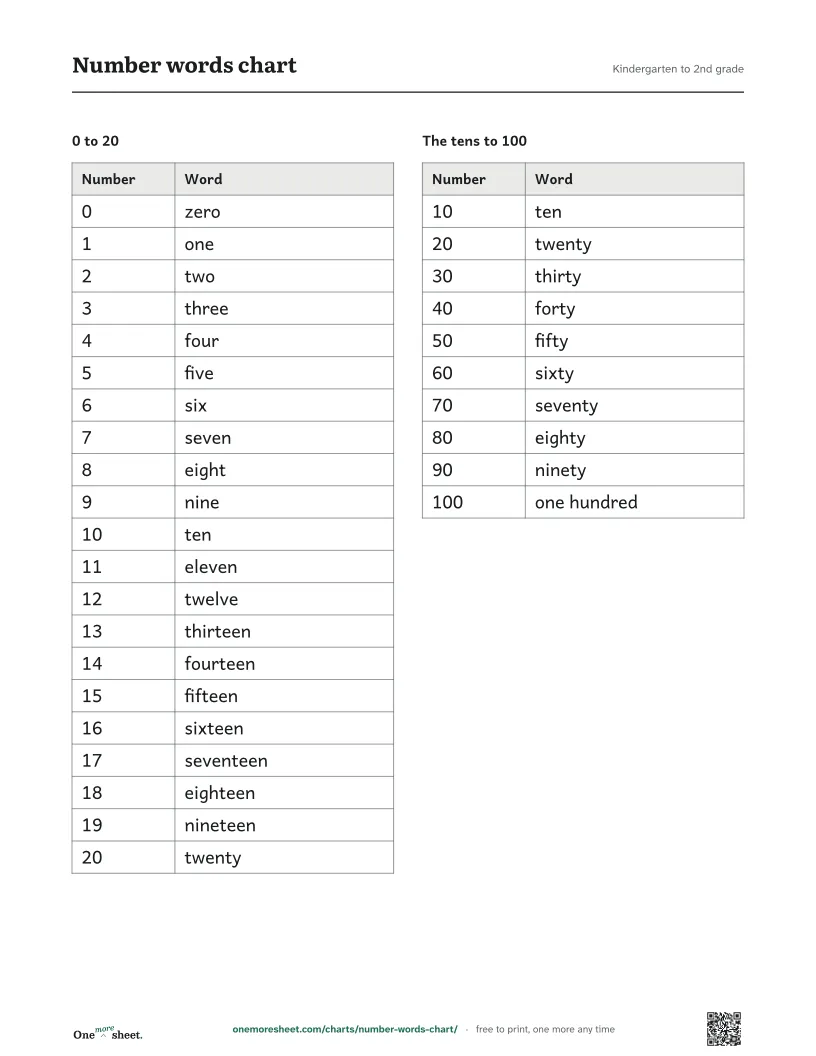
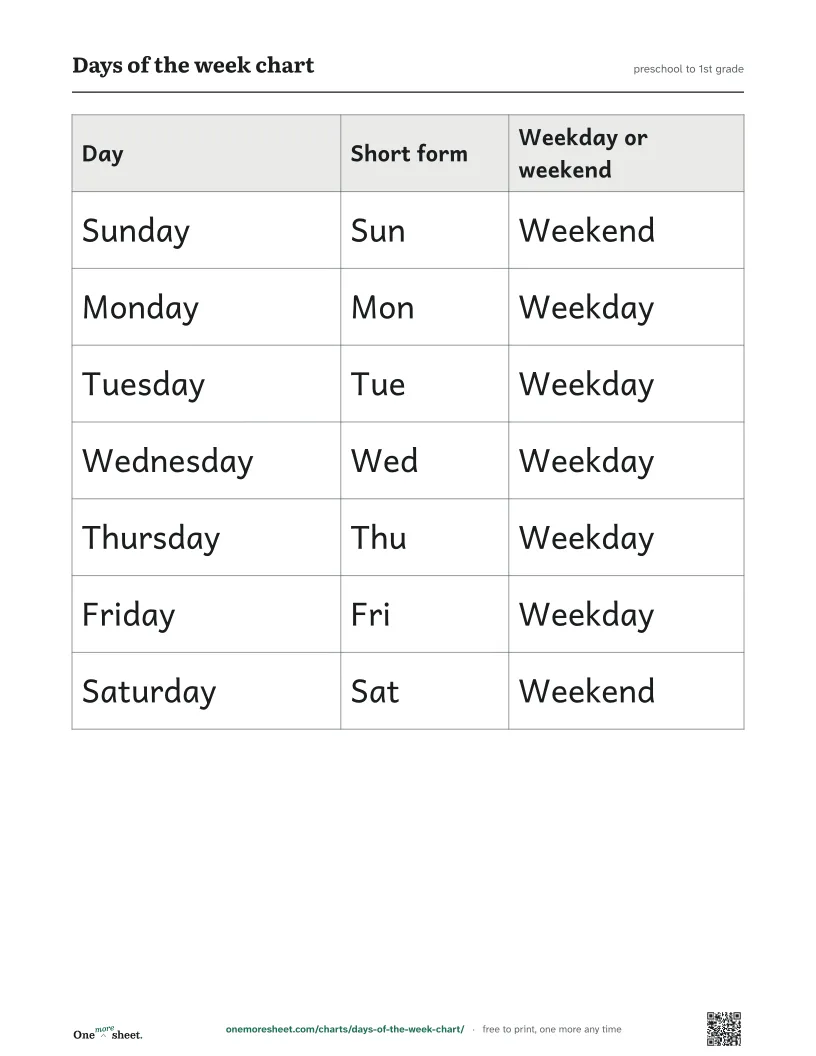
The Fry sight word lists now run to the thousandth word, one page for each hundred. There are new wall charts too: the number words to one hundred, the days of the week and the months of the year, in large print for young children.
Show all 10 sheetsShow fewer
Printable charts and lists
- Days of the week chart preschool to 1st grade
- Fry sight words, eighth 100 5th grade
- Fry sight words, fifth 100 4th grade
- Fry sight words, fourth 100 3rd grade to 4th grade
- Fry sight words, ninth 100 5th grade
- Fry sight words, seventh 100 5th grade
- Fry sight words, sixth 100 4th grade to 5th grade
- Fry sight words, tenth 100 5th grade
- Months of the year chart Kindergarten to 2nd grade
- Number words chart Kindergarten to 2nd grade
18 sheets
Parts of speech, and English skills at more grades
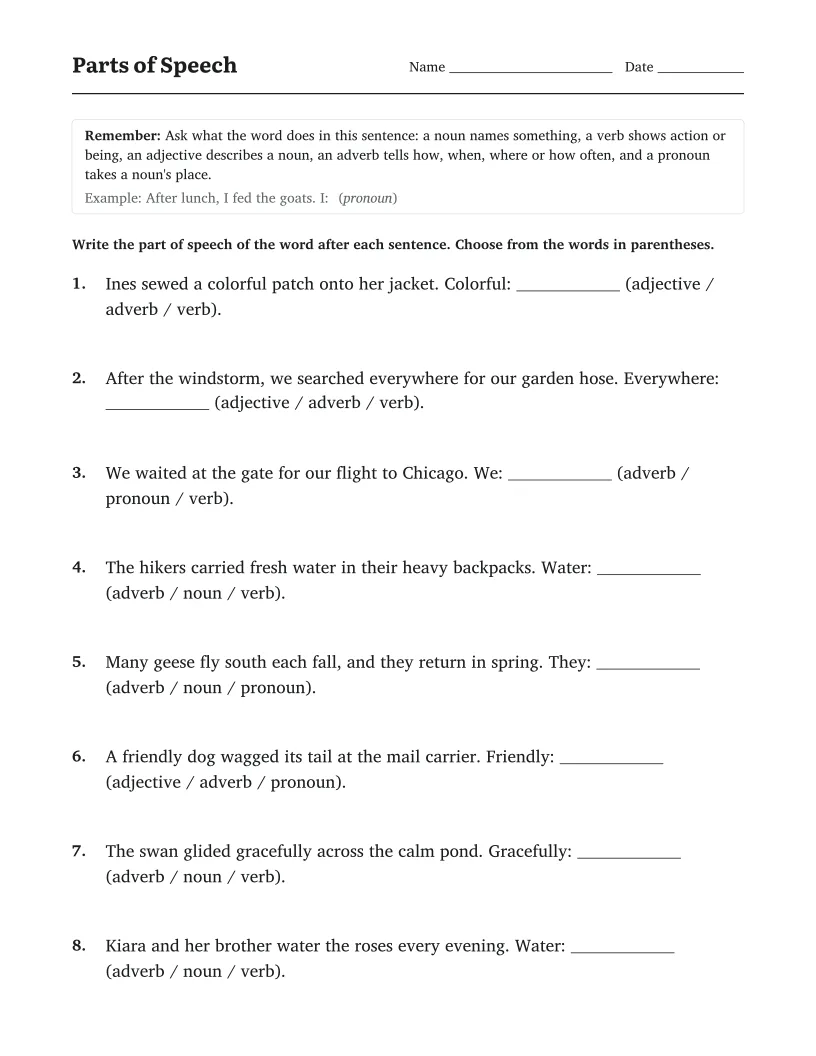
A parts of speech sheet for 2nd to 6th grade, where your child writes the job one word does in its sentence. Nouns, verbs, adjectives, context clues, main idea, similes and metaphors and a few other English skills now reach the grade just below or above where they stopped.
1st grade reading comprehension2nd grade vocabulary3rd grade grammar4th grade grammar

Show all 18 sheetsShow fewer
1st grade
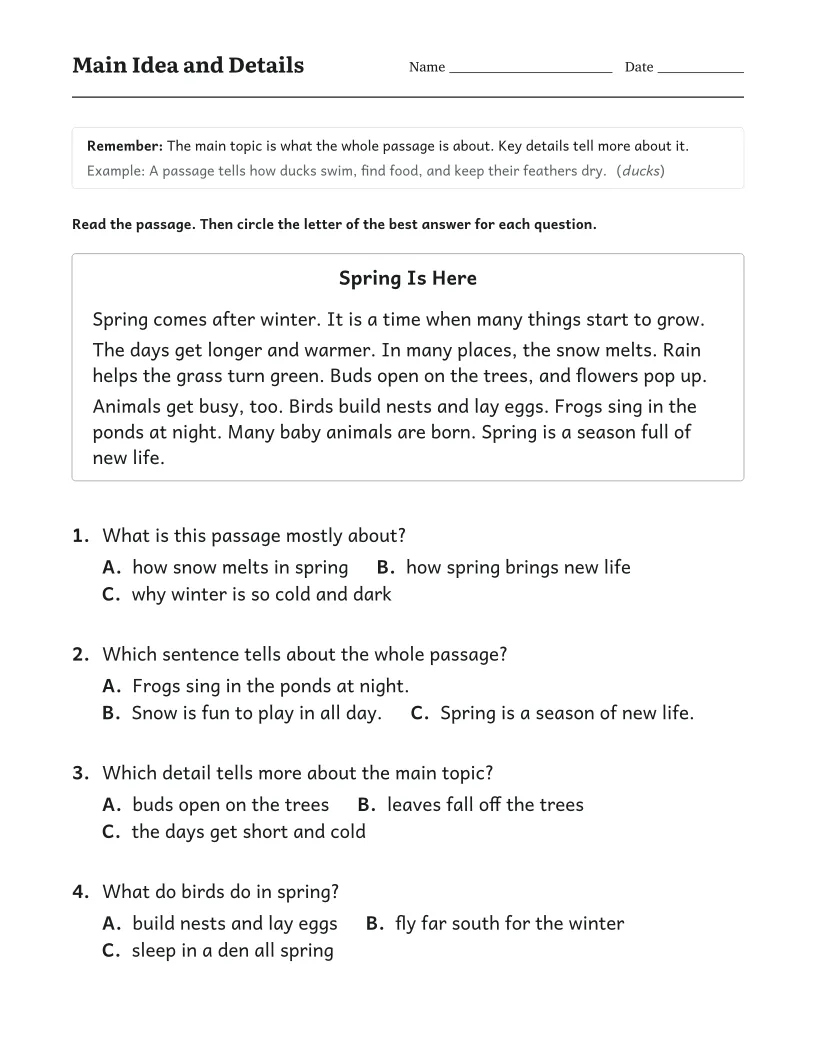
- Main idea and details The main idea is what the whole passage is about, in one sentence. The details are the smaller facts that back it up.
2nd grade
- Context clues The sentence around a hard word usually hides its meaning. Read past the word, find the clue, then decide: The arid desert had not seen rain for months, so arid must mean very dry.
- Multiple-meaning words Some words carry more than one meaning: a bat flies at night, and a bat hits a baseball. The rest of the sentence tells you which meaning is on duty.
- Parts of speech Ask what the word does in this sentence: a noun names something, a verb shows an action or a state of being, an adjective describes a noun, an adverb tells how, when, where or how often, and a pronoun takes the place of a noun.
3rd grade
- Action verbs An action verb tells what someone or something does.
- Context clues The sentence around a hard word usually hides its meaning. Read past the word, find the clue, then decide: The arid desert had not seen rain for months, so arid must mean very dry.
- Identifying nouns A noun names a person, a place, a thing, or an animal.
- Parts of speech Ask what the word does in this sentence: a noun names something, a verb shows an action or a state of being, an adjective describes a noun, an adverb tells how, when, where or how often, and a pronoun takes the place of a noun.
- Similes and metaphors A simile compares with like or as: brave as a lion. A metaphor says one thing IS another: the classroom was a zoo.
4th grade
- Action verbs An action verb tells what someone or something does.
- Identifying adjectives An adjective describes a noun. It tells what kind, how many, or which one.
- Identifying nouns A noun names a person, a place, a thing, or an animal.
- Parts of speech Ask what the word does in this sentence: a noun names something, a verb shows an action or a state of being, an adjective describes a noun, an adverb tells how, when, where or how often, and a pronoun takes the place of a noun.
- Types of sentences A statement tells. A question asks. A command orders. An exclamation bursts with feeling.
5th grade
- Homophones Homophones are words that sound exactly alike but are spelled differently and mean different things: sea and see, bear and bare. The sentence tells you which one belongs.
- Parts of speech Ask what the word does in this sentence: a noun names something, a verb shows an action or a state of being, an adjective describes a noun, an adverb tells how, when, where or how often, and a pronoun takes the place of a noun.
- Quotation marks in dialogue Quotation marks hug the exact words someone says, and the comma stays inside the hug: "Let's go," said Maya.
6th grade
- Parts of speech Ask what the word does in this sentence: a noun names something, a verb shows an action or a state of being, an adjective describes a noun, an adverb tells how, when, where or how often, and a pronoun takes the place of a noun.
6 sheets
Inferences, theme and more reading skills for 2nd grade
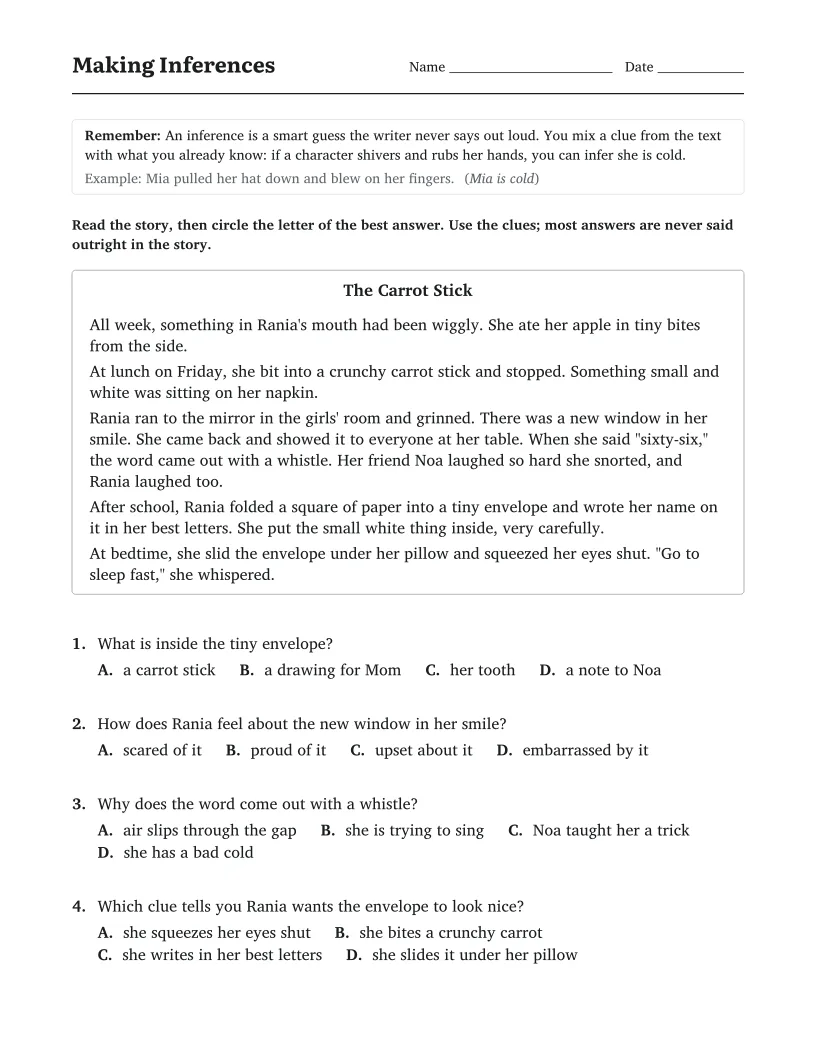
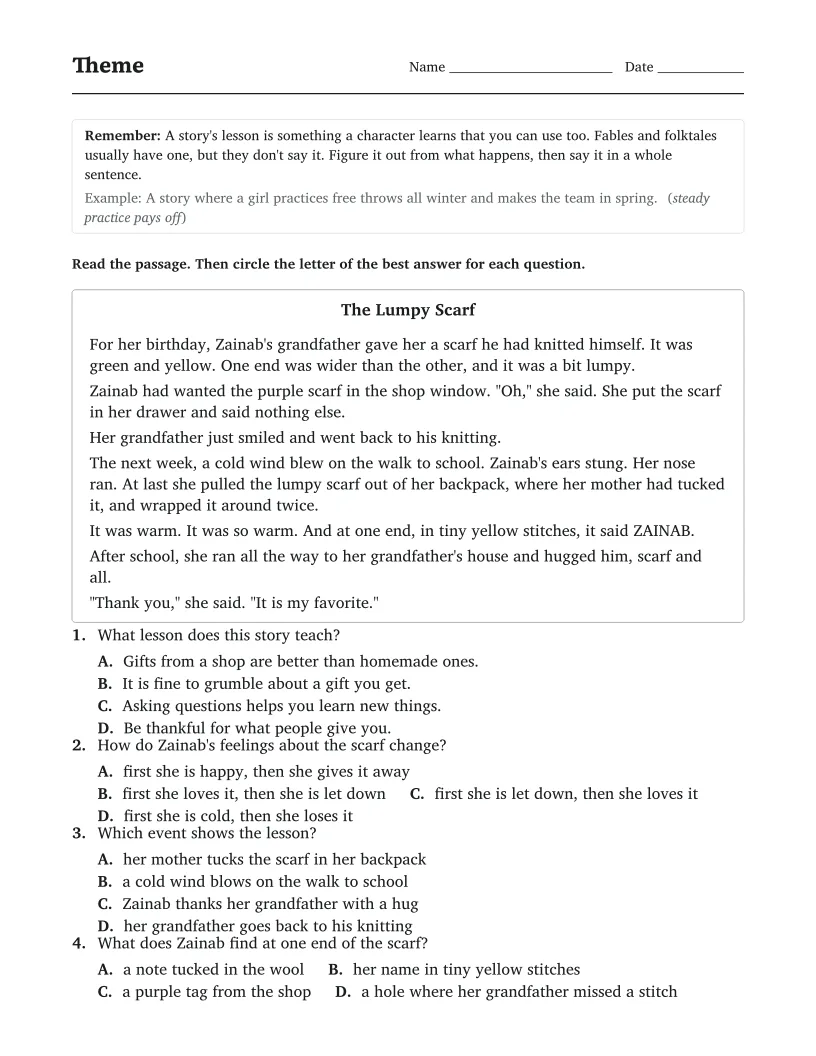
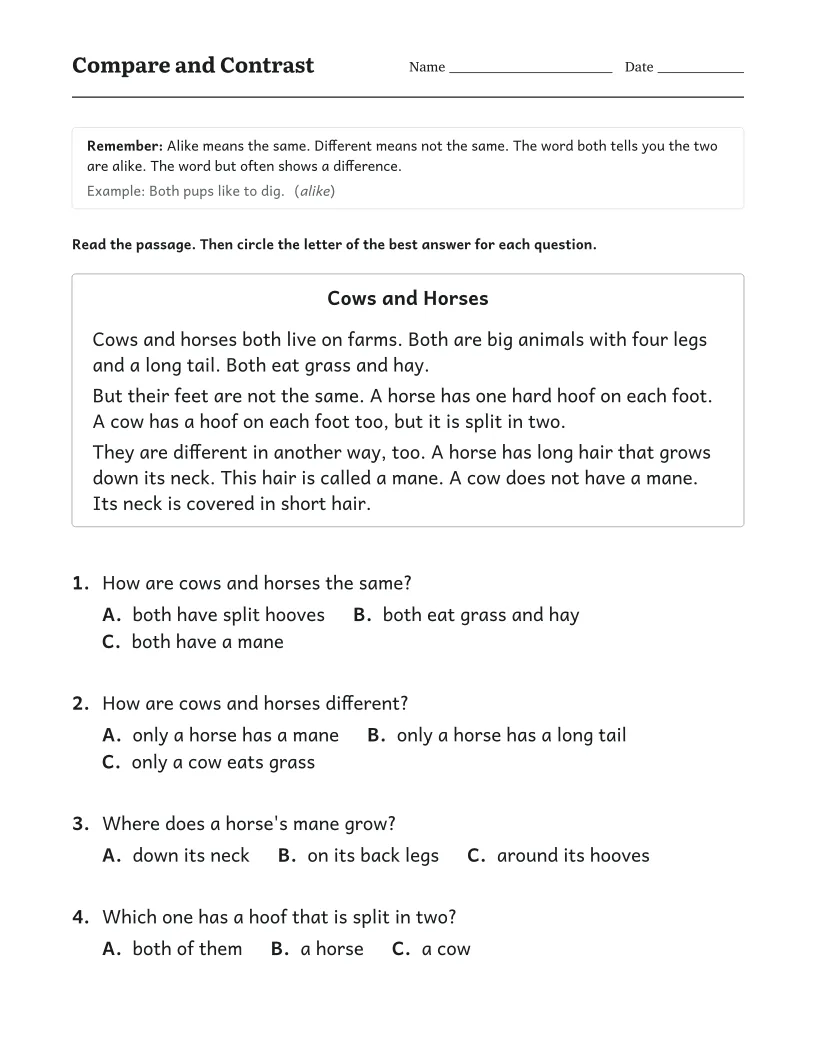
Making inferences, author's purpose, theme and point of view now start at 2nd grade. Each sheet is one short story or article with four questions. On the theme sheets your child works out the lesson of a fable that never says it, and every point of view story has two characters who feel differently about the same thing. Compare and contrast now reaches 1st and 2nd grade too.
2nd grade reading comprehension1st grade reading comprehension
Show all 6 sheetsShow fewer
1st grade
- Compare and contrast Comparing finds how two things are alike. Contrasting finds how they differ. Good readers do both at once.
2nd grade
- Author's purpose Every writer has a reason for writing. The three big reasons are easy to remember as PIE: to Persuade (change your mind), to Inform (teach you facts), or to Entertain (tell you a fun story). To find the purpose, ask what the writer wants you to do after reading.
- Compare and contrast Comparing finds how two things are alike. Contrasting finds how they differ. Good readers do both at once.
- Making inferences An inference is a smart guess the writer never says out loud. You mix a clue from the text with what you already know: if a character shivers and rubs her hands, you can infer she is cold.
- Point of view Point of view is who tells the story. A character inside it says I. A narrator outside it says he, she, and names.
- Theme The theme is what a story teaches about life, said in a full sentence. Not what the story is about, but what it shows you.
15 sheets
Figurative language, classic poems and more reading skills
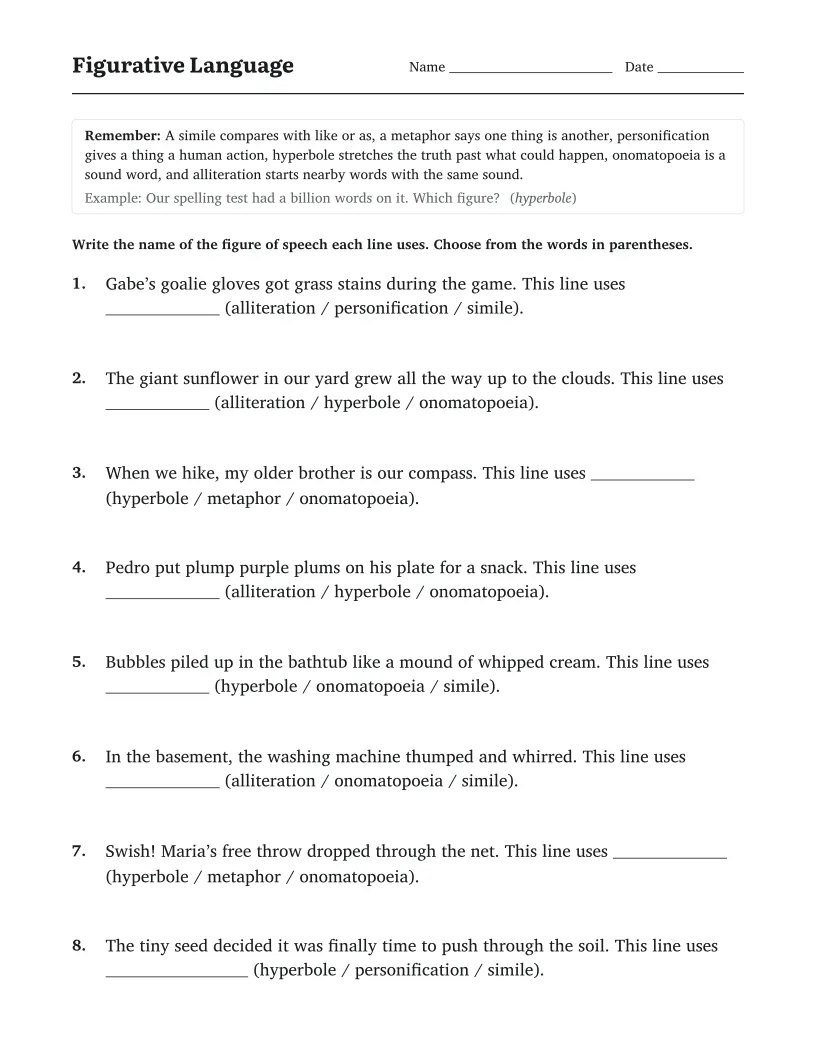
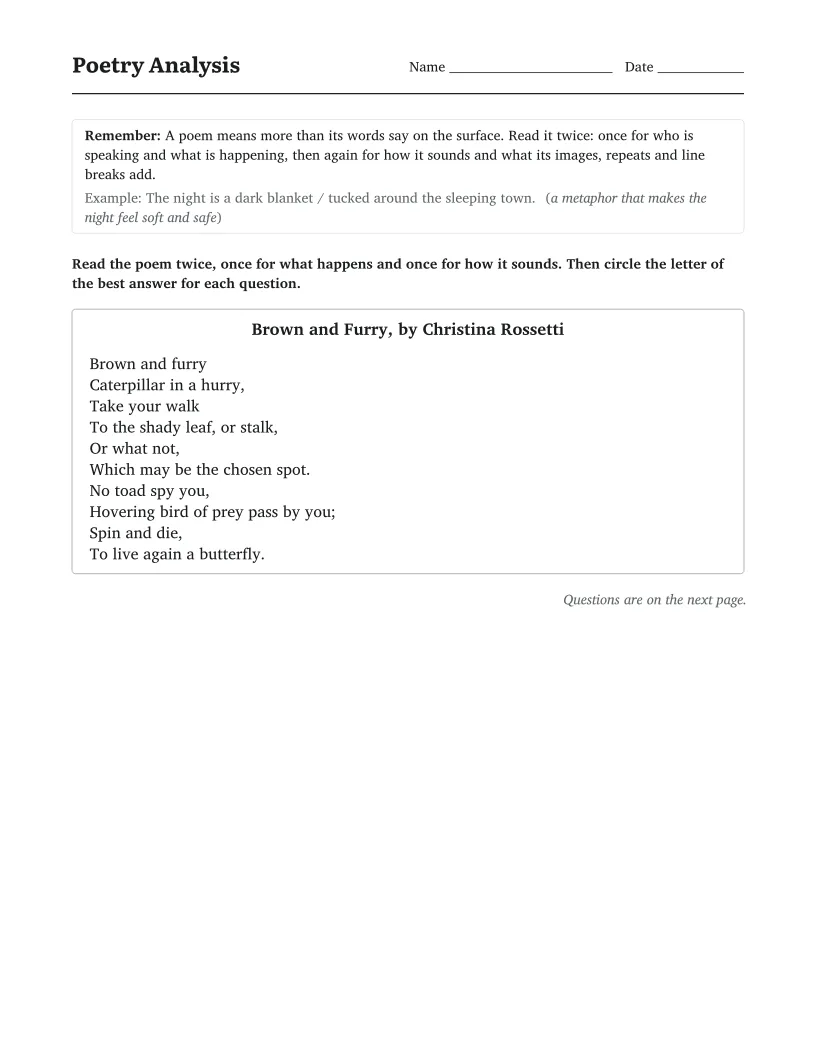
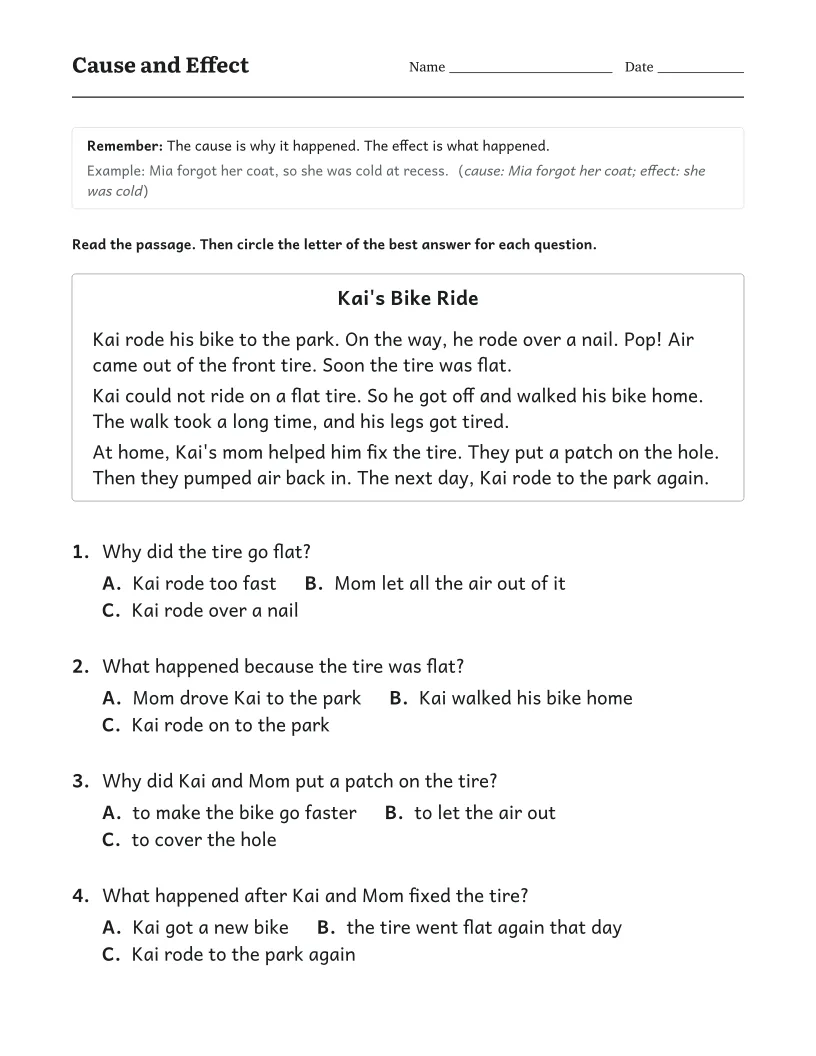
A new figurative language sheet for 3rd to 6th grade: your child reads a line and writes which figure of speech it uses, from simile and metaphor up to idiom and onomatopoeia. The 4th to 6th grade poetry sheets print classic poems the way the poets wrote them, with questions on rhyme, stanzas and meaning. Cause and effect, character traits, compare and contrast, and fact and opinion each gained a grade or two.
1st grade reading comprehension3rd grade vocabulary5th grade reading comprehension6th grade reading comprehension
Show all 15 sheetsShow fewer
1st grade
- Cause and effect A cause is why something happened. An effect is what happened because of it. Ask: what happened, and what made it happen?
- Fact vs opinion A fact can be checked and proven: a spider has eight legs. An opinion tells what someone thinks or feels: spiders are creepy. Ask the test question: could we look this up and settle it?
3rd grade
- Figurative language A simile compares with like or as, a metaphor says one thing is another, personification gives a thing a human action, hyperbole stretches the truth, an idiom is a saying with its own meaning, onomatopoeia is a sound word, and alliteration repeats a first sound.
4th grade
- Figurative language A simile compares with like or as, a metaphor says one thing is another, personification gives a thing a human action, hyperbole stretches the truth, an idiom is a saying with its own meaning, onomatopoeia is a sound word, and alliteration repeats a first sound.
- Poetry analysis A poem means more than its words say on the surface. Read it twice: once for who is speaking and what is happening, then again for how it sounds and what its images, repeats and line breaks add.
5th grade
- Cause and effect A cause is why something happened. An effect is what happened because of it. Ask: what happened, and what made it happen?
- Character traits A trait is what a person is like on the inside, and actions are the proof. The story never says the word; it shows you, and you name it.
- Figurative language A simile compares with like or as, a metaphor says one thing is another, personification gives a thing a human action, hyperbole stretches the truth, an idiom is a saying with its own meaning, onomatopoeia is a sound word, and alliteration repeats a first sound.
- Poetry analysis A poem means more than its words say on the surface. Read it twice: once for who is speaking and what is happening, then again for how it sounds and what its images, repeats and line breaks add.
6th grade
- Cause and effect A cause is why something happened. An effect is what happened because of it. Ask: what happened, and what made it happen?
- Character traits A trait is what a person is like on the inside, and actions are the proof. The story never says the word; it shows you, and you name it.
- Compare and contrast Comparing finds how two things are alike. Contrasting finds how they differ. Good readers do both at once.
- Fact vs opinion A fact can be checked and proven: a spider has eight legs. An opinion tells what someone thinks or feels: spiders are creepy. Ask the test question: could we look this up and settle it?
- Figurative language A simile compares with like or as, a metaphor says one thing is another, personification gives a thing a human action, hyperbole stretches the truth, an idiom is a saying with its own meaning, onomatopoeia is a sound word, and alliteration repeats a first sound.
- Poetry analysis A poem means more than its words say on the surface. Read it twice: once for who is speaking and what is happening, then again for how it sounds and what its images, repeats and line breaks add.
10 sheets
A blank calendar, conversion charts and math formulas
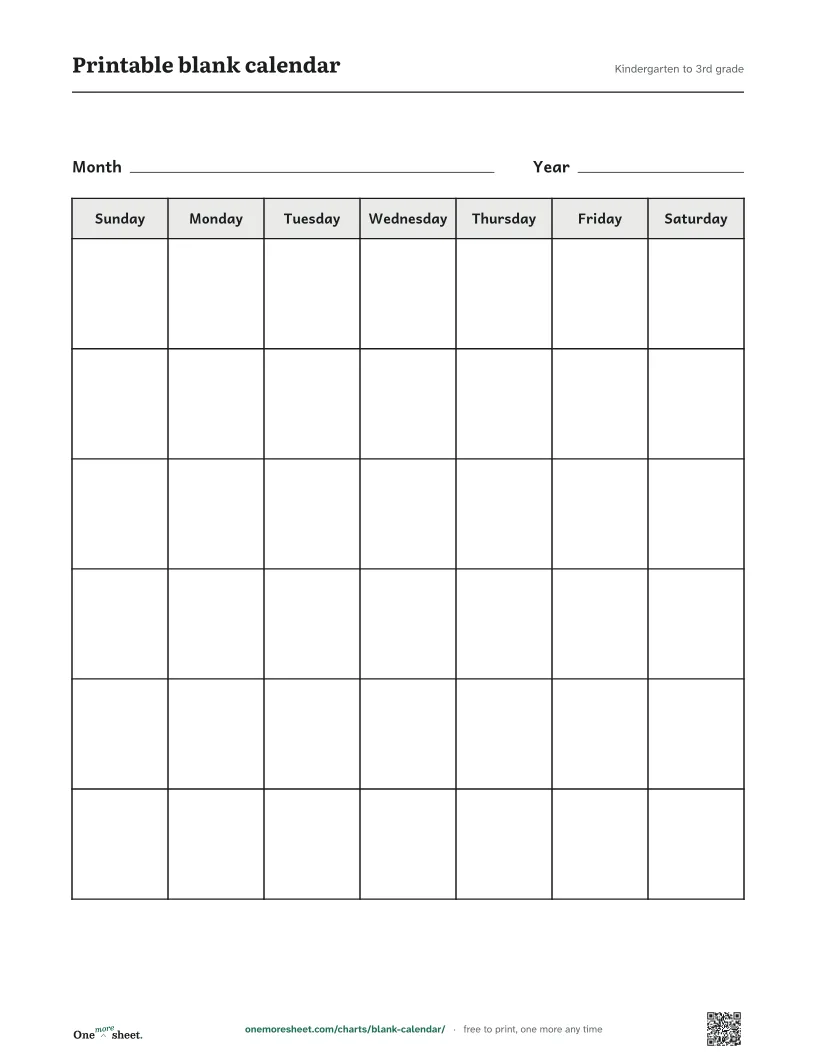
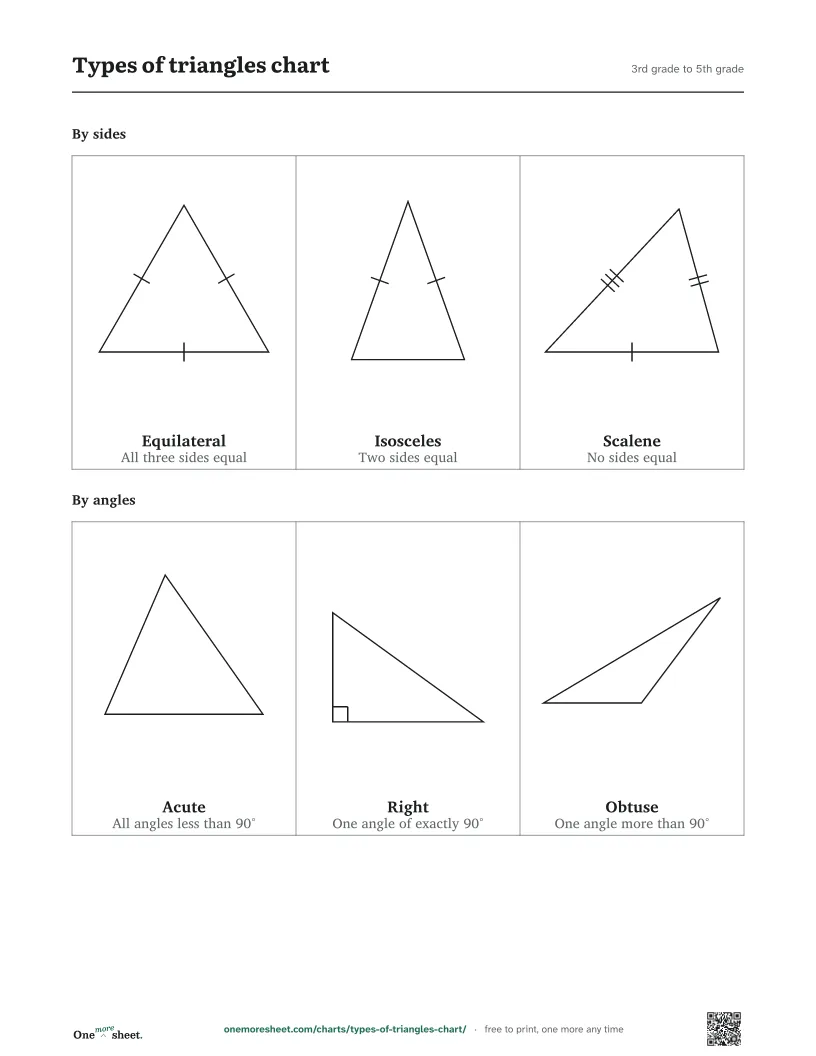
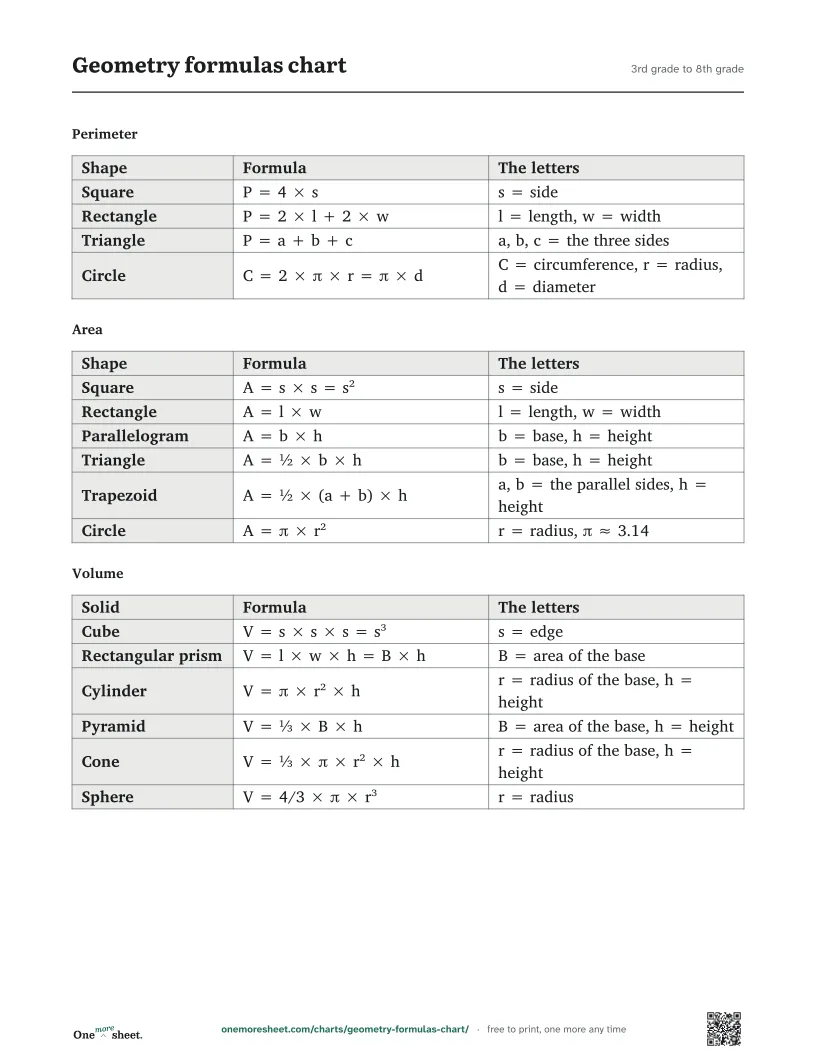
A blank calendar for any month, with Sunday or Monday first, and reference charts for the older grades: the properties of operations, geometry formulas, factors to 100, perfect cubes and Pythagorean triples. There are conversion charts for metric units, time and temperature too, and the types of triangles drawn with their tick marks.
Show all 10 sheetsShow fewer
Printable charts and lists
- Celsius to Fahrenheit chart 3rd grade to 6th grade
- Factors chart 4th grade to 6th grade
- Geometry formulas chart 3rd grade to 8th grade
- Metric conversion chart 4th grade to 6th grade
- Perfect cubes chart 6th grade to 8th grade
- Printable blank calendar Kindergarten to 3rd grade
- Properties of operations chart 1st grade to 6th grade
- Pythagorean triples chart 8th grade
- Time conversion chart 3rd grade to 5th grade
- Types of triangles chart 3rd grade to 5th grade
38 sheets
7th and 8th grade math
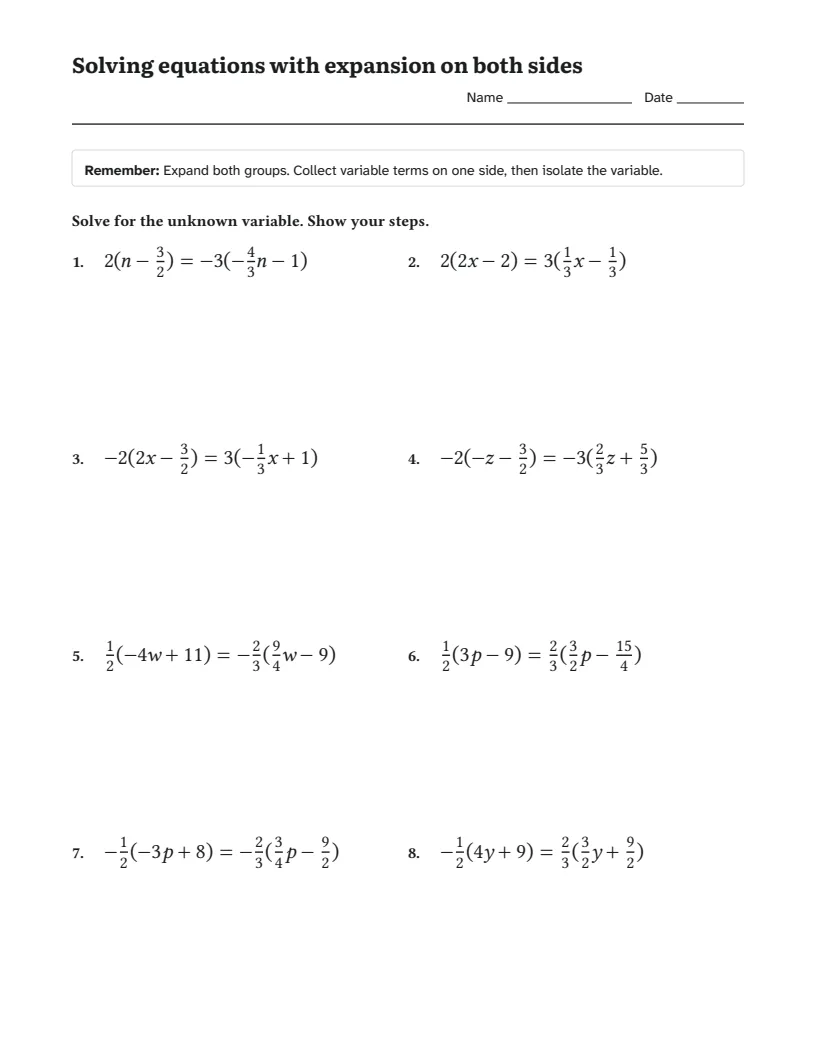
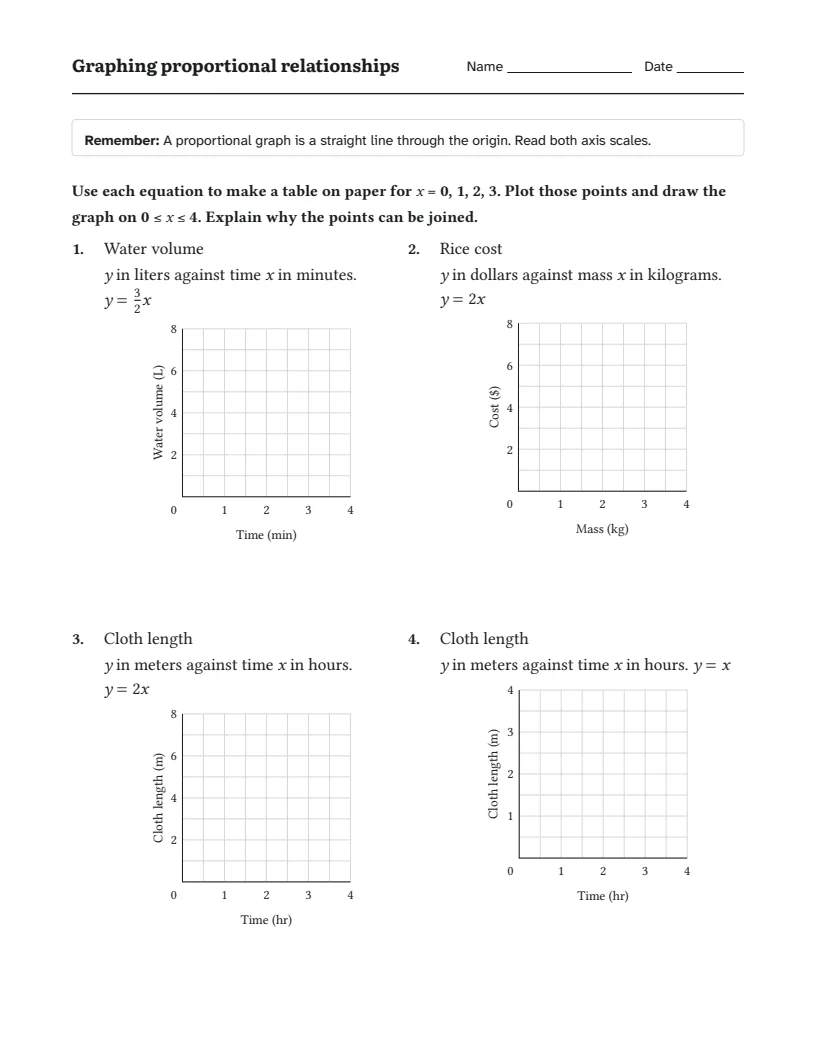
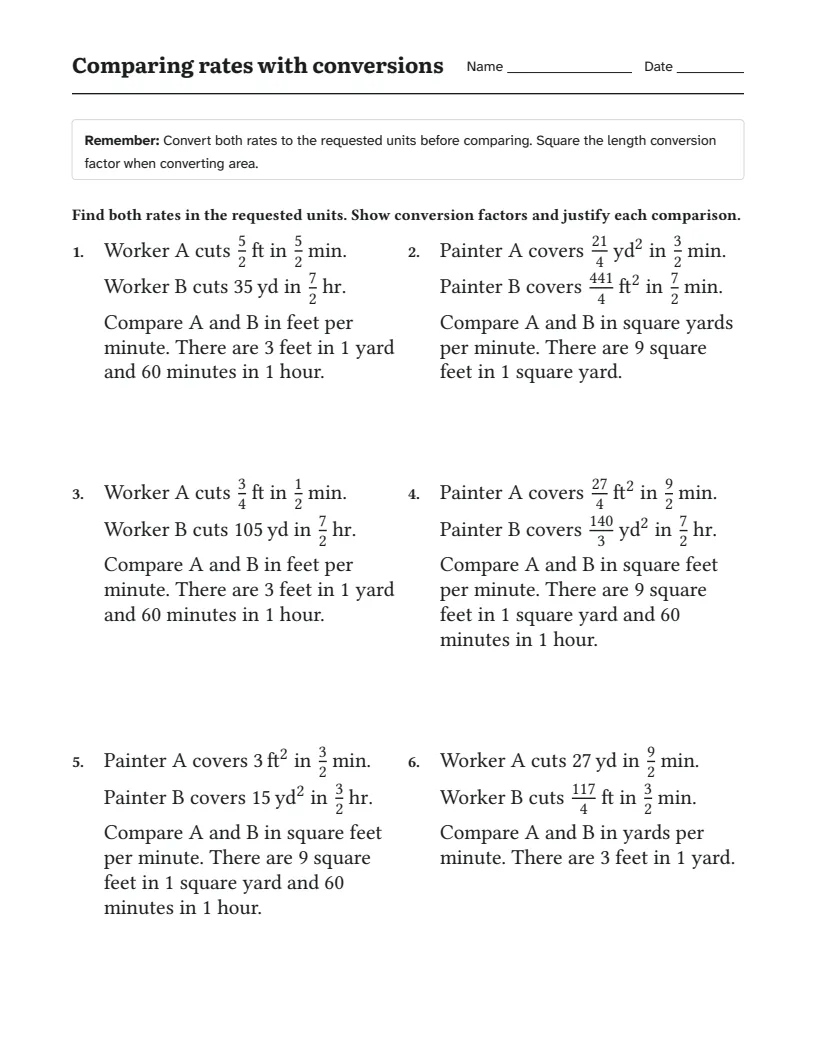
Two-step equations and inequalities, proportional relationships, rates and signed numbers for 7th grade. For 8th, equations with variables on both sides, including the ones with no solution or infinitely many. Every sheet prints with its answer key, and the 7th grade keys show the work.
Show all 38 sheetsShow fewer
7th grade
- Adding linear expressions Remove the parentheses without changing signs. Combine like terms.
- Adding signed fractions and decimals Use a common denominator for fractions and align decimal places. A minus sign before a mixed number applies to the whole value.
- Checking contextual solutions Substitute into the original model. A solution must make it true and fit the quantity and its units.
- Collecting rational like terms Add the coefficients of like terms. Use a common denominator to add fractions.
- Collecting terms and constants Combine the variable terms and constants separately. Use common denominators for fractions.
- Comparing rates with conversions Convert both rates to the same units. Square the length conversion factor for area, and check the direction of each conversion.
- Distance and displacement Signed change is end minus start. Distance is the absolute value of the change.
- Expanding and collecting like terms Multiply each term inside the parentheses by the outside factor. Then combine like terms.
- Expanding with rational factors Multiply each term inside the parentheses by the outside factor.
- Factoring out a specified rational factor Divide each term by the given factor. Keep that factor outside the parentheses, then expand to check.
- Factoring out the greatest common factor Find the greatest positive integer that divides both coefficients. Factor it out, then expand to check.
- Finding the constant across representations Divide output by input to find the unit rate. Check that both supplied views give the same rate.
- Fractional unit rates Use the requested units to decide which quantity to divide by which. Multiply by the reciprocal and keep the units.
- Graphing inequality solution sets Use an open circle for < or > and a closed circle for ≤ or ≥. Shade toward the values that satisfy the inequality.
- Graphing proportional relationships A proportional graph is a straight line through the origin. Read each coordinate using its axis label.
- Interpreting proportional graph points A proportional graph is a straight line through the origin. Read each coordinate using its axis label.
- Multistep ratio applications Keep each quantity attached to its units. A ratio between two parts uses a different base from a part of the whole.
- Opposites and zero pairs Opposites have equal magnitudes and opposite signs. Their sum is zero.
- Proportionality in graphs A proportional graph is a straight line through the origin. Read each coordinate using its axis label.
- Proportionality in tables Check that zero input gives zero output, then compare cross products of the nonzero pairs.
- Signed addition on number lines Start + change = end. Positive change moves right or up; negative change moves left or down.
- Solving grouped equations Divide both sides by the factor outside the parentheses. Then undo the addition or subtraction.
- Solving inequalities with negative coefficients Adding or subtracting preserves the direction. Dividing by a negative number reverses it.
- Solving inequalities with positive coefficients Adding or subtracting preserves the direction. Dividing by a positive number also preserves it.
- Solving two-step equations Undo the addition or subtraction first. Then divide both sides by the coefficient.
- Subtracting grouped linear expressions Subtract every term in the second group, then combine like terms.
- Subtracting signed fractions and decimals Keep the first number and add the opposite of the second. A minus sign before a mixed number applies to the whole value.
- Writing equations from quantities Define the unknown and its units. Repeated quantity plus fixed amount equals the total.
- Writing proportional equations Find the output per one input unit. Multiply the input quantity by that rate to get the output quantity.
8th grade
- Classifying linear solution sets Collect like terms on each side, then collect variable terms. A false constant equation means no solution; a true one means every real value is a solution.
- Clearing fractional coefficients Multiply every term on both sides by a nonzero common multiple of the denominators.
- Equations in mixed numeric representations Choose fractions or exact decimals. Keep each value unchanged when converting.
- Equations requiring collection of like terms Combine variable terms and constants separately on each side before solving.
- Equations with infinitely many solutions Collect like terms on each side, then collect variable terms. A false constant equation means no solution; a true one means every real value is a solution.
- Equations with no solution Collect like terms on each side, then collect variable terms. A false constant equation means no solution; a true one means every real value is a solution.
- Solving equations with expansion on both sides Expand both groups. Collect variable terms on one side, isolate the variable.
- Solving equations with one expansion Expand the parentheses first. Collect variable terms on one side, then isolate the variable. Check in the original equation.
- Solving equations with variables on both sides Collect variable terms on one side, then isolate the variable. Check in the original equation.
11 sheets
Reading for 6th to 8th grade
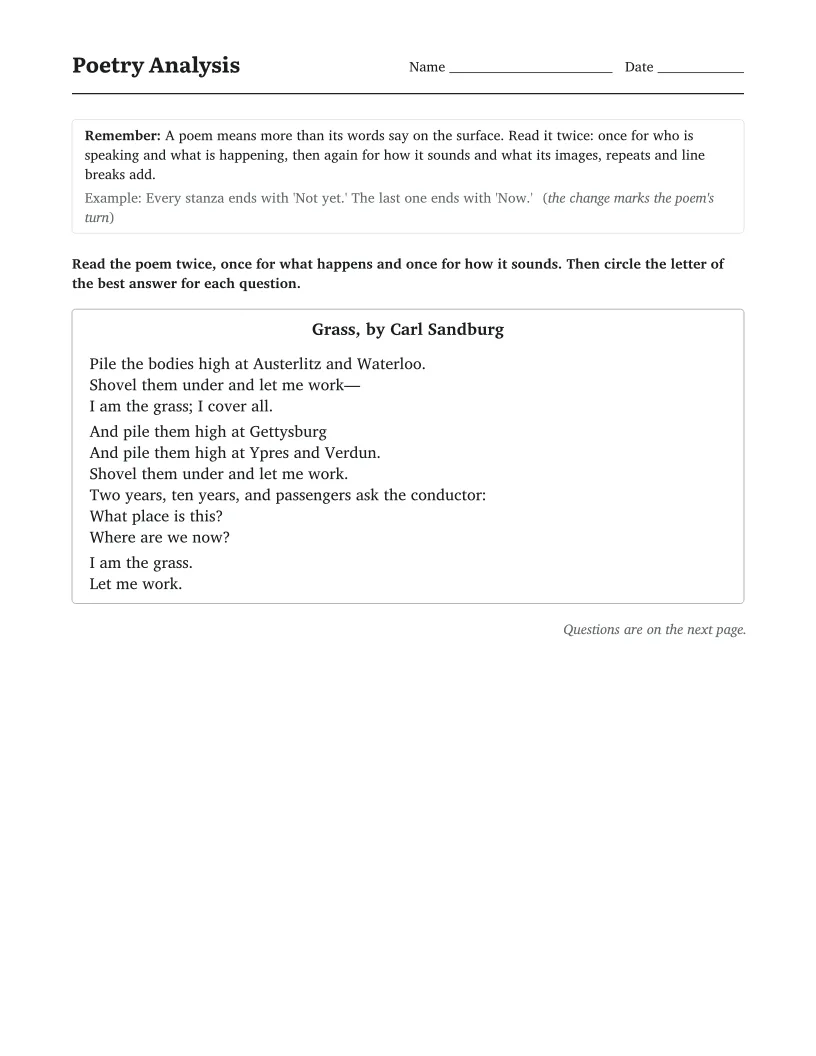
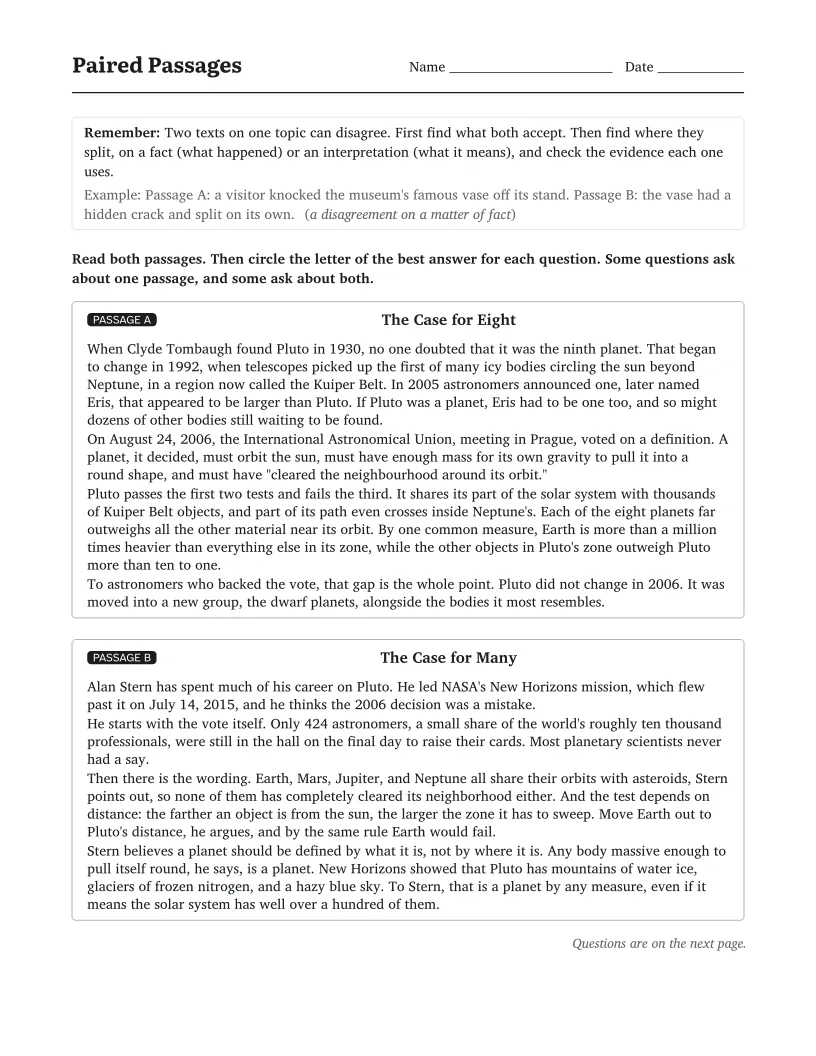
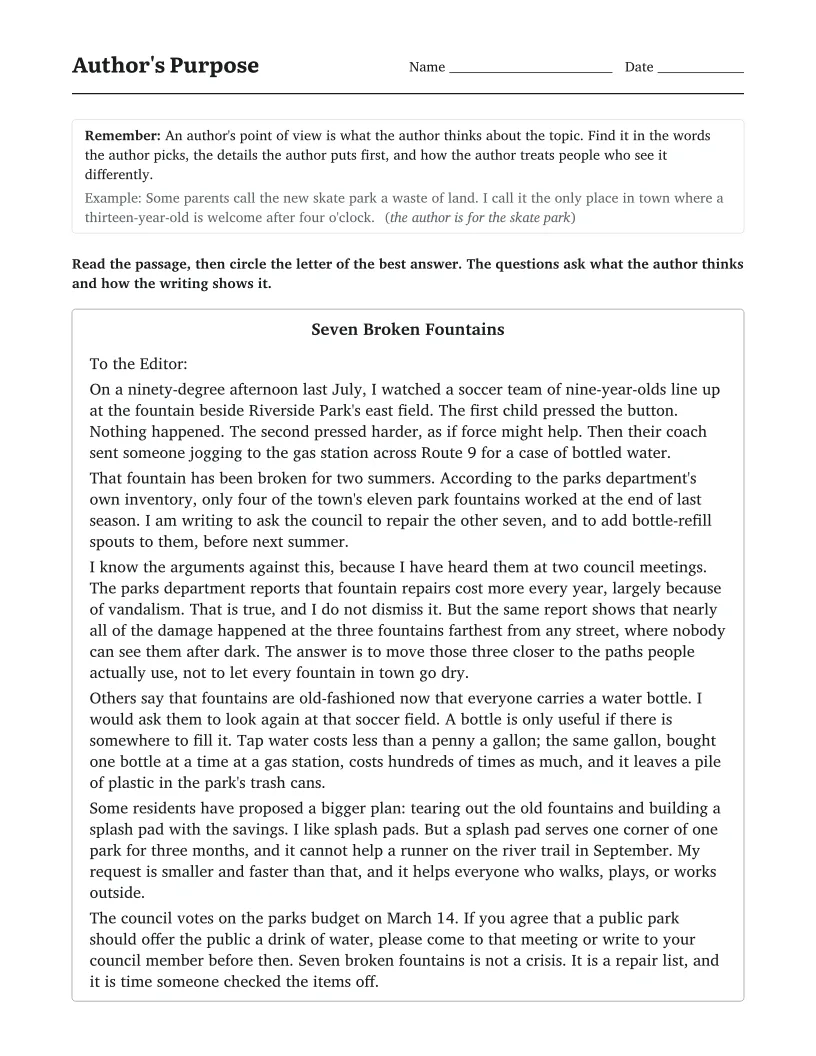
Author's purpose, point of view, text structure, paired passages and poetry. A poem always gets a page of its own, so the questions sit next to the lines they ask about.
6th grade reading comprehension7th grade reading comprehension8th grade reading comprehension
Show all 11 sheetsShow fewer
6th grade
- Author's purpose Every writer has a reason for writing. The three big reasons are easy to remember as PIE: to Persuade (change your mind), to Inform (teach you facts), or to Entertain (tell you a fun story). To find the purpose, ask what the writer wants you to do after reading.
7th grade
- Author's purpose Every writer has a reason for writing. The three big reasons are easy to remember as PIE: to Persuade (change your mind), to Inform (teach you facts), or to Entertain (tell you a fun story). To find the purpose, ask what the writer wants you to do after reading.
- Paired passages Two passages, one topic. Read both all the way through before you answer. Some questions are about one passage, some are about both, and the question always tells you which.
- Poetry analysis A poem means more than its words say on the surface. Read it twice: once for who is speaking and what is happening, then again for how it sounds and what its images, repeats and line breaks add.
- Point of view Point of view is who tells the story. A character inside it says I. A narrator outside it says he, she, and names.
- Text structure Every information text has a shape: steps in time, two things compared, causes and effects, a problem and its fixes, or one thing described. Signal words give the shape away.
8th grade
- Author's purpose Every writer has a reason for writing. The three big reasons are easy to remember as PIE: to Persuade (change your mind), to Inform (teach you facts), or to Entertain (tell you a fun story). To find the purpose, ask what the writer wants you to do after reading.
- Paired passages Two passages, one topic. Read both all the way through before you answer. Some questions are about one passage, some are about both, and the question always tells you which.
- Poetry analysis A poem means more than its words say on the surface. Read it twice: once for who is speaking and what is happening, then again for how it sounds and what its images, repeats and line breaks add.
- Point of view Point of view is who tells the story. A character inside it says I. A narrator outside it says he, she, and names.
- Text structure Every information text has a shape: steps in time, two things compared, causes and effects, a problem and its fixes, or one thing described. Signal words give the shape away.
19 sheets
Number lines, fraction strips and more charts
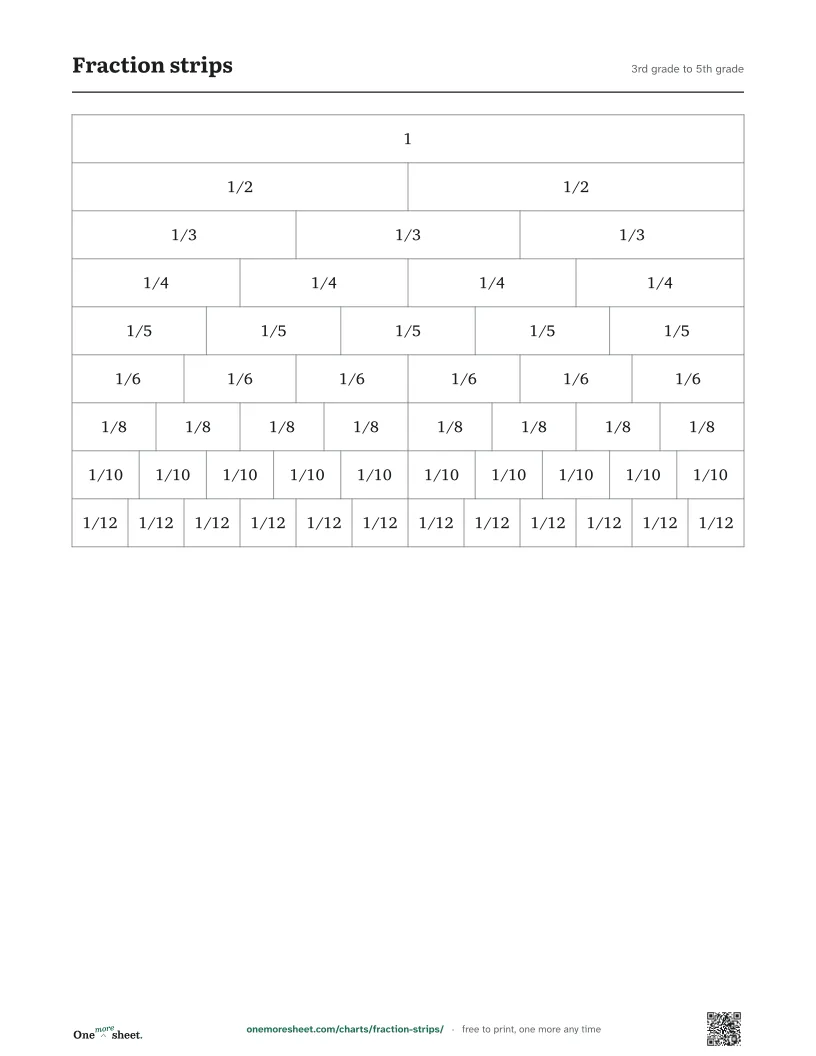
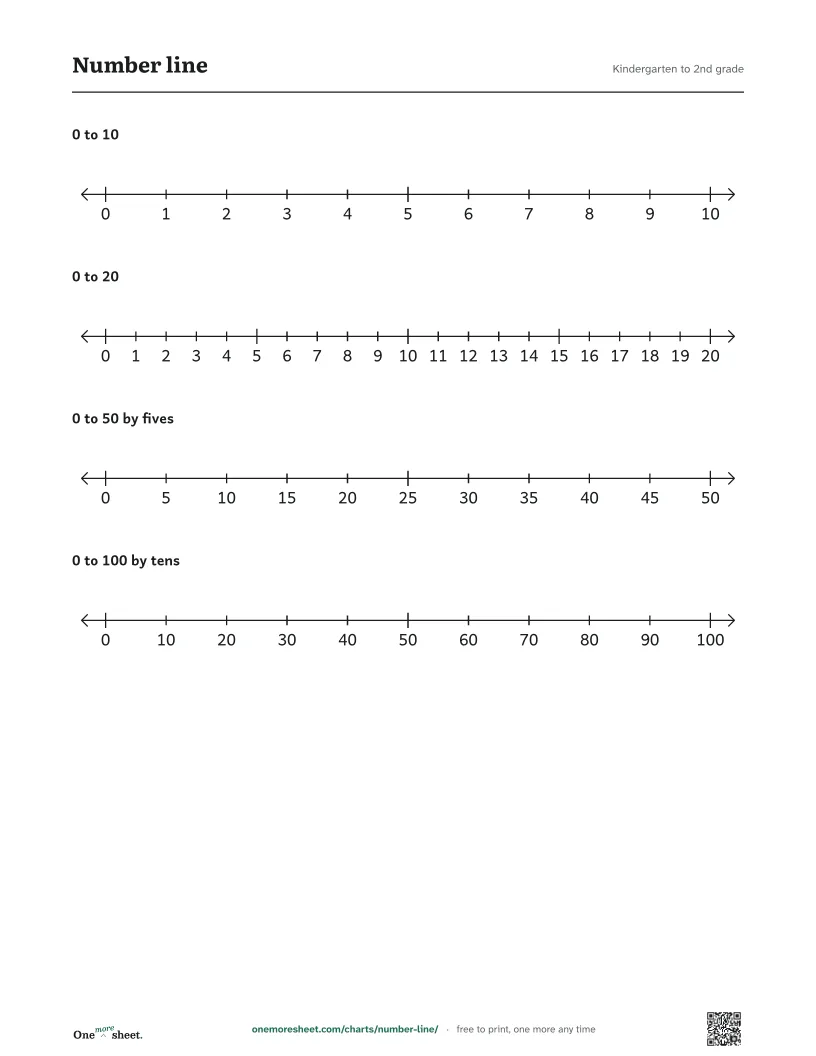
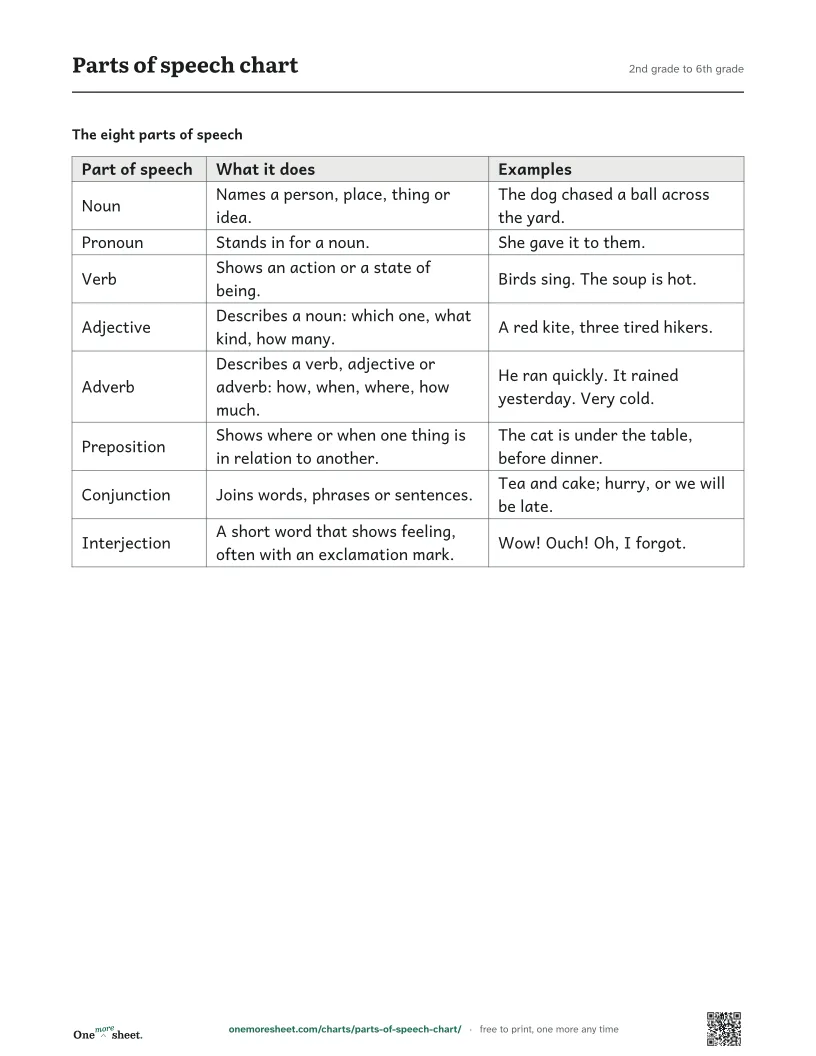
Addition and division charts, number lines with and without negatives, fraction strips, a measurement conversion chart, and one-page references for parts of speech, punctuation, verb tenses and vowels. Several also come blank, for filling in.
Show all 19 sheetsShow fewer
Printable charts and lists
- Addition chart Kindergarten to 2nd grade
- Blank addition chart 1st grade to 2nd grade
- Blank division chart 3rd grade to 4th grade
- Blank fraction strips 3rd grade to 4th grade
- Blank number line Kindergarten to 2nd grade
- Blank shapes chart Kindergarten to 2nd grade
- Division chart 3rd grade to 4th grade
- Fraction strips 3rd grade to 5th grade
- Measurement conversion chart 2nd grade to 5th grade
- Negative number line 5th grade to 6th grade
- Number line Kindergarten to 2nd grade
- Number line 1 to 20 Kindergarten to 1st grade
- Parts of speech chart 2nd grade to 6th grade
- Prime numbers chart 4th grade to 5th grade
- Punctuation chart 1st grade to 6th grade
- Shapes chart preschool to 2nd grade
- Skip counting chart 1st grade to 2nd grade
- Verb tense chart 2nd grade to 6th grade
- Vowel chart Kindergarten to 2nd grade
66 sheets
8th grade English
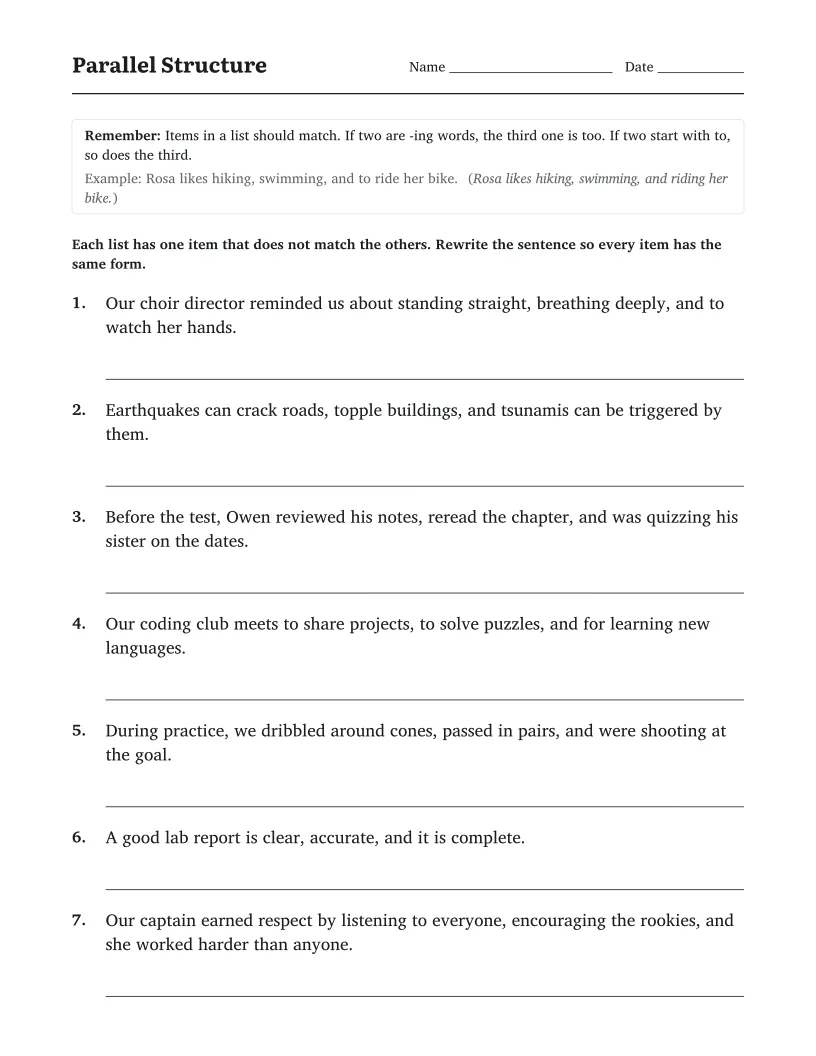
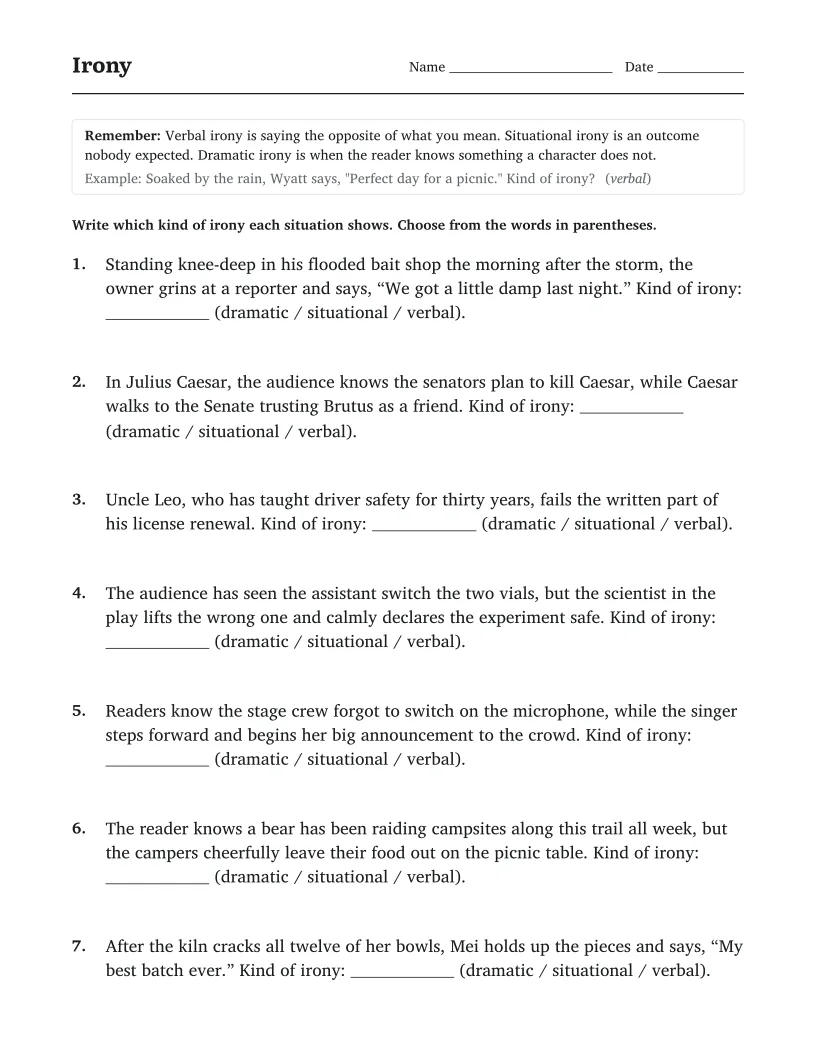
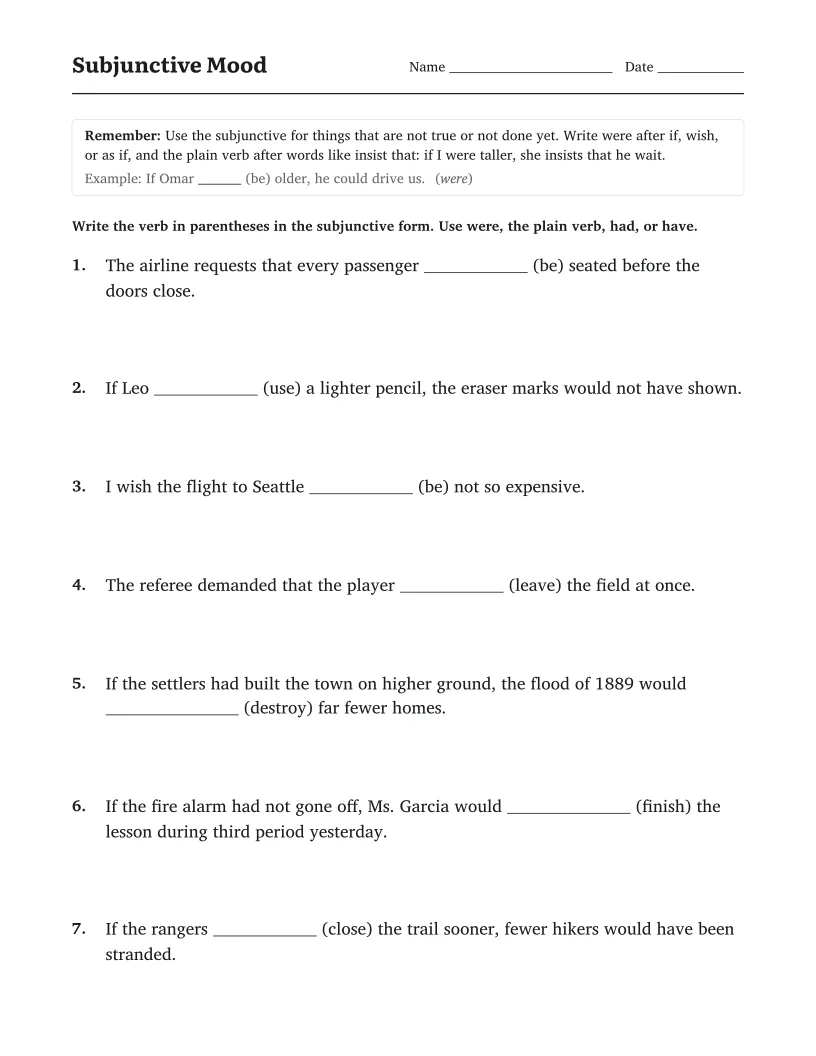
Grammar, punctuation, vocabulary and reading for 8th grade. Parallel structure, the subjunctive mood, puns, and who versus whom are new to the site. 7th grade gained reading, spelling and more grammar the same day, and both grades have spelling and vocabulary lists.
8th grade English6th grade reading comprehension7th grade reading comprehensionPrintable charts and lists
Show all 66 sheetsShow fewer
6th grade English
- Making inferences An inference is a smart guess the writer never says out loud. You mix a clue from the text with what you already know: if a character shivers and rubs her hands, you can infer she is cold.
- Text evidence Evidence is the exact line that proves a point. Don't tell me the story says so. Show me the sentence where it says so.
7th grade English
- Claim and counterclaim Every sentence in an argument has a job. Evidence backs up the claim. A counterclaim argues against it. A rebuttal brings up the other side and answers it. An irrelevant sentence does neither.
- Commas after introductory phrases When a sentence starts with a warm-up phrase, a comma marks where the real sentence begins: After the storm, we raked the yard.
- Commonly misspelled words Every famous misspelling has a trap: a double letter (really), a letter people double by mistake (until), or a silent sneak (friend). Know your word's trap and you own it.
- Conjunctive adverbs A conjunctive adverb joins two sentences into one and names the link: however for a contrast, therefore for a result, furthermore for one more point. Put a semicolon before it and a comma after it.
- Correlative conjunctions Correlative conjunctions work in fixed pairs: either/or, neither/nor, both/and, not only/but also, whether/or. Spot the first half, and the second half is already decided.
- Fiction reading comprehension The answers hide in the story. Read it once for fun, then go back and point to the exact sentence that proves each answer.
- Hyphens When two or more words work together as one describing word in front of a noun, join them with hyphens: a ten-minute break. Self-, ex- and all- always take a hyphen, and so do the numbers twenty-one to ninety-nine.
- Main idea and details The main idea is what the whole passage is about, in one sentence. The details are the smaller facts that back it up.
- Making inferences An inference is a smart guess the writer never says out loud. You mix a clue from the text with what you already know: if a character shivers and rubs her hands, you can infer she is cold.
- Nonfiction reading comprehension Nonfiction is true information. Read to find out what the passage teaches, and be ready to point to the fact that answers each question.
- Pronoun-antecedent agreement A pronoun has to match the noun it stands for: Maya packed her bag, and the twins packed their bags. In school writing, a team acting as one takes its, and each of the girls takes her.
- Run-on sentences A run-on squeezes two sentences into one. Find where the first idea ends, then add a period and a capital letter.
- Spelling words Each week has its own list, and most weeks share a secret: the words follow one spelling pattern. Find the pattern and half the list spells itself.
- Subordinating conjunctions Subordinating conjunctions join a helper idea to a main idea and name the link: because (why), although (surprise), until (time), if (condition).
- Text evidence Evidence is the exact line that proves a point. Don't tell me the story says so. Show me the sentence where it says so.
- Theme The theme is what a story teaches about life, said in a full sentence. Not what the story is about, but what it shows you.
- Wordiness and redundancy Say it once. If one word already means what another word adds, cut the extra word. Return back becomes return, and blue in color becomes blue.
8th grade English
- Active and passive voice In the active voice the subject does the action: Priya checked the thermometer. In the passive voice the subject receives it: the thermometer was checked by Priya.
- Allusion An allusion is a quick nod to a story, a myth, or a famous moment. The writer expects you to catch it without being told.
- Analogies An analogy is a word puzzle in two pairs: work out how the first pair fits together, then finish the second pair the very same way.
- Claim and counterclaim Every sentence in an argument has a job. Evidence backs up the claim. A counterclaim argues against it. A rebuttal brings up the other side and answers it. An irrelevant sentence does neither.
- Commas between coordinate adjectives Two adjectives that could swap places, or that sound right with and between them, need a comma. Otherwise they do not.
- Commas for extra detail Extra information rides in the sentence wrapped in commas: My bike, which has a bell, lives on the porch. Lift it out and you still know which bike.
- Commonly confused words Some words sound alike but mean different things: their, there, and they're are three different words.
- Commonly misspelled words Every famous misspelling has a trap: a double letter (really), a letter people double by mistake (until), or a silent sneak (friend). Know your word's trap and you own it.
- Compound-complex sentences Count the clauses. One independent clause is simple, two is compound, one plus a dependent clause is complex, and two plus a dependent clause is compound-complex.
- Conjunctive adverbs A conjunctive adverb joins two sentences into one and names the link: however for a contrast, therefore for a result, furthermore for one more point. Put a semicolon before it and a comma after it.
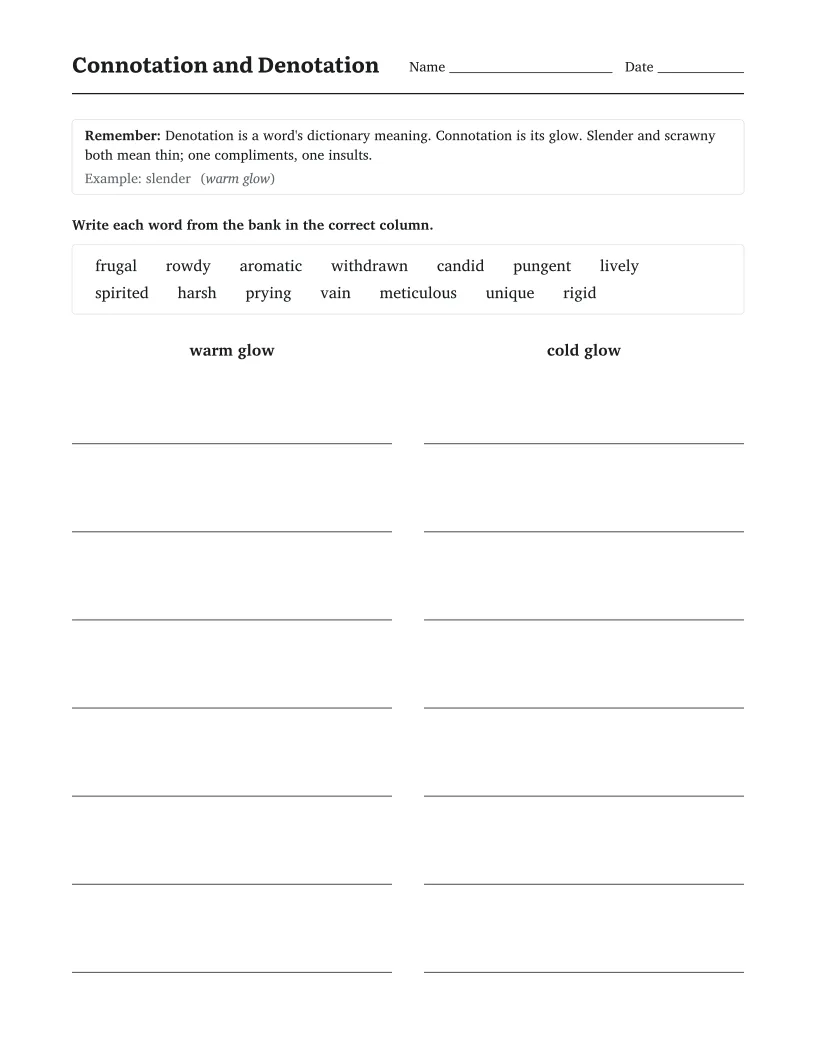
- Connotation and denotation Denotation is a word's dictionary meaning. Connotation is its glow. Slender and scrawny both mean thin; one compliments, one insults.
- Context clues The sentence around a hard word usually hides its meaning. Read past the word, find the clue, then decide: The arid desert had not seen rain for months, so arid must mean very dry.
- Direct and indirect objects The direct object answers what after the verb. The indirect object answers to whom or for whom, and it sits in front of the direct object.
- Fiction reading comprehension The answers hide in the story. Read it once for fun, then go back and point to the exact sentence that proves each answer.
- Greek and Latin roots Old Greek and Latin word parts hide inside big English words: tele means far, so telescope, telephone, and television all reach across distance.
- Hyphens When two or more words work together as one describing word in front of a noun, join them with hyphens: a ten-minute break. Self-, ex- and all- always take a hyphen, and so do the numbers twenty-one to ninety-nine.
- Idioms An idiom means something different from its exact words. A piece of cake means easy; raining cats and dogs means pouring. The sentence around it tells you which.
- Irony Verbal irony is saying the opposite of what you mean. Situational irony is an outcome nobody expected. Dramatic irony is when the reader knows something a character does not.
- Linking and transition words Transition words are the road signs of writing: also adds, however turns, therefore concludes, meanwhile runs alongside. Choose the sign that matches the turn.
- Literary devices A literary device is a tool a writer uses on purpose. Alliteration, assonance and onomatopoeia play with sound. Hyperbole makes things bigger than the truth and understatement makes them smaller. Personification, oxymoron and allusion make you see something in a new way.
- Main idea and details The main idea is what the whole passage is about, in one sentence. The details are the smaller facts that back it up.
- Making inferences An inference is a smart guess the writer never says out loud. You mix a clue from the text with what you already know: if a character shivers and rubs her hands, you can infer she is cold.
- Misplaced and dangling modifiers A describing phrase grabs whatever word sits closest to it. Put it next to the word you meant, or the sentence describes the wrong thing.
- Nonfiction reading comprehension Nonfiction is true information. Read to find out what the passage teaches, and be ready to point to the fact that answers each question.
- Parallel structure Items in a list should match. If two are -ing words, the third one is too. If two start with to, so does the third.
- Phrases and clauses A clause has a subject and its own verb. A phrase does not. A clause that can stand alone as a sentence is independent; one that cannot is dependent.
- Pronoun-antecedent agreement A pronoun has to match the noun it stands for: Maya packed her bag, and the twins packed their bags. In school writing, a team acting as one takes its, and each of the girls takes her.
- Puns A pun is a joke that uses one word two ways at once. The baker could never make enough dough: dough is bread, and dough is money.
- Run-on sentences A run-on squeezes two sentences into one. Find where the first idea ends, then add a period and a capital letter.
- Semicolons and colons A semicolon joins two sentences that could stand alone. A colon introduces what comes next: a list, an example, a name, or a sentence that explains the first one.
- Shifts in verb voice and mood When two parts of a sentence do the same job, keep them in the same voice and mood. Do not start a set of steps as commands and finish them as a statement.
- Similes and metaphors A simile compares with like or as: brave as a lion. A metaphor says one thing IS another: the classroom was a zoo.
- Spelling words Each week has its own list, and most weeks share a secret: the words follow one spelling pattern. Find the pattern and half the list spells itself.
- Subject and object pronouns Subject pronouns do the action: I, he, she, we, they. Object pronouns receive it: me, him, her, us, them. Drop the other person and your ear solves it: 'The coach chose me.'
- Subject-verb agreement The verb has to match the subject: one dog barks, two dogs bark.
- Subjunctive mood Use the subjunctive for things that are not true or not done yet. Write were after if, wish, or as if, and the plain verb after words like insist that: if I were taller, she insists that he wait.
- Text evidence Evidence is the exact line that proves a point. Don't tell me the story says so. Show me the sentence where it says so.
- The dash and the ellipsis A dash marks a sudden break or sets off a list that renames something. An ellipsis shows that speech or writing trailed off.
- Theme The theme is what a story teaches about life, said in a full sentence. Not what the story is about, but what it shows you.
- Verb moods Mood is the job a sentence does. Indicative tells, imperative orders, interrogative asks, conditional says what would happen, and subjunctive imagines or insists.
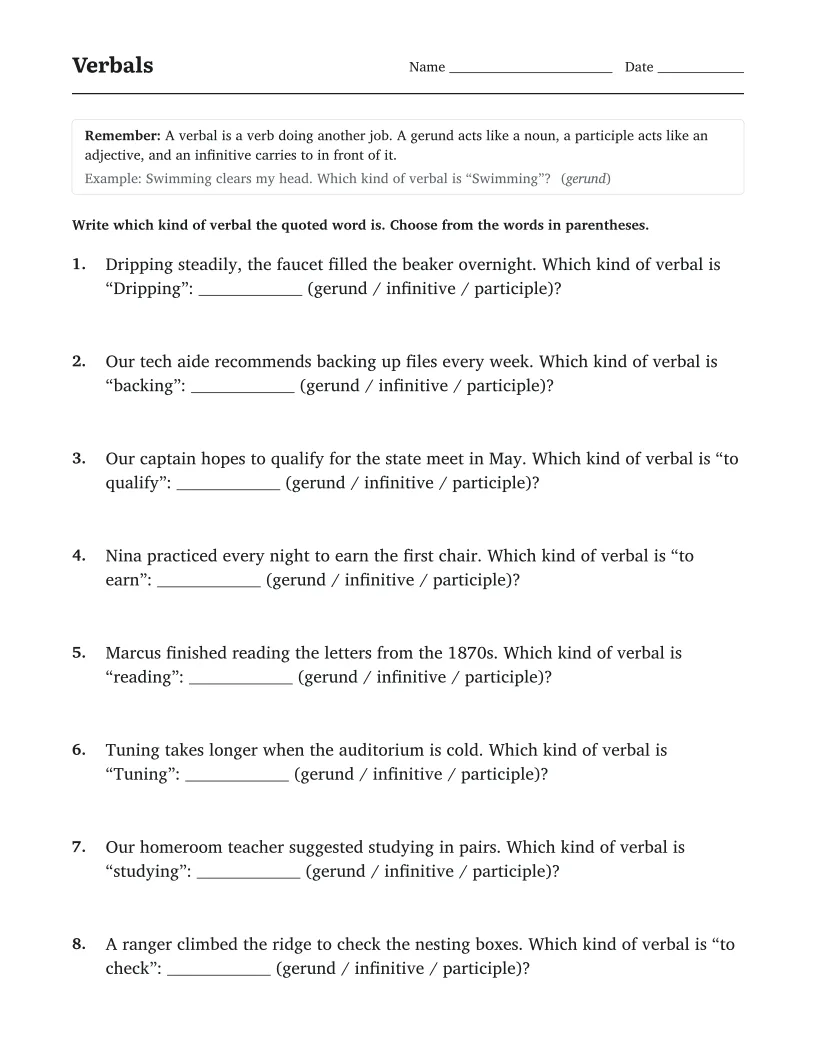
- Verbals A verbal is a verb doing another job. A gerund acts like a noun, a participle acts like an adjective, and an infinitive carries to in front of it.
- Who and whom In formal writing, put he or him in place of the blank and rebuild that part of the sentence. If he fits, write who or whoever. If him fits, write whom or whomever.
- Wordiness and redundancy Say it once. If one word already means what another word adds, cut the extra word. Return back becomes return, and blue in color becomes blue.
Printable charts and lists
- 7th grade spelling words 7th grade
- 7th grade vocabulary words 7th grade
- 8th grade spelling words 8th grade
- 8th grade vocabulary words 8th grade
44 sheets
Picture phonics for Pre-K to 2nd grade
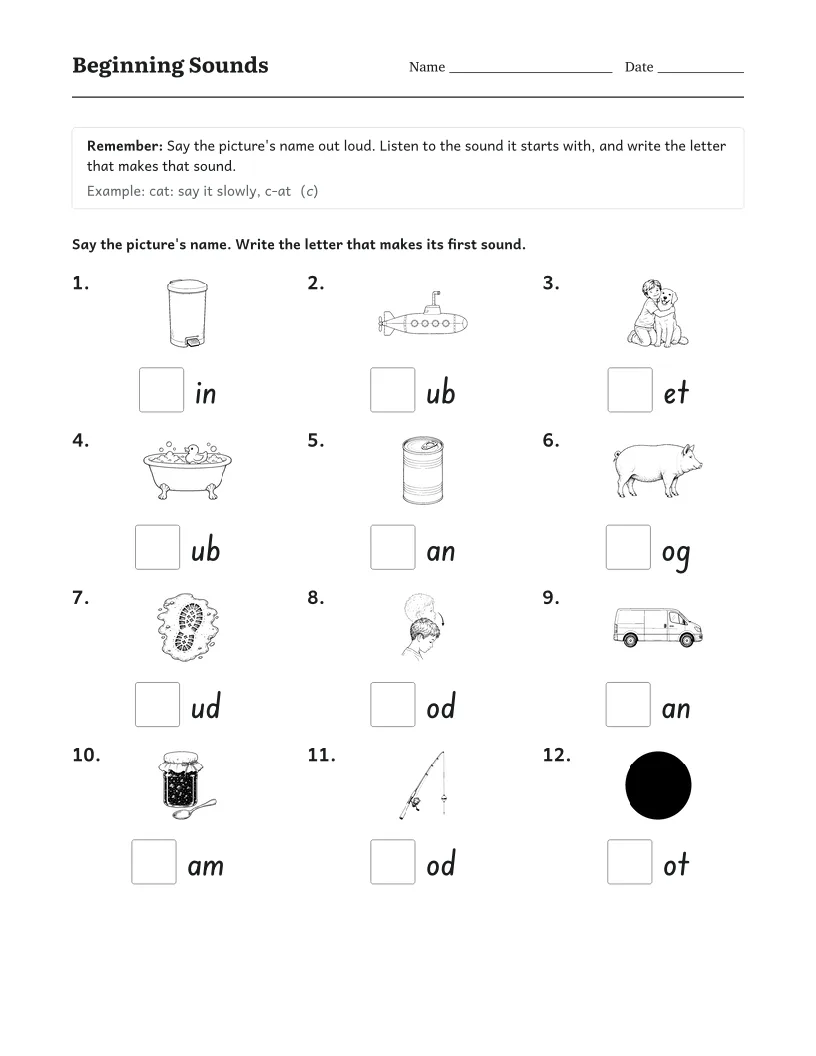
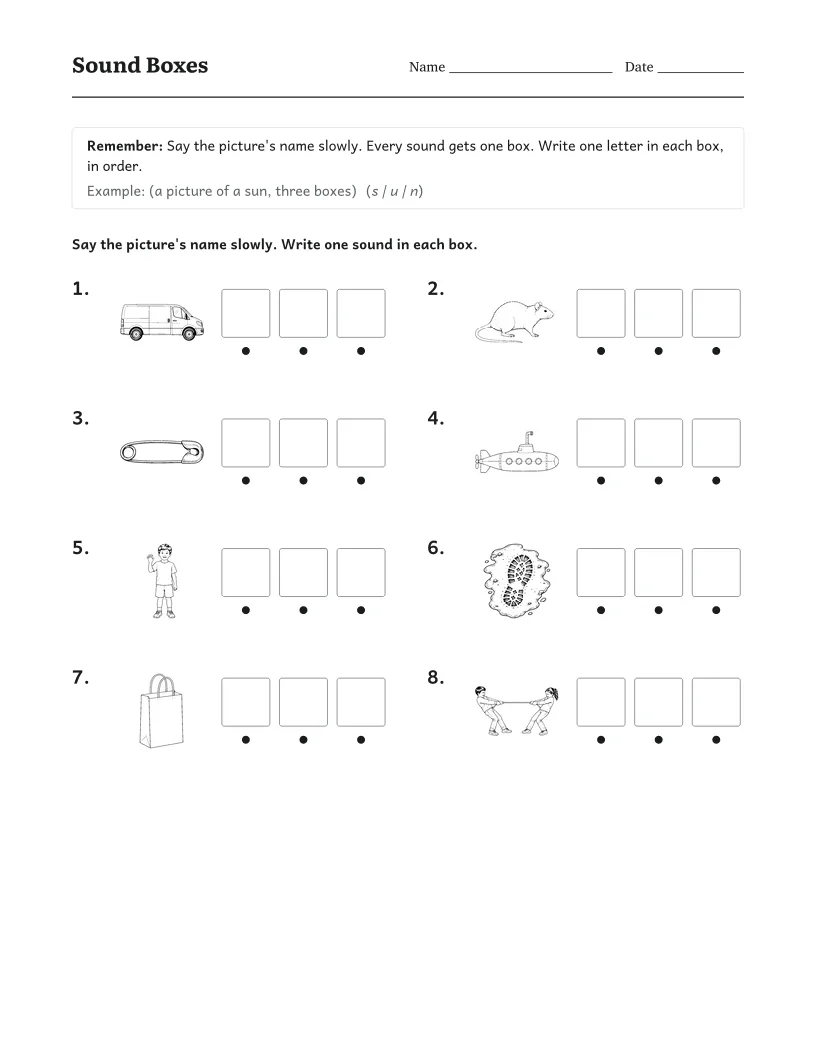
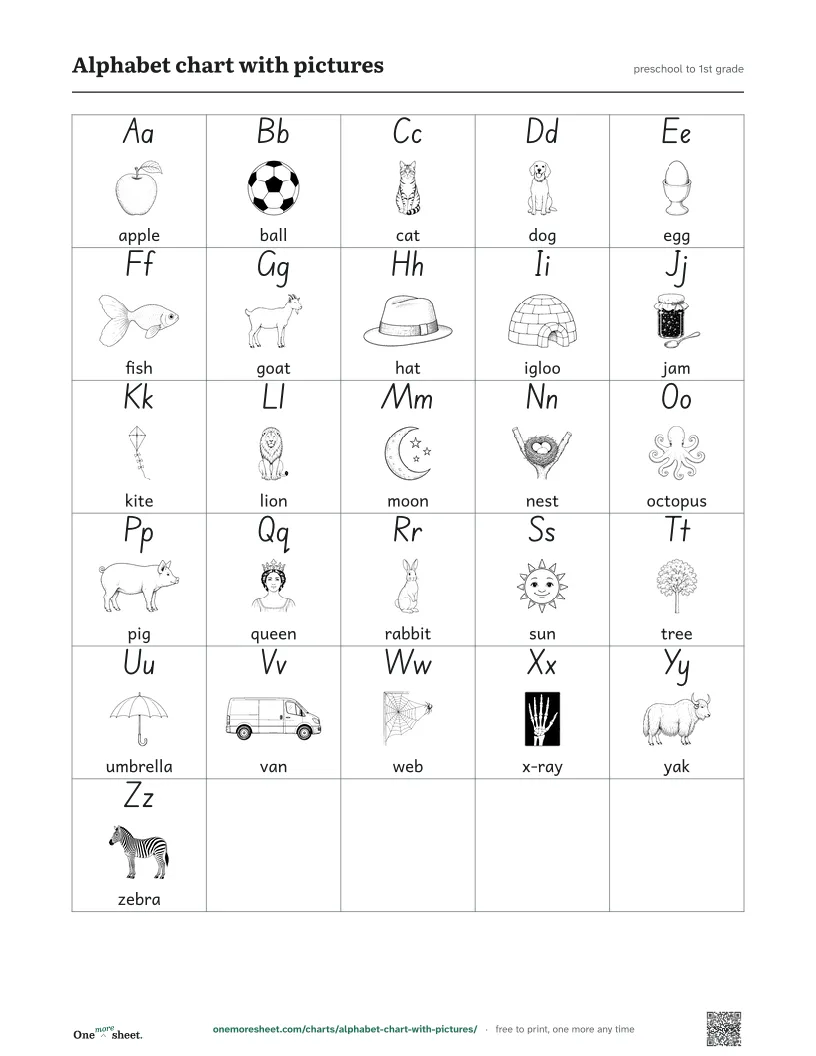
Beginning, middle and ending sounds, rhymes, syllables and sound boxes, built on pictures a young reader can name. Children write the letter or the word instead of circling it. Kindergarten counting has picture sheets now too, and there is an alphabet chart with a picture for every letter.
Pre-K phonicsKindergarten phonics1st grade phonics2nd grade phonics
Show all 44 sheetsShow fewer
Pre-K English
- Action words An action word says what somebody is doing. Look at the picture and ask: what is happening?
- Beginning sounds Say the picture's name out loud. Listen to the sound it starts with, and write the letter that makes that sound.
- Picture words Say the picture's name. Then trace the word beside it, starting at the top of each letter.
- Positional words The same cat is in every picture. What changes is where it is, and that is the word to write.
- Rhyming pictures Say both picture names. Words that rhyme end with the same sound. Write both words.
Pre-K math
- Comparing numbers to 10 The open side of < or > always faces the bigger number.
- Count the objects Count the objects. Write how many.
Kindergarten English
- Action words An action word says what somebody is doing. Look at the picture and ask: what is happening?
- Beginning sounds Say the picture's name out loud. Listen to the sound it starts with, and write the letter that makes that sound.
- Body parts Point to it on yourself first. Then find its word in the bank and write it on the line.
- CVC picture words Say the picture's name slowly, one sound at a time. Write the letters for those sounds, in order.
- Ending sounds Say the picture's name and hold on to the very last sound. Write the letter for that sound.
- Middle sounds Say the picture's name slowly and listen to the sound in the middle. Write the vowel you hear.
- Opposites Two pictures, one word written. The second picture shows the opposite, and its word is in the bank.
- Picture sequencing Look at all the pictures first. Find the one that happens first and write 1 in its box, then keep going.
- Picture writing prompts Look at the whole picture first. Say one thing that is happening, then write that sentence down.
- Positional words The same cat is in every picture. What changes is where it is, and that is the word to write.
- Rhyming pictures Say both picture names. Words that rhyme end with the same sound. Write both words.
- Sound boxes Say the picture's name slowly. Every sound gets one box. Write one letter in each box, in order.
- Syllables with pictures Say the picture's name and clap once for every part you hear. Write how many claps in the box.
- Weather words Every picture is a kind of weather. Say what the day is doing, then find that word in the bank at the top.
Kindergarten math
- Count the objects Count the objects. Write how many.
- More or fewer Count each group. Write how many. Which group has more?
- Sort and count pictures Count the pictures of each kind. Write how many.
1st grade English
- Action words An action word says what somebody is doing. Look at the picture and ask: what is happening?
- Beginning sounds Say the picture's name out loud. Listen to the sound it starts with, and write the letter that makes that sound.
- Body parts Point to it on yourself first. Then find its word in the bank and write it on the line.
- CVC picture words Say the picture's name slowly, one sound at a time. Write the letters for those sounds, in order.
- Ending sounds Say the picture's name and hold on to the very last sound. Write the letter for that sound.
- Middle sounds Say the picture's name slowly and listen to the sound in the middle. Write the vowel you hear.
- Opposites Two pictures, one word written. The second picture shows the opposite, and its word is in the bank.
- Picture compound words Name both pictures, then push the two words together. The word you get is the compound word.
- Picture sequencing Look at all the pictures first. Find the one that happens first and write 1 in its box, then keep going.
- Picture writing prompts Look at the whole picture first. Say one thing that is happening, then write that sentence down.
- Positional words The same cat is in every picture. What changes is where it is, and that is the word to write.
- Rhyming pictures Say both picture names. Words that rhyme end with the same sound. Write both words.
- Sound boxes Say the picture's name slowly. Every sound gets one box. Write one letter in each box, in order.
- Syllables with pictures Say the picture's name and clap once for every part you hear. Write how many claps in the box.
- Weather words Every picture is a kind of weather. Say what the day is doing, then find that word in the bank at the top.
2nd grade English
- Picture compound words Name both pictures, then push the two words together. The word you get is the compound word.
- Picture sequencing Look at all the pictures first. Find the one that happens first and write 1 in its box, then keep going.
- Picture writing prompts Look at the whole picture first. Say one thing that is happening, then write that sentence down.
- Syllables with pictures Say the picture's name and clap once for every part you hear. Write how many claps in the box.
Printable charts and lists
- Alphabet chart with pictures preschool to 1st grade
32 sheets
7th grade English
Grammar, punctuation and vocabulary for 7th grade: phrases and clauses, misplaced modifiers, active and passive voice, semicolons, Greek and Latin roots, and figurative language. Subject-verb agreement sheets for 5th and 6th grade came with it.

Show all 32 sheetsShow fewer
5th grade
- Subject-verb agreement The verb has to match the subject: one dog barks, two dogs bark.
6th grade
- Subject-verb agreement The verb has to match the subject: one dog barks, two dogs bark.
7th grade
- Active and passive voice In the active voice the subject does the action: Priya checked the thermometer. In the passive voice the subject receives it: the thermometer was checked by Priya.
- Adages and proverbs A proverb is a small sentence carrying old advice: the early bird catches the worm. The situation around it tells you which saying fits.
- Allusion An allusion is a quick nod to a story, a myth, or a famous moment. The writer expects you to catch it without being told.
- Analogies An analogy is a word puzzle in two pairs: work out how the first pair fits together, then finish the second pair the very same way.
- Commas between coordinate adjectives Two adjectives that could swap places, or that sound right with and between them, need a comma. Otherwise they do not.
- Commas for extra detail Extra information rides in the sentence wrapped in commas: My bike, which has a bell, lives on the porch. Lift it out and you still know which bike.
- Commonly confused words Some words sound alike but mean different things: their, there, and they're are three different words.
- Compound-complex sentences Count the clauses. One independent clause is simple, two is compound, one plus a dependent clause is complex, and two plus a dependent clause is compound-complex.
- Connotation and denotation Denotation is a word's dictionary meaning. Connotation is its glow. Slender and scrawny both mean thin; one compliments, one insults.
- Context clues The sentence around a hard word usually hides its meaning. Read past the word, find the clue, then decide: The arid desert had not seen rain for months, so arid must mean very dry.
- Direct and indirect objects The direct object answers what after the verb. The indirect object answers to whom or for whom, and it sits in front of the direct object.
- Formal or informal? English wears different clothes for different rooms. Formal: Good afternoon; I would appreciate your help. Informal: Hey! Wanna play? Both are correct, in their place.
- Greek and Latin roots Old Greek and Latin word parts hide inside big English words: tele means far, so telescope, telephone, and television all reach across distance.
- Idioms An idiom means something different from its exact words. A piece of cake means easy; raining cats and dogs means pouring. The sentence around it tells you which.
- Irony Verbal irony is saying the opposite of what you mean. Situational irony is an outcome nobody expected. Dramatic irony is when the reader knows something a character does not.
- Linking and transition words Transition words are the road signs of writing: also adds, however turns, therefore concludes, meanwhile runs alongside. Choose the sign that matches the turn.
- Misplaced and dangling modifiers A describing phrase grabs whatever word sits closest to it. Put it next to the word you meant, or the sentence describes the wrong thing.
- Personification and hyperbole Personification gives human actions to things: the wind whispered. Hyperbole exaggerates on purpose: I've told you a million times.
- Phrases and clauses A clause has a subject and its own verb. A phrase does not. A clause that can stand alone as a sentence is independent; one that cannot is dependent.
- Punctuating titles of short works Short works wear quotation marks: poems, songs, stories, and articles. 'The Raven' is a poem; a whole book would be underlined or set in italics instead.
- Semicolons and colons A semicolon joins two sentences that could stand alone. A colon introduces what comes next: a list, an example, a name, or a sentence that explains the first one.
- Sentence fragments A fragment is a piece of a sentence. Find what it is missing: the naming part (subject) or the telling part (predicate).
- Shifts in verb voice and mood When two parts of a sentence do the same job, keep them in the same voice and mood. Do not start a set of steps as commands and finish them as a statement.
- Similes and metaphors A simile compares with like or as: brave as a lion. A metaphor says one thing IS another: the classroom was a zoo.
- Subject and object pronouns Subject pronouns do the action: I, he, she, we, they. Object pronouns receive it: me, him, her, us, them. Drop the other person and your ear solves it: 'The coach chose me.'
- Subject-verb agreement The verb has to match the subject: one dog barks, two dogs bark.
- The dash and the ellipsis A dash marks a sudden break or sets off a list that renames something. An ellipsis shows that speech or writing trailed off.
- Verb moods Mood is the job a sentence does. Indicative tells, imperative orders, interrogative asks, conditional says what would happen, and subjunctive imagines or insists.
- Verb tense consistency A sentence picks a time and sticks to it. If the first verb is past, its teammates ride past too: she set the table and poured the water, not pours.
- Verbals A verbal is a verb doing another job. A gerund acts like a noun, a participle acts like an adjective, and an infinitive carries to in front of it.
51 sheets
Pre-K, handwriting and printable charts
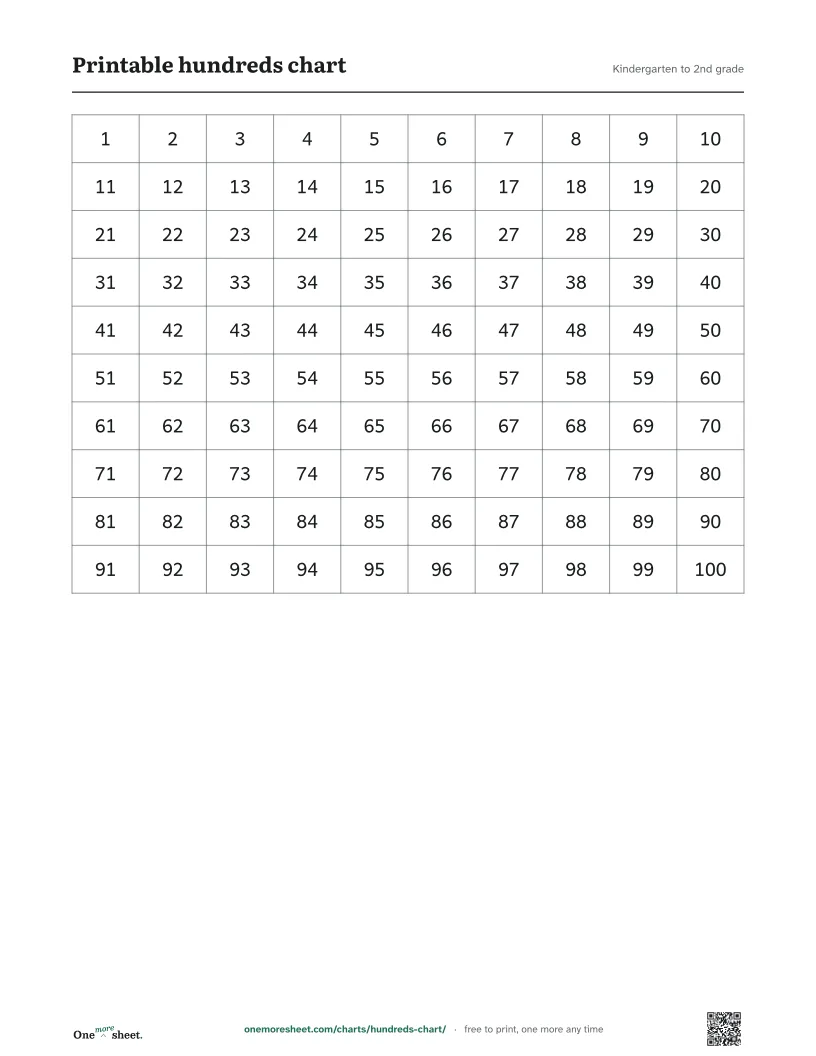
Pre-K gets a section of its own: tracing, cutting practice and counting. Handwriting runs from lines and shapes up to whole sentences, and name tracing prints any name you type. There are new charts too: hundreds and multiplication charts, place value, Dolch and Fry sight words, and spelling lists for 1st to 6th grade.
Printable charts and listsPre-K worksheetsKindergarten handwriting1st grade handwriting
Show all 51 sheetsShow fewer
Pre-K English
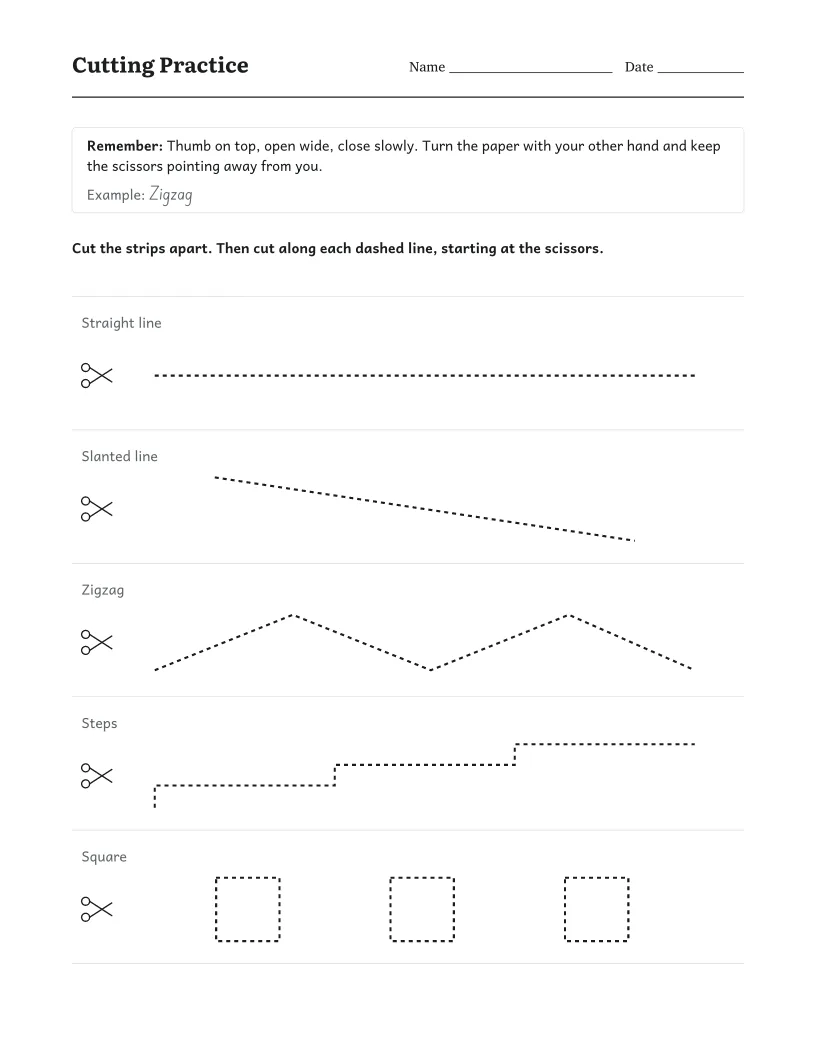
- Cutting practice Thumb on top, open wide, close slowly. Turn the paper with your other hand and keep the scissors pointing away from you.
- Dolch pre-primer sight words The pre-primer words are your first forty sight words: little words like the, my, and jump that show up in almost every book you'll ever open.
- Letter tracing Every letter starts at the top. The capital is tall; the small letter has its own size and its own home on the lines.
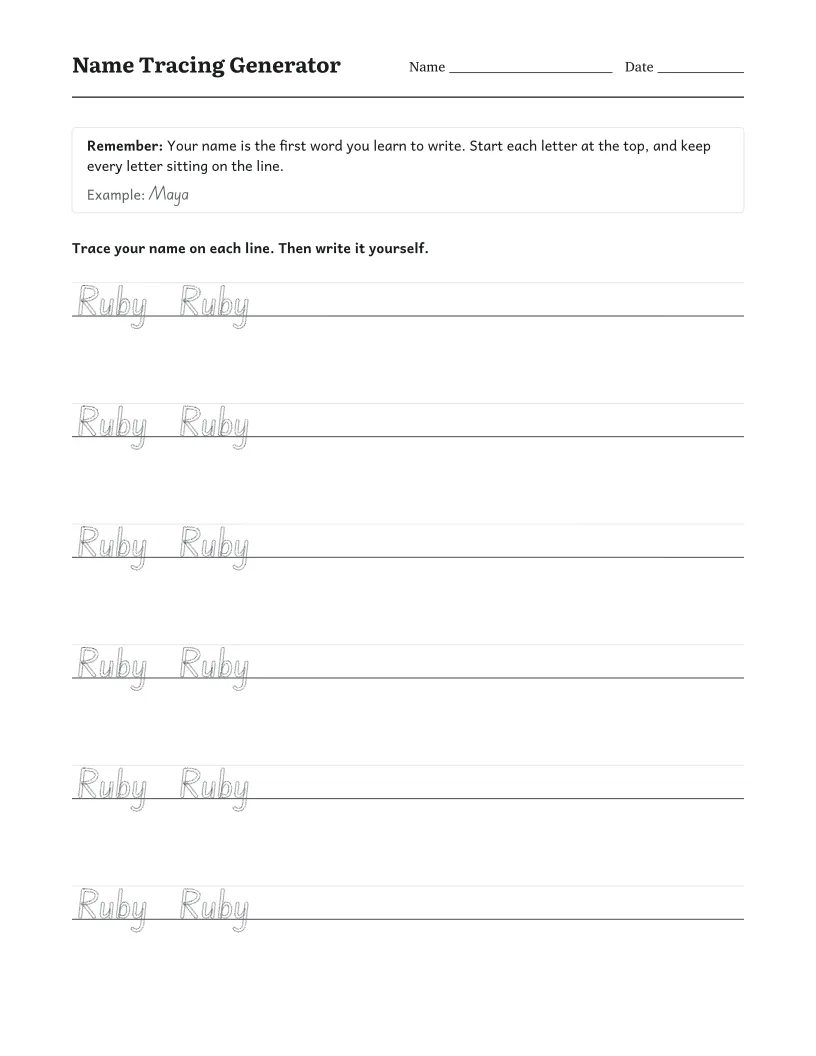
- Name tracing generator Your name is the first word you learn to write. Start each letter at the top, and keep every letter sitting on the line.
- Number tracing Numbers start at the top too. Trace the dots, then write the number on your own.
- Tracing lines and shapes Put your pencil on a dot. Follow its dotted line all the way to the end without lifting your pencil.
Pre-K math
- Counting & number recognition 0–10 Count objects one by one. Say the numbers in order to tell how many.
- Counting to 5 Touch each dot and say the numbers in order. The last number you say is how many.
Kindergarten English
- Cutting practice Thumb on top, open wide, close slowly. Turn the paper with your other hand and keep the scissors pointing away from you.
- Letter tracing Every letter starts at the top. The capital is tall; the small letter has its own size and its own home on the lines.
- Name tracing generator Your name is the first word you learn to write. Start each letter at the top, and keep every letter sitting on the line.
- Number tracing Numbers start at the top too. Trace the dots, then write the number on your own.
- Sentence tracing A telling sentence starts with a capital letter, has a space between every word, and ends with a period. Trace it, then write it yourself the same way.
- Tracing lines and shapes Put your pencil on a dot. Follow its dotted line all the way to the end without lifting your pencil.
1st grade English
- Letter tracing Every letter starts at the top. The capital is tall; the small letter has its own size and its own home on the lines.
- Name tracing generator Your name is the first word you learn to write. Start each letter at the top, and keep every letter sitting on the line.
- Sentence tracing A telling sentence starts with a capital letter, has a space between every word, and ends with a period. Trace it, then write it yourself the same way.
Printable charts and lists
- 120 chart 1st grade
- 1st grade spelling words 1st grade
- 2nd grade spelling words 2nd grade
- 3rd grade spelling words 3rd grade
- 4th grade spelling words 4th grade
- 5th grade spelling words 5th grade
- 6th grade spelling words 6th grade
- Alphabet chart preschool to 1st grade
- Blank hundreds chart Kindergarten to 2nd grade
- Blank multiplication chart 3rd grade to 4th grade
- Commonly misspelled words list 3rd grade to 6th grade
- Cursive letters chart 2nd grade to 4th grade
- CVC word list Kindergarten to 1st grade
- Dolch pre-primer sight words preschool
- Dolch sight words for 1st grade 1st grade
- Dolch sight words for 2nd grade 2nd grade
- Dolch sight words for 3rd grade 3rd grade
- Dolch sight words for kindergarten Kindergarten
- Fill-in multiplication chart 3rd grade to 4th grade
- Fry sight words, first 100 Kindergarten to 1st grade
- Fry sight words, second 100 1st grade to 2nd grade
- Fry sight words, third 100 2nd grade to 3rd grade
- Handwriting paper preschool to 3rd grade
- Hundreds chart with missing numbers Kindergarten to 2nd grade
- Hundreds chart, 4 per page Kindergarten to 2nd grade
- Irregular verbs list 2nd grade to 4th grade
- Multiplication chart 1 to 20 4th grade to 6th grade
- Number chart 1 to 20 preschool to 1st grade
- Number chart 1 to 50 Kindergarten to 1st grade
- Place value chart with decimals 4th grade to 5th grade
- Printable hundreds chart Kindergarten to 2nd grade
- Printable multiplication chart 2nd grade to 4th grade
- Printable place value chart 2nd grade to 5th grade
- Roman numerals chart 3rd grade to 5th grade