Phonics & word study worksheets
Letter sounds, blends, vowel teams, and everything that makes words decodable. From 3rd grade on this is word study: syllable division, prefixes and suffixes, Greek and Latin roots, schwa, and the spelling patterns of longer words.
Nothing in phonics matches that. Search the whole site
Skip past the listSight words 7 skills
- Dolch grade 1 sight words Sight words are the words you meet so often that your eyes should know them without sounding out. Trace each one, then write it on your own.
- Dolch grade 2 sight words Sight words are the words you meet so often that your eyes should know them without sounding out. Say each one, cover it, and write it from memory.
- Dolch grade 3 sight words Sight words are the words you meet so often that your eyes should know them without sounding out. Say each one, cover it, and write it from memory.
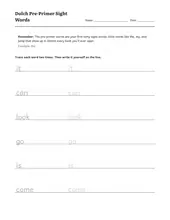
- Dolch pre-primer sight words The pre-primer words are your first forty sight words: little words like the, my, and jump that show up in almost every book you'll ever open.
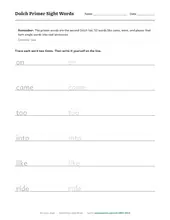
- Dolch primer sight words The primer words are the second Dolch list: 52 words like came, went, and please that turn single words into real sentences.
- Fry instant words Fry words are the words you meet most often in books. Know them on sight and reading speeds up.
- Sight words Sight words are the little words you see everywhere. Sound out the parts you can, learn the tricky part by heart, and practice until you know the word in a snap.


Word families 6 skills
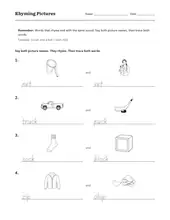
- Rhyming pictures, new Say both picture names. Words that rhyme end with the same sound. Write both words.
- Short a word families Words in the same family share their ending: cat, hat, and bat are all -at words.
- Short e word families Words in the same family share their ending: pet and wet are -et words; bell and shell are -ell words.
- Short i word families Words in the same family share their ending: win and chin are -in words; kick and stick are -ick words.
- Short o word families Words in the same family share their ending: hop and stop are -op words; rock and clock are -ock words.
- Short u word families Words in the same family share their ending: bug and rug are -ug words; jump and bump are -ump words.


Digraphs 2 skills
- Beginning digraphs (sh, ch, th) Two letters can team up to make one new sound: sh in ship, ch in chip, th in thin.
- Ending digraphs (sh, ch, th) Letter teams work at the ends of words too: fish ends in sh, lunch ends in ch, bath ends in th.


Vowel teams 8 skills
- Long a vowel teams (ai, ay) Two vowels can team up to say one long sound. Ai and ay both say the long a, and position picks the team: ay ends a word (play, day), ai works inside it (rain, train).
- Long e vowel teams (ee, ea) Ee and ea both say the long e sound: see, eat. The tricky part is remembering which team each word uses.
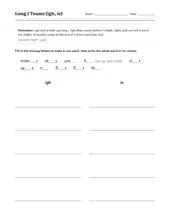
- Long i teams (igh, ie) Igh and ie both say long i. Igh often comes before t (night, light) and can end a word too (high); ie usually comes at the end of a short word (pie, tie).
- Long o vowel teams (oa, ow) Oa and ow both say the long o sound: boat, snow. Oa works inside words; ow usually takes the end.
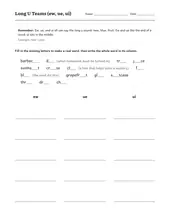
- Long u teams (ew, ue, ui) Ew, ue, and ui all can say the long u sound: new, blue, fruit. Ew and ue like the end of a word; ui sits in the middle.
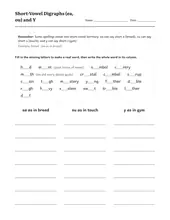
- Short-vowel digraphs (ea, ou) and y Some spellings sneak into short-vowel territory: ea can say short e (bread), ou can say short u (touch), and y can say short i (gym).
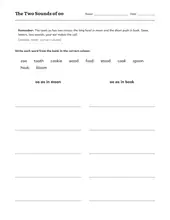
- The two sounds of oo The team oo has two voices: the long howl in moon and the short push in book. Same letters, two sounds; your ear makes the call.
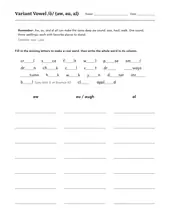
- Variant vowel /ô/ (aw, au, al) Aw, au, and al all can make the same deep aw sound: saw, haul, walk. One sound, three spellings, each with favorite places to stand.



R-controlled vowels 2 skills
- R-controlled vowels (ar, or, er) When r follows a vowel, it bosses the sound around: car, corn, and bird don't use their short vowels.
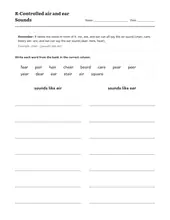
- R-controlled air and ear sounds R bends the vowel in front of it. Air, are, and ear can all say the air sound (chair, care, bear); eer, ere, and ear can say the ear sound (deer, here, hear).

Syllables 6 skills
- Counting syllables Syllables are the beats in a word. Clap them out: cat has one, apple has two, banana has three.
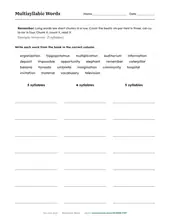
- Multisyllabic words Long words are short chunks in a row. Count the beats: im-por-tant is three, cal-cu-la-tor is four. Chunk it, count it, read it.
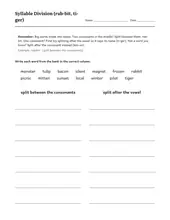
- Syllable division (rab-bit, ti-ger) Big words break into beats. Two consonants in the middle? Split between them: rab-bit. One consonant? First try splitting after the vowel so it says its name (ti-ger). Not a word you know? Split after the consonant instead (lem-on).
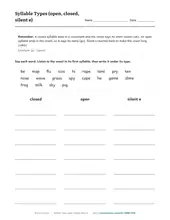
- Syllable types (open, closed, silent e) A closed syllable ends in a consonant and the vowel says its short sound (cat). An open syllable ends in the vowel, so it says its name (go). Silent e reaches back to make the vowel long (cake).
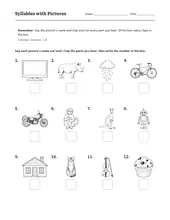
- Syllables with pictures, new Say the picture's name and clap once for every part you hear. Write how many claps in the box.
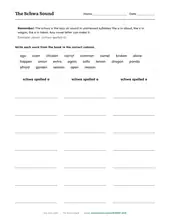
- The schwa sound The schwa is the lazy uh sound in unstressed syllables: the a in about, the o in wagon, the e in taken. Any vowel letter can make it.

Consonant blends 3 skills
- Beginning blends (bl, cr, st) A blend is two consonants that work side by side, and you can still hear both: bl in black, cr in crab, st in star.
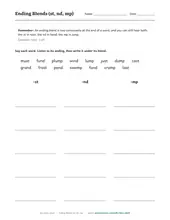
- Ending blends (st, nd, mp) An ending blend is two consonants at the end of a word, and you can still hear both: the st in nest, the nd in hand, the mp in jump.
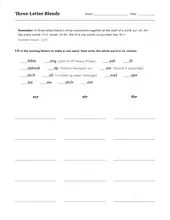
- Three-letter blends A three-letter blend is three consonants together at the start of a word: scr, str, thr. Say every sound: s-t-r, street. In thr, the th is one sound, so you hear two: th-r.

Alphabet & letter sounds 6 skills
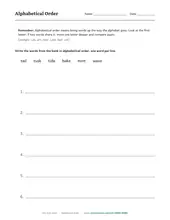
- Alphabetical order Alphabetical order means lining words up the way the alphabet goes. Look at the first letter; if two words share it, move one letter deeper and compare again.
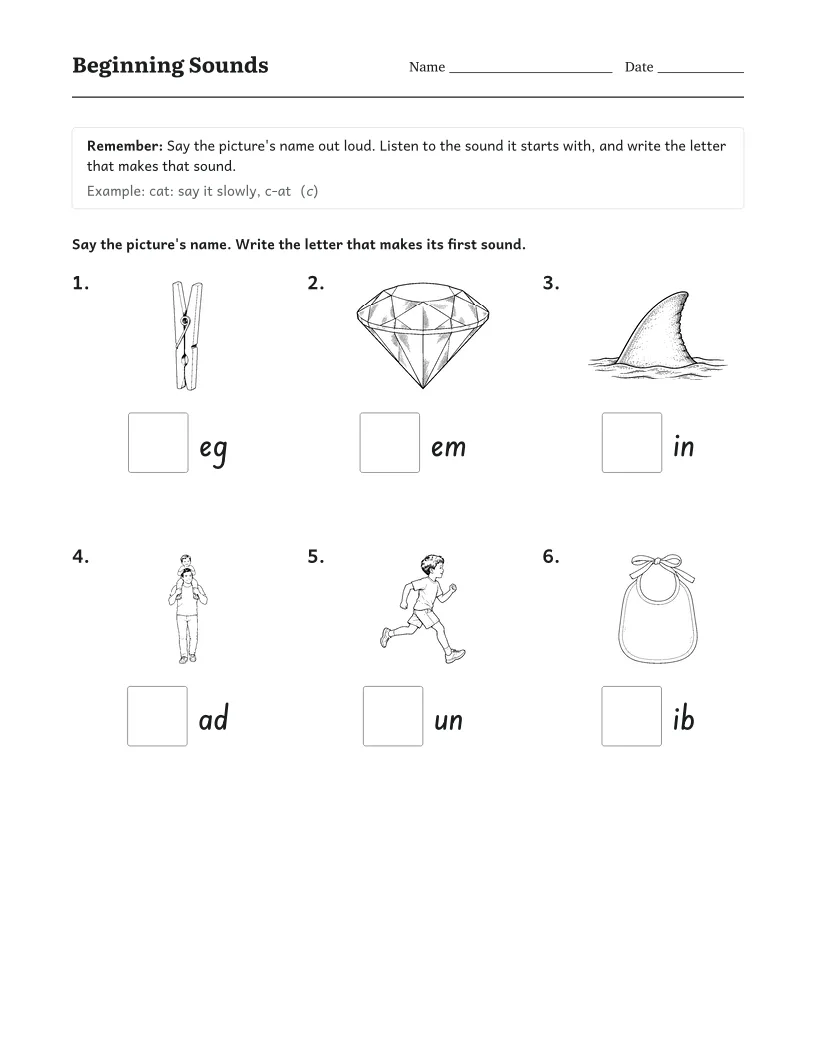
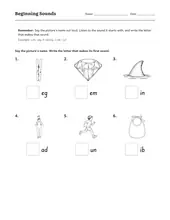
- Beginning sounds, new Say the picture's name out loud. Listen to the sound it starts with, and write the letter that makes that sound.
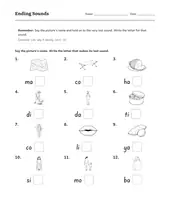
- Ending sounds, new Say the picture's name and hold on to the very last sound. Write the letter for that sound.
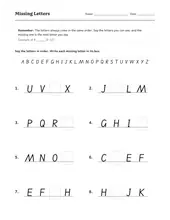
- Missing letters, new The letters always come in the same order. Say the letters you can see, and the missing one is the next letter you say.
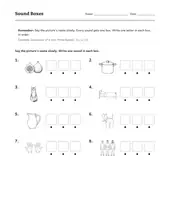
- Sound boxes, new Say the picture's name slowly. Every sound gets one box. Write one letter in each box, in order.
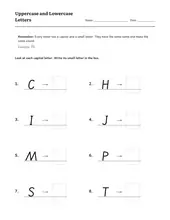
- Uppercase and lowercase letters, new Every letter has a capital and a small letter. They have the same name and make the same sound.
Vowel patterns 8 skills
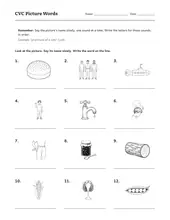
- CVC picture words, new Say the picture's name slowly, one sound at a time. Write the letters for those sounds, in order.
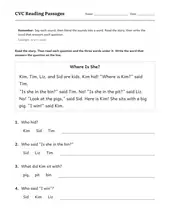
- CVC reading passages, new Say each sound, then blend the sounds into a word. Read the story, then write the word that answers each question.
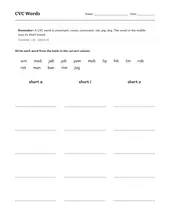
- CVC words A CVC word is consonant, vowel, consonant: cat, pig, dog. The vowel in the middle says its short sound.
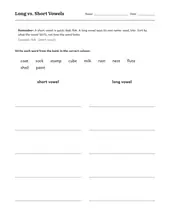
- Long vs. short vowels A short vowel is quick: bed, fish. A long vowel says its own name: seed, kite. Sort by what the vowel SAYS, not how the word looks.
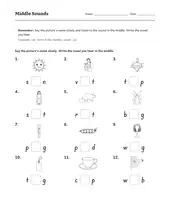
- Middle sounds, new Say the picture's name slowly and listen to the sound in the middle. Write the vowel you hear.
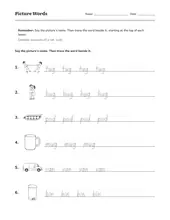
- Picture words Say the picture's name. Then trace the word beside it, starting at the top of each letter.
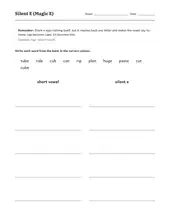
- Silent e (magic e) Silent e says nothing itself, but it reaches back one letter and makes the vowel say its name: cap becomes cape, kit becomes kite.
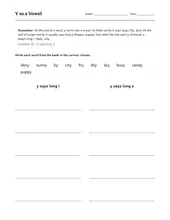
- Y as a vowel At the end of a word, y turns into a vowel. In little words it says long i (fly, sky). At the end of longer words it usually says long e (happy, puppy), but when the last part is stressed, y keeps long i: reply, July.
Diphthongs 2 skills
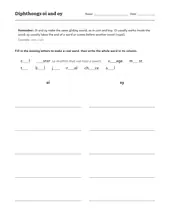
- Diphthongs oi and oy Oi and oy make the same gliding sound, as in coin and boy. Oi usually works inside the word; oy usually takes the end of a word or comes before another vowel (royal).
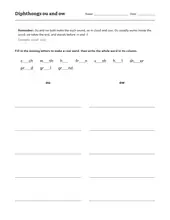
- Diphthongs ou and ow Ou and ow both make the ouch sound, as in cloud and cow. Ou usually works inside the word; ow takes the end, and stands before -n and -l.
Consonant patterns 2 skills
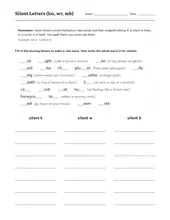
- Silent letters (kn, wr, mb) Some letters wrote themselves into words and then stopped talking. K is silent in knee, w in write, b in lamb. You spell them; you never say them.
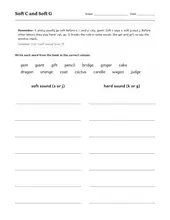
- Soft c and soft g C and g usually go soft before e, i, and y: city, giant. Soft c says s; soft g says j. Before other letters they stay hard: cat, go. G breaks the rule in some words, like get and girl, so say the word to check.
Word endings 2 skills
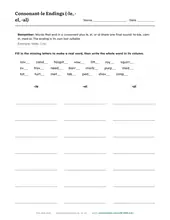
- Consonant-le endings (-le, -el, -al) Words that end in a consonant plus le, el, or al share one final sound: ta-ble, cam-el, med-al. The ending is its own last syllable.
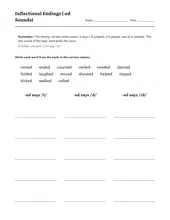
- Inflectional endings (-ed sounds) The ending -ed has three voices: it says t in jumped, d in played, and id in wanted. The last sound of the base word picks the voice.
All English worksheets →
More English topics: Grammar · Sentence structure · Capitalization · Punctuation · Spelling · Vocabulary · Reading comprehension · Handwriting · Writing