Grammar & parts of speech worksheets

Nouns, verbs, adjectives, adverbs, and the rest of the parts of speech.
Nothing in grammar matches that. Search the whole site
Skip past the listNouns 7 skills
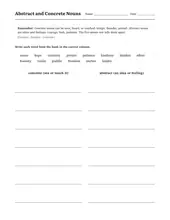
- Abstract and concrete nouns Concrete nouns can be seen, heard, or touched: bridge, thunder, pretzel. Abstract nouns are ideas and feelings: courage, luck, patience. The five-senses test tells them apart.
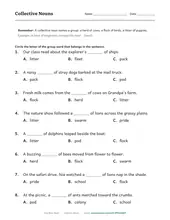
- Collective nouns A collective noun names a group: a herd of cows, a flock of birds, a litter of puppies.
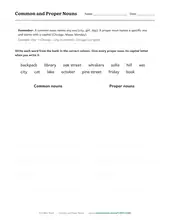
- Common and proper nouns A common noun names any one (city, girl, day). A proper noun names a specific one and starts with a capital (Chicago, Maya, Monday).
- Identifying nouns A noun names a person, a place, a thing, or an animal.
- Irregular plural nouns Some nouns don't add -s for the plural. They change: one mouse, two mice; one foot, two feet.
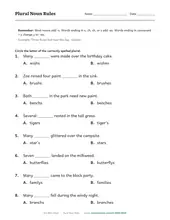
- Plural noun rules Most nouns add -s. Words ending in x, ch, sh, or s add -es. Words ending in consonant + y change y to -ies.
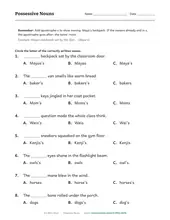
- Possessive nouns Add apostrophe-s to show owning: Maya's backpack. If the owners already end in s, the apostrophe goes after: the twins' room.


Verbs 15 skills
- Action verbs An action verb tells what someone or something does.
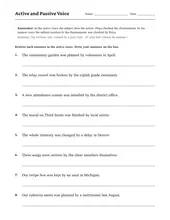
- Active and passive voice In the active voice the subject does the action: Priya checked the thermometer. In the passive voice the subject receives it: the thermometer was checked by Priya.
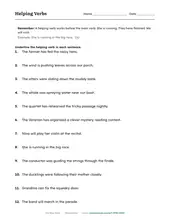
- Helping verbs A helping verb works before the main verb: She is running. They have finished. We will visit.
- Irregular past tense verbs Irregular verbs don't add -ed for the past. They change: go became went, eat became ate.
- Linking verbs A linking verb connects the subject to a word that describes it: The soup smells wonderful.
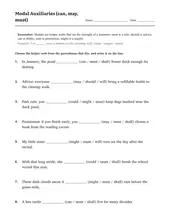
- Modal auxiliaries (can, may, must) Modals are helper verbs that set the strength of a sentence: must is a rule, should is advice, can is ability, may is permission, might is a maybe.
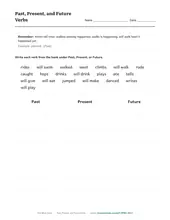
- Past, present, and future verbs Verbs tell time: walked already happened, walks is happening, will walk hasn't happened yet.
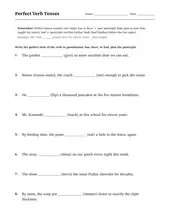
- Perfect verb tenses Perfect tenses connect two times: has or have + past participle links past to now (has taught for years); had + participle reaches further back (had finished before the bus came).
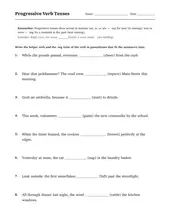
- Progressive verb tenses Progressive tenses show action in motion: am, is, or are + -ing for now (is raining); was or were + -ing for a moment in the past (was raining).
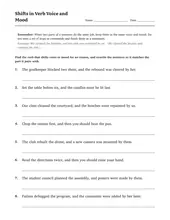
- Shifts in verb voice and mood When two parts of a sentence do the same job, keep them in the same voice and mood. Do not start a set of steps as commands and finish them as a statement.
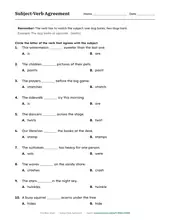
- Subject-verb agreement The verb has to match the subject: one dog barks, two dogs bark.
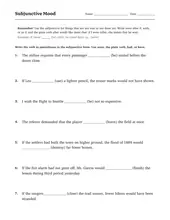
- Subjunctive mood Use the subjunctive for things that are not true or not done yet. Write were after if, wish, or as if, and the plain verb after words like insist that: if I were taller, she insists that he wait.
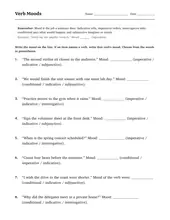
- Verb moods Mood is the job a sentence does. Indicative tells, imperative orders, interrogative asks, conditional says what would happen, and subjunctive imagines or insists.
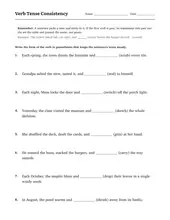
- Verb tense consistency A sentence picks a time and sticks to it. If the first verb is past, its teammates ride past too: she set the table and poured the water, not pours.
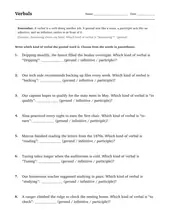
- Verbals A verbal is a verb doing another job. A gerund acts like a noun, a participle acts like an adjective, and an infinitive carries to in front of it.



Adjectives 5 skills
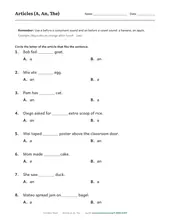
- Articles (a, an, the) Use a before a consonant sound and an before a vowel sound: a banana, an apple.
- Comparative and superlative adjectives Use -er to compare two things and -est to compare three or more: taller of the two, tallest of all.
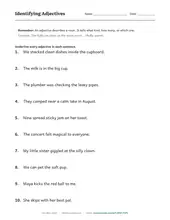
- Identifying adjectives An adjective describes a noun. It tells what kind, how many, or which one.
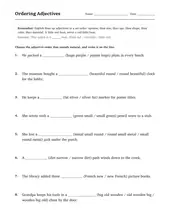
- Ordering adjectives English lines up adjectives in a set order: opinion, then size, then age, then shape, then color, then material. A little red boat, never a red little boat.
- This, that, these, and those This and these point to things close by; that and those point to things far away. This and that are for one; these and those are for more.


Adverbs 5 skills
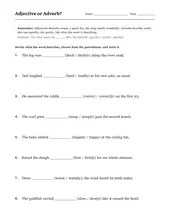
- Adjective or adverb? Adjectives describe nouns: a quick fox, the soup smells wonderful. Adverbs describe verbs: she runs quickly, stir gently. Ask what the word is describing.
- Adverbs of how, when, and where Adverbs answer three questions about an action: how (quietly), when (today), and where (outside).
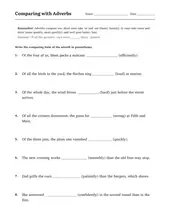
- Comparing with adverbs Adverbs compare too: short ones take -er and -est (faster, fastest); -ly ones take more and most (more quickly, most quickly); and well goes better, best.
- Identifying adverbs An adverb tells how, when, or where something happens.
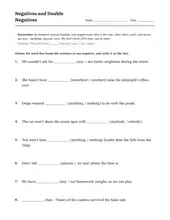
- Negatives and double negatives In standard written English, one negative per idea is the rule. After don't, can't, and never, use any-, anything, anyone, ever: We don't have ANY time, not no time.


Pronouns 9 skills
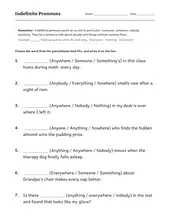
- Indefinite pronouns Indefinite pronouns point at no one in particular: everyone, someone, nobody, anything. They let a sentence talk about people and things without naming them.
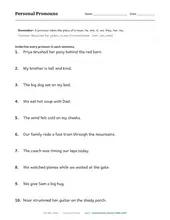
- Personal pronouns A pronoun takes the place of a noun: he, she, it, we, they, her, my.
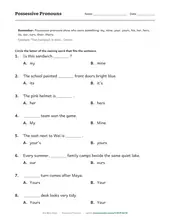
- Possessive pronouns Possessive pronouns show who owns something: my, mine, your, yours, his, her, hers, its, our, ours, their, theirs.
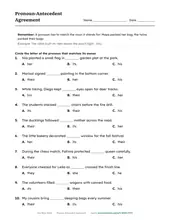
- Pronoun-antecedent agreement A pronoun has to match the noun it stands for: Maya packed her bag, and the twins packed their bags. In school writing, a team acting as one takes its, and each of the girls takes her.
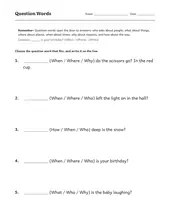
- Question words Question words open the door to answers: who asks about people, what about things, where about places, when about times, why about reasons, and how about the way.
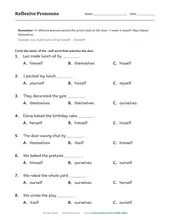
- Reflexive pronouns A reflexive pronoun points the action back at the doer: I made it myself; they helped themselves.
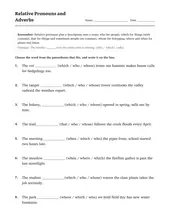
- Relative pronouns and adverbs Relative pronouns glue a description onto a noun: who for people, which for things (with commas), that for things and sometimes people (no commas), whose for belonging, where and when for places and times.
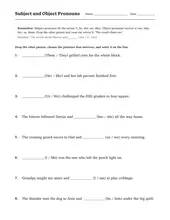
- Subject and object pronouns Subject pronouns do the action: I, he, she, we, they. Object pronouns receive it: me, him, her, us, them. Drop the other person and your ear solves it: 'The coach chose me.'
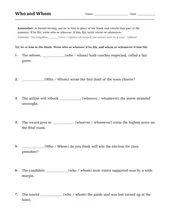
- Who and whom In formal writing, put he or him in place of the blank and rebuild that part of the sentence. If he fits, write who or whoever. If him fits, write whom or whomever.
Prepositions 1 skills
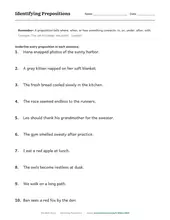
- Identifying prepositions A preposition tells where, when, or how something connects: in, on, under, after, with.
Conjunctions 4 skills
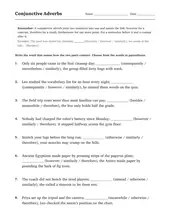
- Conjunctive adverbs A conjunctive adverb joins two sentences into one and names the link: however for a contrast, therefore for a result, furthermore for one more point. Put a semicolon before it and a comma after it.
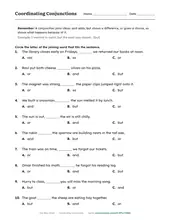
- Coordinating conjunctions A conjunction joins ideas: and adds, but shows a difference, or gives a choice, so shows what happens because of it.
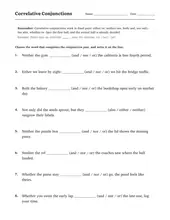
- Correlative conjunctions Correlative conjunctions work in fixed pairs: either/or, neither/nor, both/and, not only/but also, whether/or. Spot the first half, and the second half is already decided.
- Subordinating conjunctions Subordinating conjunctions join a helper idea to a main idea and name the link: because (why), although (surprise), until (time), if (condition).

Interjections 1 skills
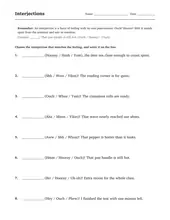
- Interjections An interjection is a burst of feeling with its own punctuation: Ouch! Hooray! Shh! It stands apart from the sentence and sets its emotion.
Mixed parts of speech 3 skills
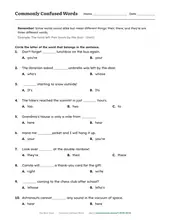
- Commonly confused words Some words sound alike but mean different things: their, there, and they're are three different words.
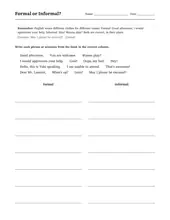
- Formal or informal? English wears different clothes for different rooms. Formal: Good afternoon; I would appreciate your help. Informal: Hey! Wanna play? Both are correct, in their place.
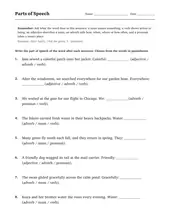
- Parts of speech, new Ask what the word does in this sentence: a noun names something, a verb shows an action or a state of being, an adjective describes a noun, an adverb tells how, when, where or how often, and a pronoun takes the place of a noun.
All English worksheets →
More English topics: Sentence structure · Capitalization · Punctuation · Spelling · Phonics · Vocabulary · Reading comprehension · Handwriting · Writing