Counting & place value worksheets

Counting, number writing, place value, and rounding: how numbers are built and named.
Nothing in counting & place value matches that. Search the whole site
Skip past the listCounting & number sense 21 skills
- Comparing numbers to 10 The open side of < or > always faces the bigger number.
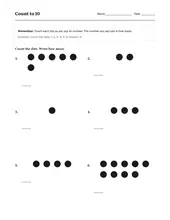
- Counting & number recognition 0–10 Count objects one by one. Say the numbers in order to tell how many.
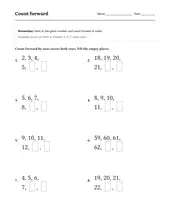
- Counting forward Start at the given number, not at 1. Each blank is one more than the number before it.
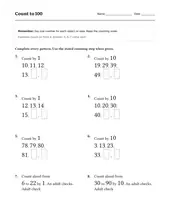
- Counting to 100 Count by ones or by tens. Say each number in order, and the blank is the next one you say.
- Counting to 120 The next number is always one more. Use the numbers around the blank to help.
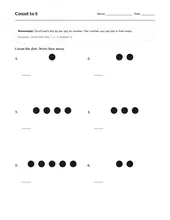
- Counting to 5 Touch each dot and say the numbers in order. The last number you say is how many.
- Greater than, less than Compare the biggest place first: the open side of the symbol faces the bigger number.
- Ordering numbers Compare the numbers place by place, then write them in the order asked.
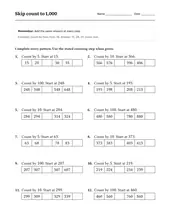
- Skip counting to 1,000 Find the step first: does the row go up by 5, by 10, or by 100? Then keep that step for every blank.
- Skip counting to 100 Skip count by 2s, 5s, or 10s to find the missing number.
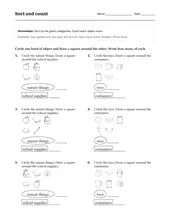
- Sort and count Sort first, then count. Decide which group each thing belongs to before you count how many are in each group.
- Teen numbers 11–20 A teen number is one full ten and some extra ones.
- Writing numbers 0–20 Start each number at the top, and go slow. Neat beats fast.
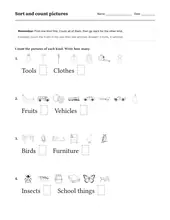
- Sort and count pictures, new Count the pictures of each kind. Write how many.
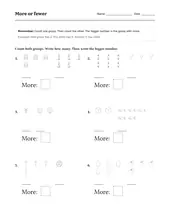
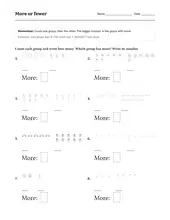
- More or fewer, new Count each group. Write how many. Which group has more?
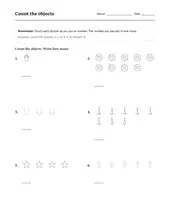
- Count the objects Count the objects. Write how many.
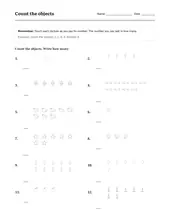
- Count the objects, new Count the objects. Write how many.
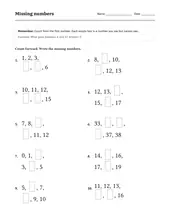
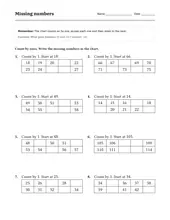
- Missing numbers, new Count forward. Write the missing numbers.
- Missing numbers, new Count by ones. Write the missing numbers in the chart.
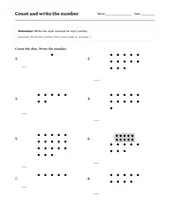
- Count and write the number Count the dots. Write the number.
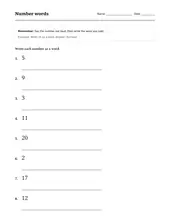
- Number words, new Write each number as a word.






Place value & rounding 10 skills
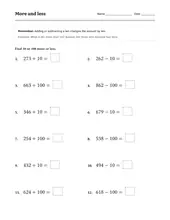
- 10 or 100 more or less Ten more or less moves the tens digit. One hundred more or less moves the hundreds digit. The other digits stay put.
- Expanded form Expanded form stretches a number out to show what each digit is worth, like 358 = 300 + 50 + 8.
- Hundreds, tens & ones A 3-digit number is made of hundreds, tens, and ones. Count each kind, then write the digits in order.
- Place value & rounding to 1,000,000 Know the value of each digit. Round numbers to a given place.
- Place value to thousands The place tells the value: the same digit 7 can be worth 7, 70, 700, or 7,000 depending on where it sits.
- Powers of 10 The exponent counts the tens: 10^3 means 10 × 10 × 10. Multiplying shifts digits left; dividing shifts them right.
- Rounding to the nearest 10 and 100 Look at the digit one place to the right: 5 or more rounds up, 4 or less rounds down.
- Ten more, ten less Only the tens digit changes: ten more is one ten up, ten less is one ten down.
- Tens & ones Count the tens first, then the ones. The tens digit is written first.
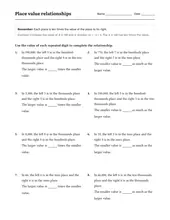
- Place value relationships Use the value of each repeated digit to complete the relationship.


All math worksheets →
More math topics: Addition & subtraction · Multiplication & division · Word problems · Factors & patterns · Fractions · Decimals · Ratios & percents · Expressions & equations · Shapes & angles · Area & volume · Measurement · Data & graphing