Vocabulary worksheets

Synonyms, antonyms, word parts, and words with more than one meaning.
Nothing in vocabulary matches that. Search the whole site
Skip past the listWord relationships 13 skills
- Analogies An analogy is a word puzzle in two pairs: work out how the first pair fits together, then finish the second pair the very same way.
- Antonyms Antonyms are opposites: hot and cold, up and down, open and closed.
- Compound words A compound word is two words joined into one new meaning: sun + flower = sunflower.
- Connotation and denotation Denotation is a word's dictionary meaning. Connotation is its glow. Slender and scrawny both mean thin; one compliments, one insults.
- Dictionary guide words Guide words are the first and last words on a dictionary page. A word lives on that page only if it fits between them alphabetically.
- Homophones Homophones are words that sound exactly alike but are spelled differently and mean different things: sea and see, bear and bare. The sentence tells you which one belongs.
- Multiple-meaning words Some words carry more than one meaning: a bat flies at night, and a bat hits a baseball. The rest of the sentence tells you which meaning is on duty.
- Opposites, new Two pictures, one word written. The second picture shows the opposite, and its word is in the bank.
- Picture compound words, new Name both pictures, then push the two words together. The word you get is the compound word.
- Shades of meaning Words come in strengths. Glad is a birthday card; thrilled is fireworks. Sorting everyday words from their stronger cousins tunes your word volume knob.
- Spatial and time-order words Some words place things in space: beside, beneath, between. Others place events in time: during, until, meanwhile. Writers steer with both.
- Synonyms Synonyms are words that mean almost the same thing: happy and glad, big and large.
- Word sorts (categories) Sorting words into groups, animals here, foods there, is thinking made visible. Every word belongs somewhere, and saying why is the real work.



Prefixes and suffixes 9 skills
- Absorbed prefixes (im-, il-, ir-) The prefix in- changes its skin to match the word it joins: im- before m and p (impossible), il- before l (illegal), ir- before r (irregular). Usually it means not; sometimes it means in or into (illuminate).
- Number prefixes (uni-, bi-, tri-) Some prefixes are numbers in disguise: uni- means one, bi- means two, tri- means three. A tricycle is a three-wheeler by name.
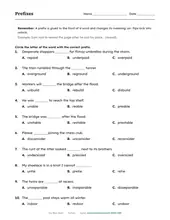
- Prefixes A prefix is glued to the front of a word and changes its meaning: un- flips lock into unlock.
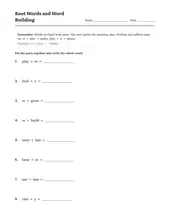
- Root words and word building Words are built from parts. The root carries the meaning: play. Prefixes and suffixes snap on: re + play = replay, play + er = player.
- Suffixes A suffix is glued to the end of a word and changes its job: care becomes careful, careless, or carefully.
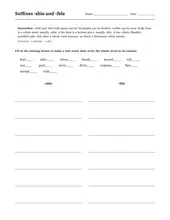
- Suffixes -able and -ible -able and -ible both mean can-be: breakable can be broken, visible can be seen. If the base is a whole word, usually -able; if the base is a broken piece, usually -ible. A few rebels (flexible, sensible) take -ible after a whole word anyway, so check a dictionary when unsure.
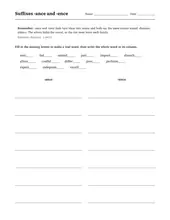
- Suffixes -ance and -ence -ance and -ence both turn ideas into nouns and both say the same unsure sound: distance, silence. The schwa hides the vowel, so the eye must learn each family.
- Suffixes -ive and -ize -ive builds describing words: act becomes active. -ize builds doing words: final becomes finalize. One suffix makes adjectives, the other makes verbs.
- Suffixes -tion and -sion -tion and -sion both turn actions into things: act becomes action, decide becomes decision. -tion usually says shun. -sion says shun in mission but zhun in vision. The base word picks the spelling.

Greek and Latin roots 1 skills
- Greek and Latin roots Old Greek and Latin word parts hide inside big English words: tele means far, so telescope, telephone, and television all reach across distance.

Figurative language 9 skills
- Adages and proverbs A proverb is a small sentence carrying old advice: the early bird catches the worm. The situation around it tells you which saying fits.
- Allusion An allusion is a quick nod to a story, a myth, or a famous moment. The writer expects you to catch it without being told.
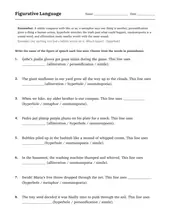
- Figurative language, new A simile compares with like or as, a metaphor says one thing is another, personification gives a thing a human action, hyperbole stretches the truth, an idiom is a saying with its own meaning, onomatopoeia is a sound word, and alliteration repeats a first sound.
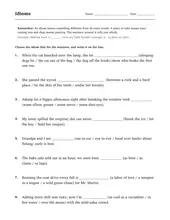
- Idioms An idiom means something different from its exact words. A piece of cake means easy; raining cats and dogs means pouring. The sentence around it tells you which.
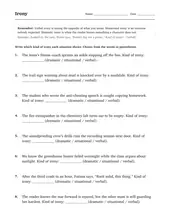
- Irony Verbal irony is saying the opposite of what you mean. Situational irony is an outcome nobody expected. Dramatic irony is when the reader knows something a character does not.
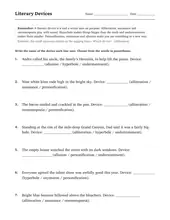
- Literary devices A literary device is a tool a writer uses on purpose. Alliteration, assonance and onomatopoeia play with sound. Hyperbole makes things bigger than the truth and understatement makes them smaller. Personification, oxymoron and allusion make you see something in a new way.
- Personification and hyperbole Personification gives human actions to things: the wind whispered. Hyperbole exaggerates on purpose: I've told you a million times.
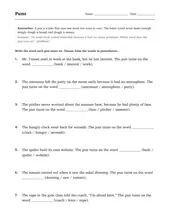
- Puns A pun is a joke that uses one word two ways at once. The baker could never make enough dough: dough is bread, and dough is money.
- Similes and metaphors A simile compares with like or as: brave as a lion. A metaphor says one thing IS another: the classroom was a zoo.


Context clues 1 skills
- Context clues The sentence around a hard word usually hides its meaning. Read past the word, find the clue, then decide: The arid desert had not seen rain for months, so arid must mean very dry.

Word meanings, new 5 skills
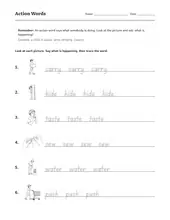
- Action words An action word says what somebody is doing. Look at the picture and ask: what is happening?
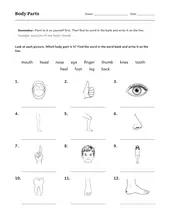
- Body parts Point to it on yourself first. Then find its word in the bank and write it on the line.
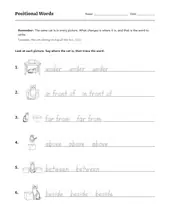
- Positional words The same cat is in every picture. What changes is where it is, and that is the word to write.
- Shape names Every shape has a name. Look at its sides and corners, say its name, then write it.
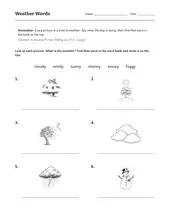
- Weather words Every picture is a kind of weather. Say what the day is doing, then find that word in the bank at the top.

All English worksheets →
More English topics: Grammar · Sentence structure · Capitalization · Punctuation · Spelling · Phonics · Reading comprehension · Handwriting · Writing