Math worksheets
Every math skill we teach, Pre-K–8, one sheet each, free with its answer key. Pick a grade to print, or filter for a skill.
Nothing in math matches that. Search the whole site
Skip past the listCounting & place value 31 skills
Counting & number sense
- Comparing numbers to 10 The open side of < or > always faces the bigger number.
- Counting & number recognition 0–10 Count objects one by one. Say the numbers in order to tell how many.
- Counting forward Start at the given number, not at 1. Each blank is one more than the number before it.
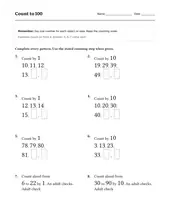
- Counting to 100 Count by ones or by tens. Say each number in order, and the blank is the next one you say.
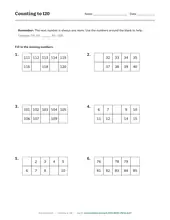
- Counting to 120 The next number is always one more. Use the numbers around the blank to help.
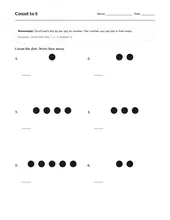
- Counting to 5 Touch each dot and say the numbers in order. The last number you say is how many.
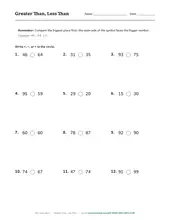
- Greater than, less than Compare the biggest place first: the open side of the symbol faces the bigger number.
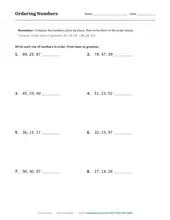
- Ordering numbers Compare the numbers place by place, then write them in the order asked.
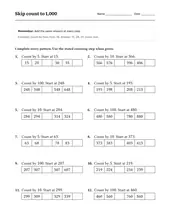
- Skip counting to 1,000 Find the step first: does the row go up by 5, by 10, or by 100? Then keep that step for every blank.
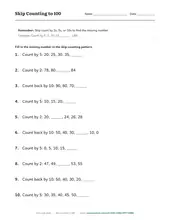
- Skip counting to 100 Skip count by 2s, 5s, or 10s to find the missing number.
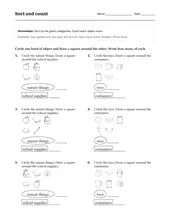
- Sort and count Sort first, then count. Decide which group each thing belongs to before you count how many are in each group.
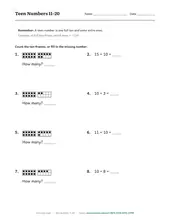
- Teen numbers 11–20 A teen number is one full ten and some extra ones.
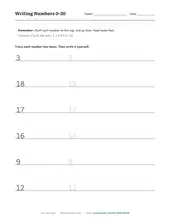
- Writing numbers 0–20 Start each number at the top, and go slow. Neat beats fast.
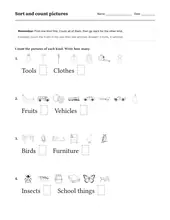
- Sort and count pictures Count the pictures of each kind. Write how many.
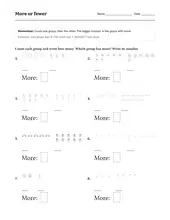
- More or fewer Count each group. Write how many. Which group has more?
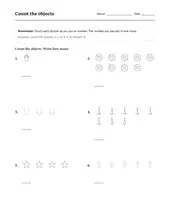
- Count the objects Count the objects. Write how many.
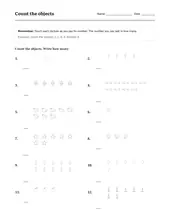
- Count the objects Count the objects. Write how many.
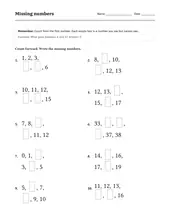
- Missing numbers, new Count forward. Write the missing numbers.
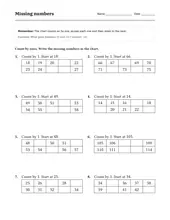
- Missing numbers, new Count by ones. Write the missing numbers in the chart.
- Count and write the number Count the dots. Write the number.
- Number words, new Write each number as a word.
Place value & rounding
- 10 or 100 more or less Ten more or less moves the tens digit. One hundred more or less moves the hundreds digit. The other digits stay put.
- Expanded form Expanded form stretches a number out to show what each digit is worth, like 358 = 300 + 50 + 8.
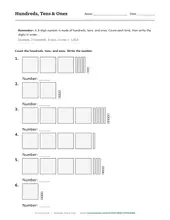
- Hundreds, tens & ones A 3-digit number is made of hundreds, tens, and ones. Count each kind, then write the digits in order.
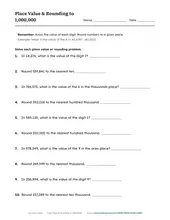
- Place value & rounding to 1,000,000 Know the value of each digit. Round numbers to a given place.
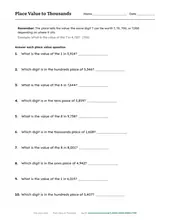
- Place value to thousands The place tells the value: the same digit 7 can be worth 7, 70, 700, or 7,000 depending on where it sits.
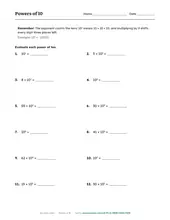
- Powers of 10 The exponent counts the tens: 10^3 means 10 × 10 × 10. Multiplying shifts digits left; dividing shifts them right.
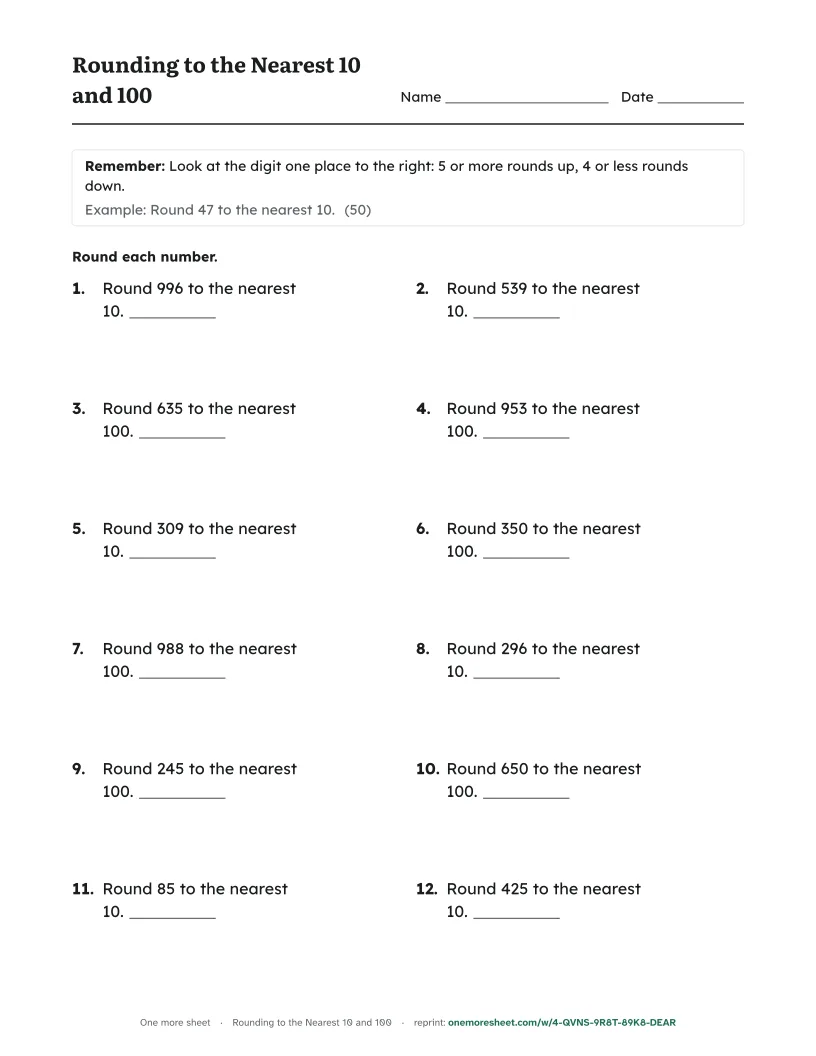
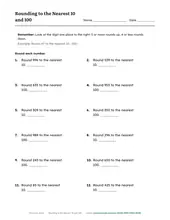
- Rounding to the nearest 10 and 100 Look at the digit one place to the right: 5 or more rounds up, 4 or less rounds down.
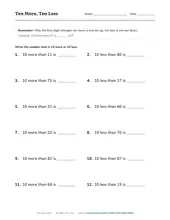
- Ten more, ten less Only the tens digit changes: ten more is one ten up, ten less is one ten down.
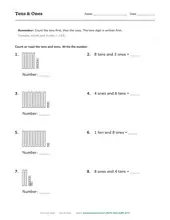
- Tens & ones Count the tens first, then the ones. The tens digit is written first.
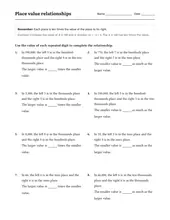
- Place value relationships Use the value of each repeated digit to complete the relationship.
Addition & subtraction 22 skills
Facts & fluency
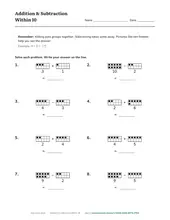
- Addition & subtraction within 10 Adding puts groups together. Subtracting takes some away. Pictures like ten-frames help you see the answer.
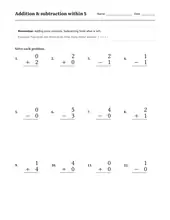
- Addition & subtraction within 5 Plus joins numbers. Minus tells how many are left after some are taken away. Learn the small facts so you can answer without counting each time.
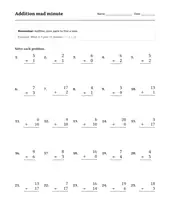
- Addition mad minute Work fast and left to right. Skip a hard one and come back; the clock does not wait.
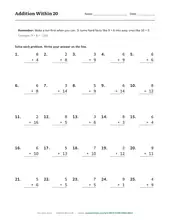
- Addition within 20 Make a ten first when you can. It turns hard facts like 9 + 6 into easy ones like 10 + 5.
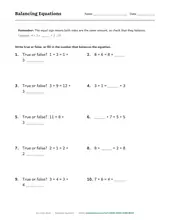
- Balancing equations The equal sign means both sides are the same amount, so check that they balance.
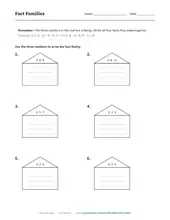
- Fact families The three numbers in the roof are a family. Write all four facts they make together.
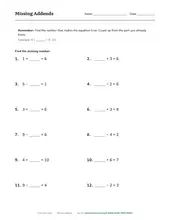
- Missing addends Find the number that makes the equation true. Count up from the part you already know.
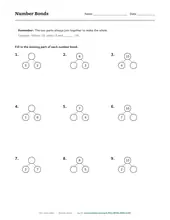
- Number bonds The two parts always join together to make the whole.
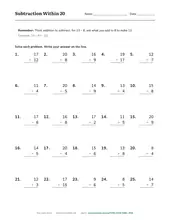
- Subtraction within 20 Think addition to subtract: for 13 − 8, ask what you add to 8 to make 13.
Multi-digit addition & subtraction
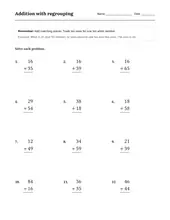
- Addition with regrouping Add the ones first. When they make ten or more, write the ones digit and carry the ten to the next column.
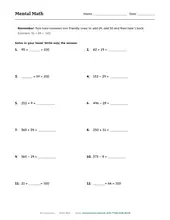
- Mental math Turn hard numbers into friendly ones: to add 29, add 30 and then take 1 back.
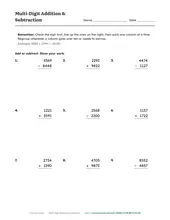
- Multi-digit addition & subtraction Check the sign first, line up the ones on the right, then work one column at a time. Regroup whenever a column goes over ten or needs to borrow.
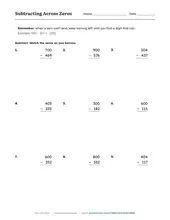
- Subtracting across zeros When a zero can't lend, keep moving left until you find a digit that can.
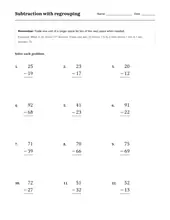
- Subtraction with regrouping If the top digit is smaller, borrow: take one ten from the next column and add ten to the digit you are subtracting from.
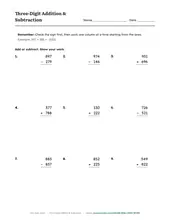
- Three-digit addition & subtraction Check the sign first, then work one column at a time starting from the ones.
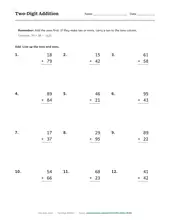
- Two-digit addition Add the ones first. If they make ten or more, carry a ten to the tens column.
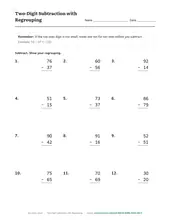
- Two-digit subtraction with regrouping If the top ones digit is too small, trade one ten for ten ones before you subtract.
Signed addition and subtraction
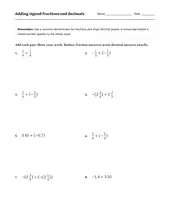
- Adding signed fractions and decimals Use a common denominator for fractions and align decimal places. A minus sign before a mixed number applies to the whole value.
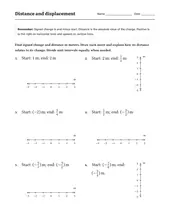
- Distance and displacement Signed change is end minus start. Distance is the absolute value of the change.
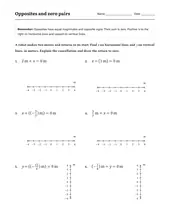
- Opposites and zero pairs Opposites have equal magnitudes and opposite signs. Their sum is zero.
- Signed addition on number lines Start + change = end. Positive change moves right or up; negative change moves left or down.
- Subtracting signed fractions and decimals Keep the first number and add the opposite of the second. A minus sign before a mixed number applies to the whole value.
Multiplication & division 29 skills
Multiplication
- 10 times table Ten times a number is the number with a 0 on the end.
- 11 times table Eleven times a single digit repeats the digit: 11 × 4 = 44. For 11 and 12, add the number to ten times itself.
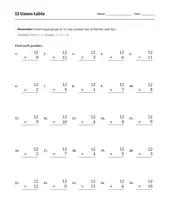
- 12 times table Twelve times a number is ten times the number plus two times the number.
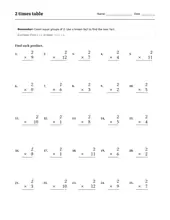
- 2 times table The 2 times table is doubling. Two times a number is the number plus itself.
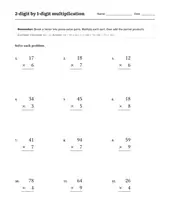
- 2-digit by 1-digit multiplication Multiply the ones first, carry if you need to, then multiply the tens and add the carry.
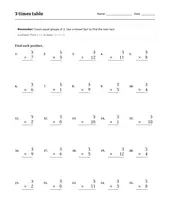
- 3 times table Three times a number is the number added three times. Count by threes: 3, 6, 9, 12.
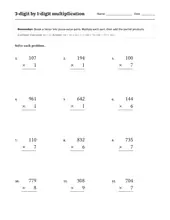
- 3-digit by 1-digit multiplication Multiply each digit by the single digit, right to left, carrying as you go.
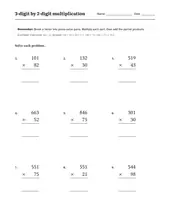
- 3-digit by 2-digit multiplication Multiply by the ones digit, then by the tens digit on a second line shifted left. Add the two lines.
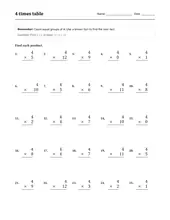
- 4 times table Four times a number is double, then double again.
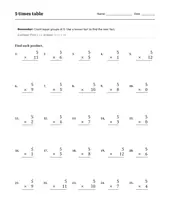
- 5 times table Five times a number ends in 0 or 5. Count by fives, or take half of ten times the number.
- 6 times table Six times a number is the 5s fact plus one more of the number. For even numbers, the answer ends in the same digit you started with.
- 7 times table The 7s have no shortcut, so learn them as facts. Remember 5, 6, 7, 8: 56 = 7 × 8.
- 8 times table Eight times a number is double, double, double.
- 9 times table Nine times a number: the tens digit is one less than the number, and the two digits add up to 9.
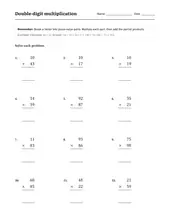
- Double-digit multiplication Multiply by the ones digit, then by the tens digit on a new line shifted one place left. Add the two lines.
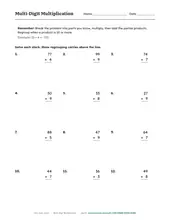
- Multi-digit multiplication Break the problem into parts you know, multiply, then add the partial products. Regroup when a product is 10 or more.
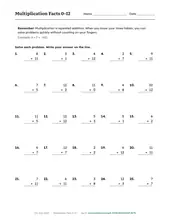
- Multiplication facts 0–12 Multiplication is repeated addition. When you know your times tables, you can solve problems quickly without counting on your fingers.
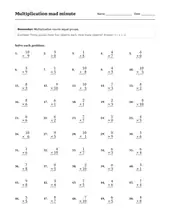
- Multiplication mad minute Answer fast and in order. Skip one you are stuck on and come back at the end.
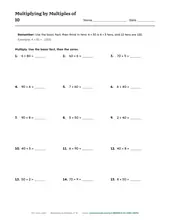
- Multiplying by multiples of 10 Use the basic fact, then think in tens: 4 × 30 is 4 × 3 tens, and 12 tens are 120.
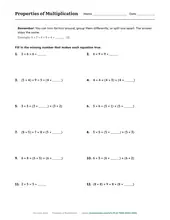
- Properties of multiplication You can turn factors around, group them differently, or split one apart. The answer stays the same.
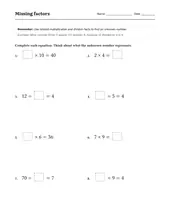
- Missing factors Complete each equation. Think about what the unknown number represents.
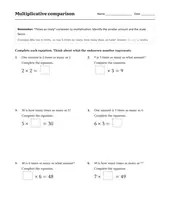
- Multiplicative comparison Complete each equation. Think about what the unknown number represents.
Division
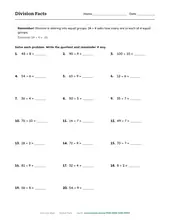
- Division facts Division is sharing into equal groups. When there are leftovers we call them remainders.
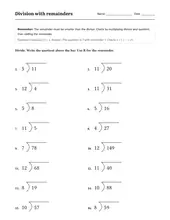
- Division with remainders Find the biggest fact that fits, then say what is left over. The leftover must be smaller than the number you divided by.
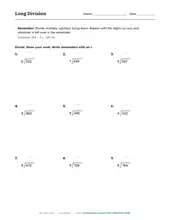
- Long division Divide, multiply, subtract, bring down. Repeat until the digits run out, and whatever is left over is the remainder.
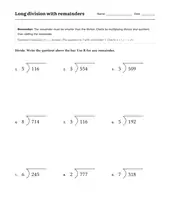
- Long division with remainders Divide, multiply, subtract, bring down. When nothing is left to bring down, what remains is the remainder: write it as r.
- Long division with two-digit divisors Estimate first: round the divisor to a friendly number like 20, guess the quotient digit, then multiply to check and adjust.
- Long division without remainders Divide, multiply, subtract, bring down. Repeat until nothing is left to bring down. Every answer here comes out even.
Mixed operations
- Mixed operations review Read the sign before you touch the numbers. Every problem on this page could be add, subtract, multiply, or divide.
Word problems 24 skills
Addition & subtraction stories
- Addition & subtraction word problems Read the whole story before you pick a sign. Does it put amounts together, or take some away?
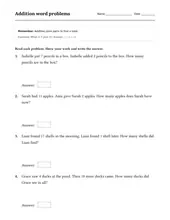
- Addition word problems Read the whole story, then find the question. If groups are coming together, add.
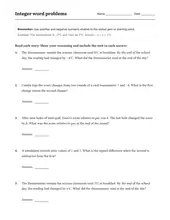
- Integer word problems Below zero is negative, above zero is positive. Adding a negative moves you down the number line; to find how far apart two values are, subtract them in the order the question says.
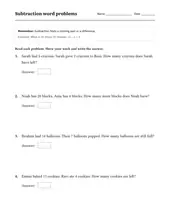
- Subtraction word problems Read the story and find the question. If something goes away, or two amounts get compared, subtract.
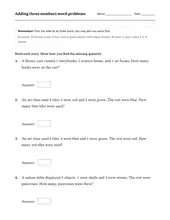
- Adding three numbers word problems Read each story. Show how you find the missing quantity.
- Two-step word problems Read each story. Show how you find the missing quantity.
Multiplication & division stories
- Division word problems Look for a total being split into equal parts. Sharing fairly or making equal groups means divide.
- Mixed operations word problems Read the whole story, find the question, and name the operation before you touch the numbers. Any of the four can show up.
- Multiplication word problems Look for equal groups in the story. Same-size groups, counted in one move: that is multiplication.
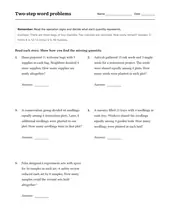
- Two-step word problems Read each story. Show how you find the missing quantity.
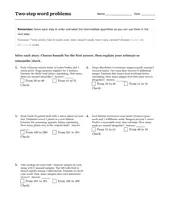
- Two-step word problems Solve each story. Choose bounds for the first answer, then explain your estimate or remainder check.
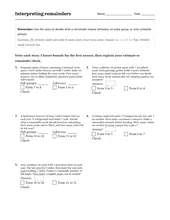
- Interpreting remainders Solve each story. Choose bounds for the first answer, then explain your estimate or remainder check.
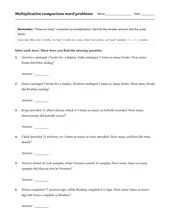
- Multiplicative comparison word problems Solve each story. Choose bounds for the first answer, then explain your estimate or remainder check.
Money & time stories
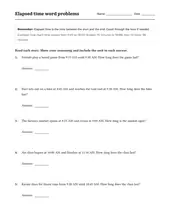
- Elapsed time word problems Find the times in the story, then count up from the earlier one. Jump to the next o'clock first, then add the extra minutes.
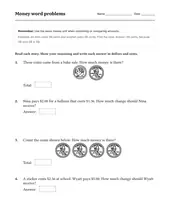
- Money word problems Count the coins from the biggest value down. When the story asks for change, start at the cost and count up.
Measurement & geometry stories
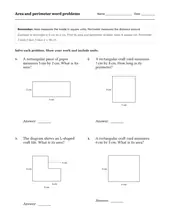
- Area & perimeter word problems Decide what the story asks for first. Covering the inside is area. Going around the edge is perimeter.
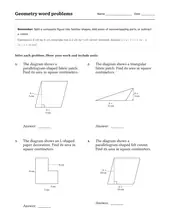
- Geometry word problems Parallelogram area is base times height. A triangle is half of that. An L-shape splits into rectangles, or subtract the missing corner from the big rectangle.
- Measurement word problems Look for the units in the story. Your answer needs a unit too, so write it every time.
- Volume word problems Volume of a box is length times width times height. Multiply two sides to get the base layer, then count how many layers tall.
Fraction stories
- Fraction word problems When the pieces are the same size, add or subtract the tops and keep the bottom. To find a fraction of a number, divide by the bottom first.
Decimal, percent & ratio stories
- Decimal word problems Line up the decimal points before adding or subtracting. When you multiply or divide, do the whole-number math first, then place the decimal point last.
- Percent word problems Percent means out of 100. To find a percent of a number, turn the percent into hundredths and multiply, or find 10% first and build from there.
- Ratio word problems A ratio compares two quantities that grow together. Find what one unit is worth, or find what both sides were multiplied by, and the missing number follows.
Data & statistics stories
- Mean, median & mode word problems Mean is the total shared out evenly. Median is the middle of the sorted list. Mode is the most common value, and range is the biggest minus the smallest.
Factors & patterns 6 skills
- Even & odd numbers Even numbers split into pairs with none left over. Check the ones digit: 0, 2, 4, 6, and 8 mean even.
- Factors & multiples Factors divide a number with nothing left over; multiples are what you get when you count by that number. Factors fit inside, multiples grow past.
- GCF & LCM The GCF is the biggest number that divides into both numbers, and the LCM is the smallest number they both divide into.
- Input-output tables One table, one rule: whatever the rule does to the first number, it does to every number.
- Number patterns Find what changes from one number to the next. That rule tells you what comes after.
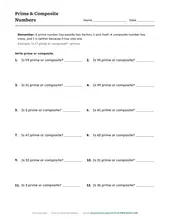
- Prime & composite numbers A prime number has exactly two factors, 1 and itself. A composite number has more, and 1 is neither because it has only one.
Fractions 19 skills
Understanding fractions
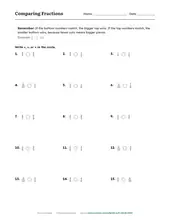
- Comparing fractions If the bottom numbers match, the bigger top wins. If the top numbers match, the smaller bottom wins, because fewer cuts means bigger pieces.
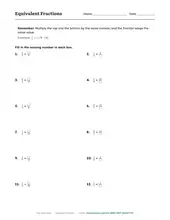
- Equivalent fractions Multiply the top and the bottom by the same number, and the fraction keeps the same value.
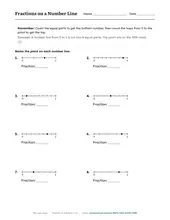
- Fractions on a number line Count the equal parts to get the bottom number, then count the hops from 0 to the point to get the top.
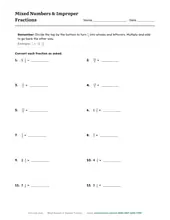
- Mixed numbers & improper fractions Divide the top by the bottom to turn 7/4 into wholes and leftovers. Multiply and add to go back the other way.
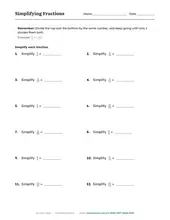
- Simplifying fractions Divide the top and the bottom by the same number, and keep going until only 1 divides them both.
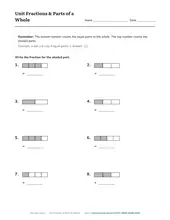
- Unit fractions & parts of a whole The bottom number counts the equal parts in the whole. The top number counts the shaded parts.
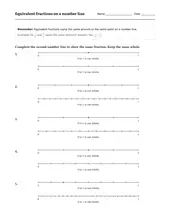
- Equivalent fractions on a number line Complete each problem. Use the models and show your reasoning where asked.
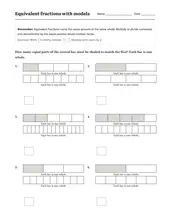
- Equivalent fractions with models Complete each problem. Use the models and show your reasoning where asked.
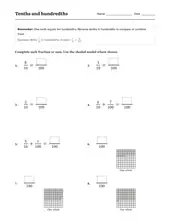
- Tenths and hundredths Complete each problem. Use the models and show your reasoning where asked.
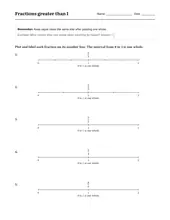
- Fractions greater than 1 Complete each problem. Use the models and show your reasoning where asked.
Fraction operations
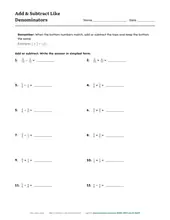
- Add & subtract like denominators When the bottom numbers match, add or subtract the tops and keep the bottom the same.
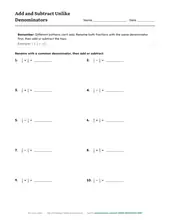
- Add and subtract unlike denominators Different bottoms can't add. Rename both fractions with the same denominator first, then add or subtract the tops.
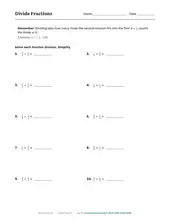
- Divide fractions If a mixed number appears, change it to an improper fraction first. Then ask how many times the second amount fits into the first.
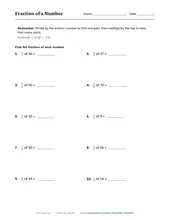
- Fraction of a number Divide by the bottom number to find one part, then multiply by the top to take that many parts.
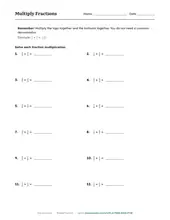
- Multiply fractions Change mixed numbers to improper fractions first. Then multiply the tops, multiply the bottoms, and simplify.
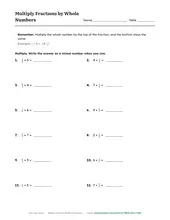
- Multiply fractions by whole numbers Multiply the whole number by the top of the fraction, and the bottom stays the same.
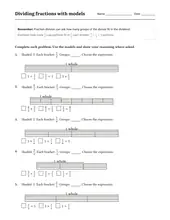
- Dividing fractions with models Complete each problem. Use the models and show your reasoning where asked.
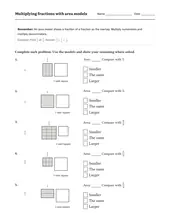
- Multiplying fractions with area models Complete each problem. Use the models and show your reasoning where asked.
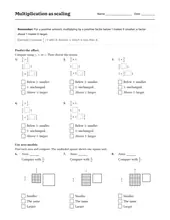
- Multiplication as scaling Complete each problem. Use the models and show your reasoning where asked.
Decimals 8 skills
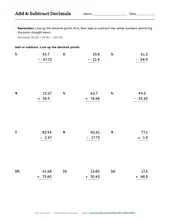
- Add & subtract decimals Line up the decimal points first, then add or subtract like whole numbers and bring the point straight down.
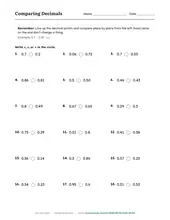
- Comparing decimals Line up the decimal points and compare place by place from the left. Extra zeros on the end don't change a thing.
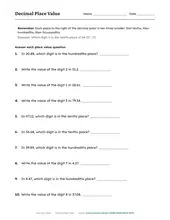
- Decimal place value Each place to the right of the decimal point is ten times smaller: first tenths, then hundredths, then thousandths.
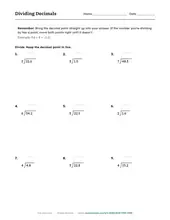
- Dividing decimals Bring the decimal point straight up into your answer. If the number you're dividing by has a point, move both points right until it doesn't.
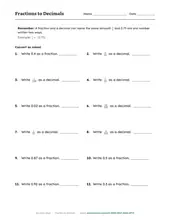
- Fractions to decimals A fraction and a decimal can name the same amount: 3/4 and 0.75 are one number written two ways.
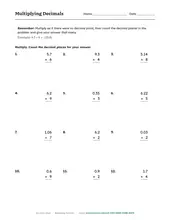
- Multiplying decimals Multiply as if there were no decimal point, then count the decimal places in the problem and give your answer that many.
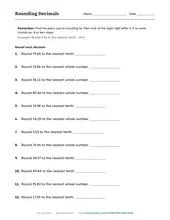
- Rounding decimals Find the place you're rounding to, then look at the digit right after it: 5 or more rounds up, 4 or less stays.
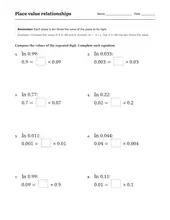
- Place value relationships Compare the values of the repeated digit. Complete each equation.
Ratios & percents 13 skills
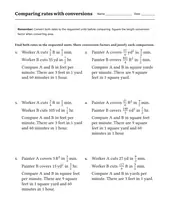
- Comparing rates with conversions Convert both rates to the same units. Square the length conversion factor for area, and check the direction of each conversion.
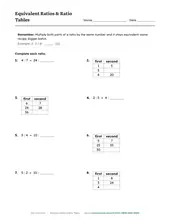
- Equivalent ratios & ratio tables Multiply both parts of a ratio by the same number and it stays equivalent: same recipe, bigger batch.
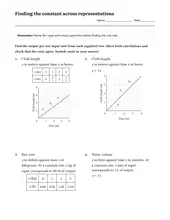
- Finding the constant across representations Divide output by input to find the unit rate. Check that both supplied views give the same rate.
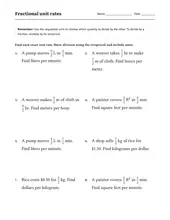
- Fractional unit rates Use the requested units to decide which quantity to divide by which. Multiply by the reciprocal and keep the units.
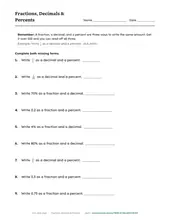
- Fractions, decimals & percents A fraction, a decimal, and a percent are three ways to write the same amount. Get it over 100 and you can read off all three.
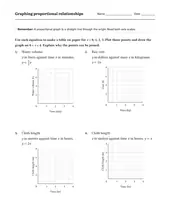
- Graphing proportional relationships A proportional graph is a straight line through the origin. Read each coordinate using its axis label.
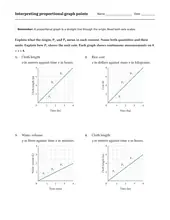
- Interpreting proportional graph points A proportional graph is a straight line through the origin. Read each coordinate using its axis label.
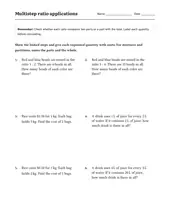
- Multistep ratio applications Keep each quantity attached to its units. A ratio between two parts uses a different base from a part of the whole.
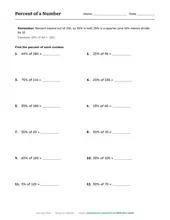
- Percent of a number Percent means out of 100, so 50% is half, 25% is a quarter, and 10% means divide by 10.
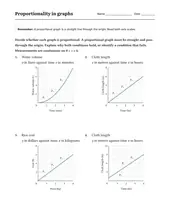
- Proportionality in graphs A proportional graph is a straight line through the origin. Read each coordinate using its axis label.
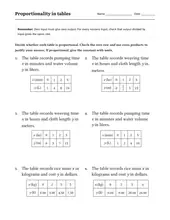
- Proportionality in tables Check that zero input gives zero output, then compare cross products of the nonzero pairs.
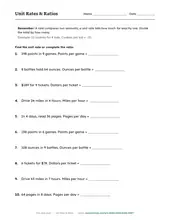
- Unit rates & ratios A rate compares two amounts; a unit rate tells how much for exactly one. Divide the total by how many.
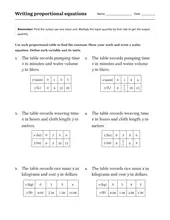
- Writing proportional equations Find the output per one input unit. Multiply the input quantity by that rate to get the output quantity.
Expressions & equations 36 skills
Integers
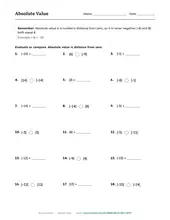
- Absolute value Absolute value is a number's distance from zero, so it is never negative: |-8| and |8| both equal 8.
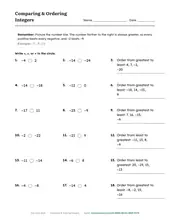
- Comparing & ordering integers Picture the number line. The number farther to the right is always greater, so every positive beats every negative, and −2 beats −9.
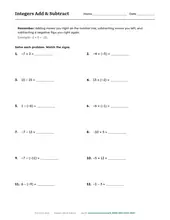
- Integers add & subtract Adding moves you right on the number line, subtracting moves you left, and subtracting a negative flips you right again.
Expressions & equations
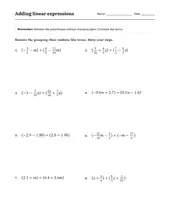
- Adding linear expressions Remove the parentheses without changing signs. Combine like terms.
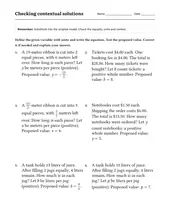
- Checking contextual solutions Substitute into the original model. A solution must make it true and fit the quantity and its units.
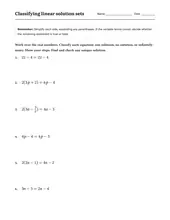
- Classifying linear solution sets Collect like terms on each side, then collect variable terms. A false constant equation means no solution; a true one means every real value is a solution.
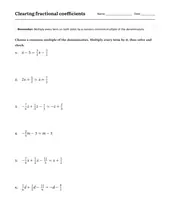
- Clearing fractional coefficients Multiply every term on both sides by a nonzero common multiple of the denominators.
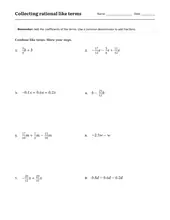
- Collecting rational like terms Add the coefficients of like terms. Use a common denominator to add fractions.
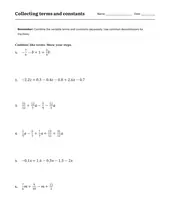
- Collecting terms and constants Combine the variable terms and constants separately. Use common denominators for fractions.
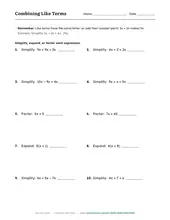
- Combining like terms Like terms have the same letter, so add their number parts: 3x + 2x makes 5x.
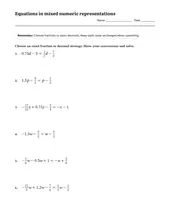
- Equations in mixed numeric representations Choose fractions or exact decimals. Keep each value unchanged when converting.
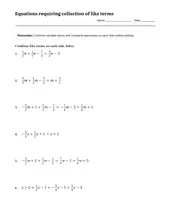
- Equations requiring collection of like terms Combine variable terms and constants separately on each side before solving.
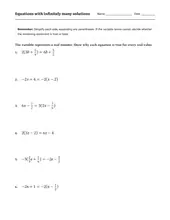
- Equations with infinitely many solutions Collect like terms on each side, then collect variable terms. A false constant equation means no solution; a true one means every real value is a solution.
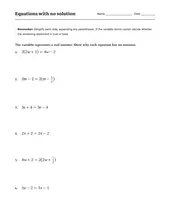
- Equations with no solution Collect like terms on each side, then collect variable terms. A false constant equation means no solution; a true one means every real value is a solution.
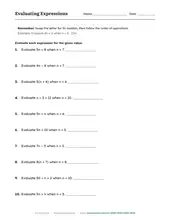
- Evaluating expressions Swap the letter for its number, then follow the order of operations.
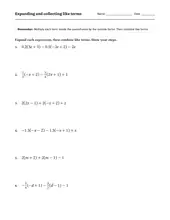
- Expanding and collecting like terms Multiply each term inside the parentheses by the outside factor. Then combine like terms.
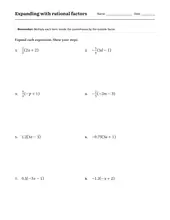
- Expanding with rational factors Multiply each term inside the parentheses by the outside factor.
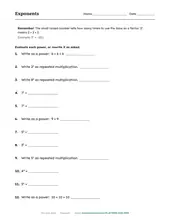
- Exponents The small raised number tells how many times to use the base as a factor: 2^3 means 2 × 2 × 2.
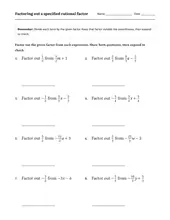
- Factoring out a specified rational factor Divide each term by the given factor. Keep that factor outside the parentheses, then expand to check.
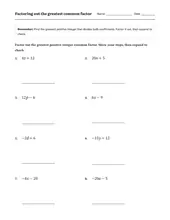
- Factoring out the greatest common factor Find the greatest positive integer that divides both coefficients. Factor it out, then expand to check.
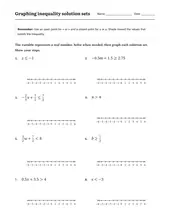
- Graphing inequality solution sets Use an open circle for < or > and a closed circle for ≤ or ≥. Shade toward the values that satisfy the inequality.
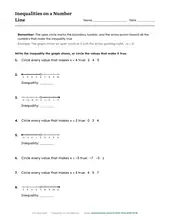
- Inequalities on a number line The open circle marks the boundary number, and the arrow points toward all the numbers that make the inequality true.
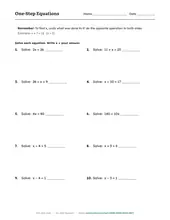
- One-step equations To find x, undo what was done to it: do the opposite operation to both sides.
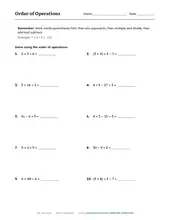
- Order of operations Work inside parentheses first, then any exponents, then multiply and divide, then add and subtract.
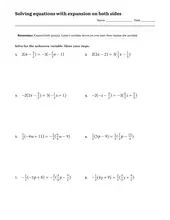
- Solving equations with expansion on both sides Expand both groups. Collect variable terms on one side, isolate the variable.
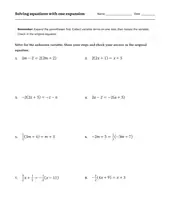
- Solving equations with one expansion Expand the parentheses first. Collect variable terms on one side, then isolate the variable. Check in the original equation.
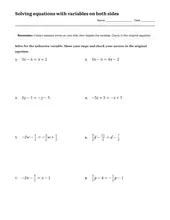
- Solving equations with variables on both sides Collect variable terms on one side, then isolate the variable. Check in the original equation.
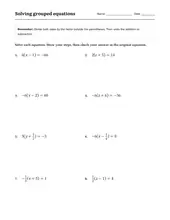
- Solving grouped equations Divide both sides by the factor outside the parentheses. Then undo the addition or subtraction.
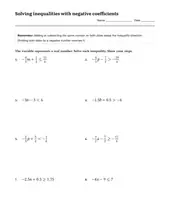
- Solving inequalities with negative coefficients Adding or subtracting preserves the direction. Dividing by a negative number reverses it.
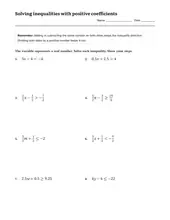
- Solving inequalities with positive coefficients Adding or subtracting preserves the direction. Dividing by a positive number also preserves it.
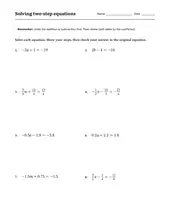
- Solving two-step equations Undo the addition or subtraction first. Then divide both sides by the coefficient.
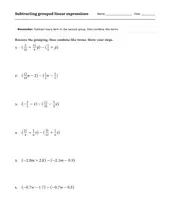
- Subtracting grouped linear expressions Subtract every term in the second group, then combine like terms.
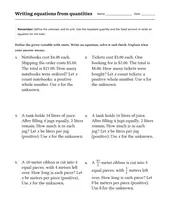
- Writing equations from quantities Define the unknown and its units. Repeated quantity plus fixed amount equals the total.
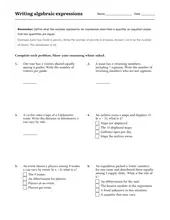
- Writing algebraic expressions Complete each problem. Show your reasoning where asked.
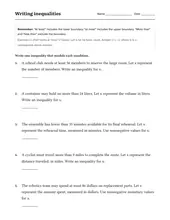
- Writing inequalities Write one inequality that models each condition.
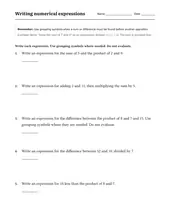
- Writing numerical expressions Write each expression. Use grouping symbols where needed. Do not evaluate.
Shapes & angles 20 skills
Shapes
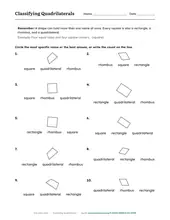
- Classifying quadrilaterals A shape can hold more than one name at once. Every square is also a rectangle, a rhombus, and a quadrilateral.
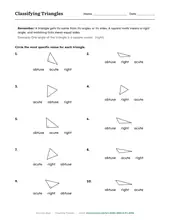
- Classifying triangles A triangle gets its name from its angles or its sides. A square mark means a right angle, and matching ticks mean equal sides.
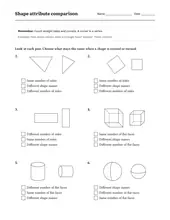
- Comparing shapes Compare flat shapes by their sides and corners. Compare solid shapes by their faces, curved surfaces, edges, and corners. Alike and different both come from those questions.
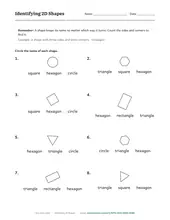
- Identifying 2d shapes A shape keeps its name no matter which way it turns. Count the sides and corners to find it.
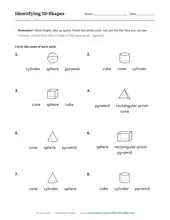
- Identifying 3d shapes Solid shapes take up space. Name the whole solid, not just the flat face you can see.
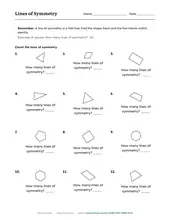
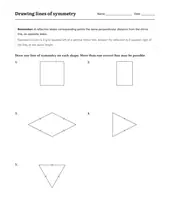
- Lines of symmetry A line of symmetry is a fold line. Fold the shape there and the two halves match exactly.
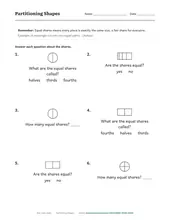
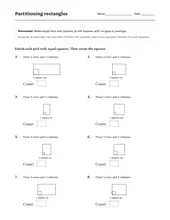
- Partitioning shapes Equal shares means every piece is exactly the same size, a fair share for everyone.
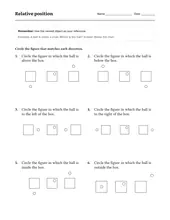
- Position words Position words tell where one thing is compared with another. Find the thing the question names first, then look at where it sits.
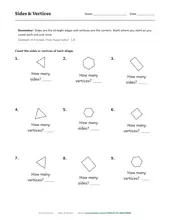
- Sides & vertices Sides are the straight edges and vertices are the corners. Mark where you start so you count each one just once.
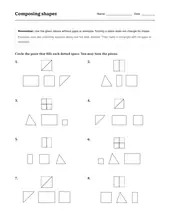
- Composing shapes Circle the piece that fills each dotted space. You may turn the pieces.
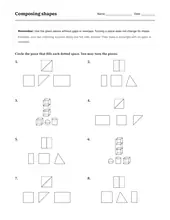
- Composing shapes Circle the piece that fills each dotted space. You may turn the pieces.
- Drawing lines of symmetry Draw one line of symmetry on each shape. More than one correct line may be possible.
- Partitioning rectangles Finish each grid with equal squares. Then count the squares.
Lines & angles
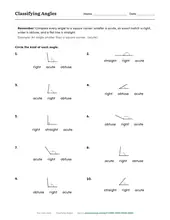
- Classifying angles Compare every angle to a square corner: smaller is acute, an exact match is right, wider is obtuse, and a flat line is straight.
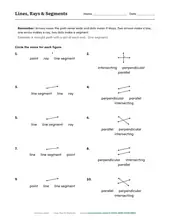
- Lines, rays & segments Arrows mean the path never ends and dots mean it stops. Two arrows make a line, one arrow makes a ray, two dots make a segment.
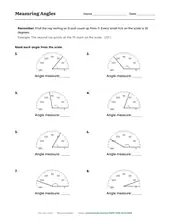
- Measuring angles Find the ray resting on 0 and count up from it. The long ticks are tens; the short tick halfway between two tens is 5 more.
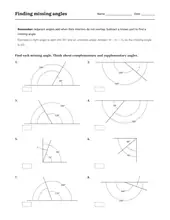
- Finding missing angles Find each missing angle. Think about complementary and supplementary angles.
Coordinate plane
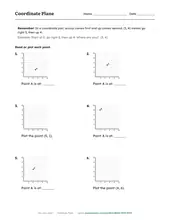
- Coordinate plane In a coordinate pair, across comes first and up comes second. (3, 4) means go right 3, then up 4.
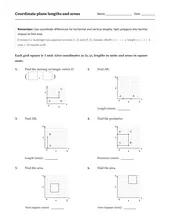
- Coordinate plane lengths and areas Each grid square is 1 unit. Give coordinates as (x, y), lengths in units and areas in square units.
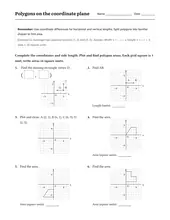
- Polygons on the coordinate plane Complete the coordinates and side length. Plot and find polygon areas. Each grid square is 1 unit; write areas in square units.
Area & volume 12 skills
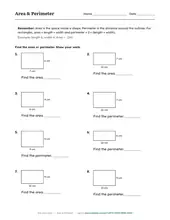
- Area & perimeter Area is the space inside a shape. Perimeter is the distance around the outside. For rectangles, area = length × width and perimeter = 2 × (length + width).
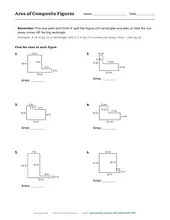
- Area of composite figures Split the figure into rectangles and triangles, then add their areas. For a cutout, subtract the missing area.
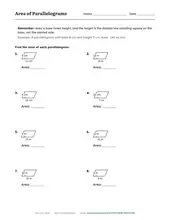
- Area of parallelograms Area is base times height, and the height is the dashed line standing square on the base, not the slanted side.
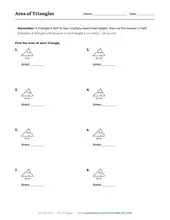
- Area of triangles A triangle is half its box: multiply base times height, then cut the answer in half.
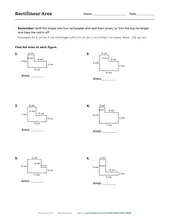
- Rectilinear area Split the shape into two rectangles and add their areas, or find the big rectangle and take the notch off.
- Surface area using nets A net is a solid unfolded flat. Surface area is the area of every face added up, so find each face on the net and add.
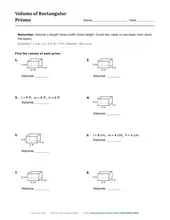
- Volume of rectangular prisms Volume is length times width times height. Count the cubes in one layer, then stack the layers.
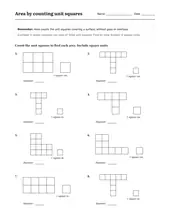
- Area by counting unit squares Count the unit squares to find each area. Include square units.
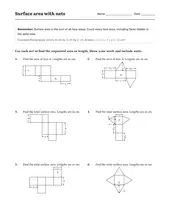
- Surface area with nets Use each net to find the requested area or length. Show your work and include units.
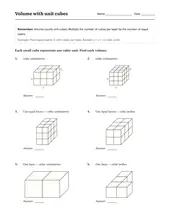
- Volume with unit cubes Each small cube represents one cubic unit. Find each volume.
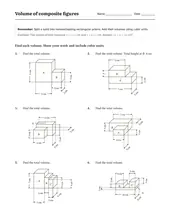
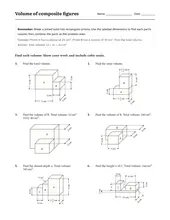
- Volume of composite figures Find each volume. Show your work and include cubic units.
- Volume of composite figures Find each volume. Show your work and include cubic units.
Measurement 15 skills
Time
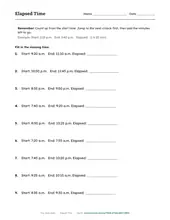
- Elapsed time Count up from the start time. Jump to the next o'clock first, then add the minutes left to go.
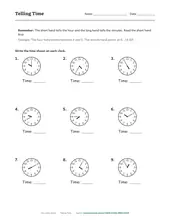
- Telling time The short hand tells the hour and the long hand tells the minutes. Read the short hand first.
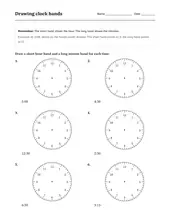
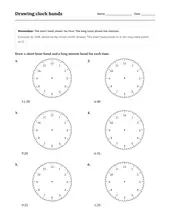
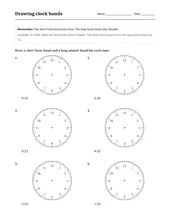
- Drawing clock hands Draw a short hour hand and a long minute hand for each time.
- Drawing clock hands Draw a short hour hand and a long minute hand for each time.
- Drawing clock hands Draw a short hour hand and a long minute hand for each time.
Length & units
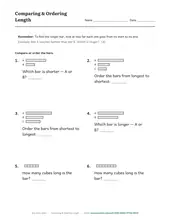
- Comparing & ordering length To find the longer bar, look at how far each one goes from its start to its end.
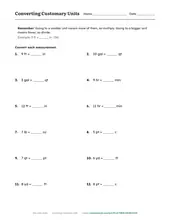
- Converting customary units Going to a smaller unit means more of them, so multiply. Going to a bigger unit means fewer, so divide.
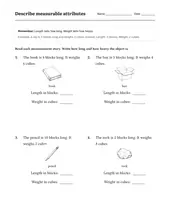
- Measurable attributes Something you can measure has a size you could compare: how tall, how long, how heavy, how much it holds. A color or a name is not a measurement.
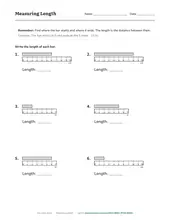
- Measuring length Find where the bar starts and where it ends. The length is the distance between them.
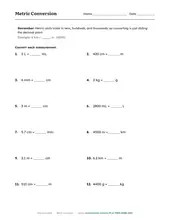
- Metric conversion Metric units trade in tens, hundreds, and thousands, so converting is just sliding the decimal point.
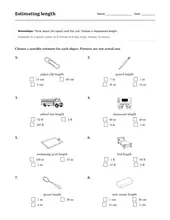
- Estimating length Choose a sensible estimate for each object. Pictures are not actual size.
- Length word problems Complete each problem. Write the answer with its unit when needed.
Mass & volume
- Liquid volume and mass Read the scale carefully: find the marked numbers, work out what one small tick is worth, and count from the last marked number. For estimates, picture the object next to something whose measure you know.
Money
- Counting coins Count the coins that are worth the most first, then count on. A dime is small, but it is worth 10 cents.
- Making change Start at the cost and count up to the money paid. What you count along the way is the change.
Data & graphing 17 skills
Graphs
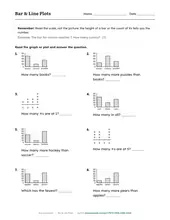
- Bar & line plots Read the scale, not the picture: the height of a bar or the count of Xs tells you the number.
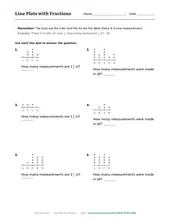
- Line plots with fractions The ticks are the ruler and the Xs are the data. Every X is one measurement.
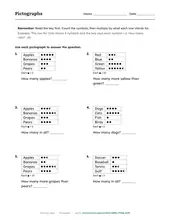
- Pictographs Read the key first. Count the symbols, then multiply by what each one stands for.
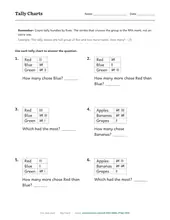
- Tally charts Count tally bundles by fives. The stroke that crosses the group is the fifth mark, not an extra one.
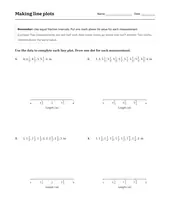
- Making line plots Use the data to complete each line plot. Draw one dot for each measurement.
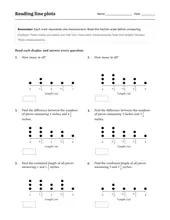
- Reading line plots Read each display and answer every question.
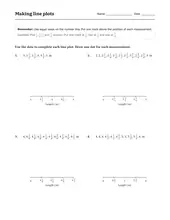
- Making line plots Use the data to complete each line plot. Draw one dot for each measurement.
Statistics
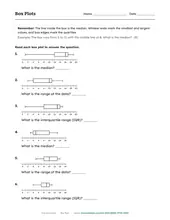
- Box plots The line inside the box is the median. Whisker ends mark the smallest and largest values, and box edges mark the quartiles.
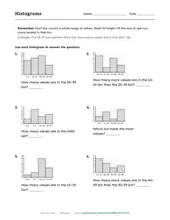
- Histograms Each bar counts a whole range of values. Read its height off the axis to see how many landed in that bin.
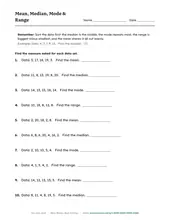
- Mean, median, mode & range Sort the data first: the median is the middle, the mode repeats most, the range is biggest minus smallest, the mean balances the values, and MAD is their average distance from the mean.
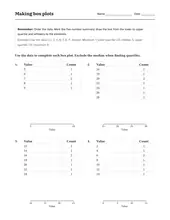
- Making box plots Use the data to complete each box plot. Exclude the median when finding quartiles.
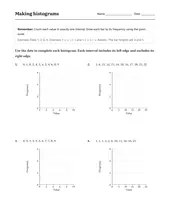
- Making histograms Use the data to complete each histogram. Each interval includes its left edge and excludes its right edge.
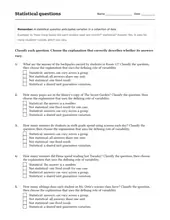
- Statistical questions Classify each question. Choose the explanation that correctly describes whether its answers vary.
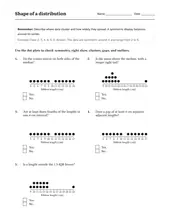
- Shape of a distribution Use the dot plots to check symmetry, right skew, clusters, gaps, and outliers.
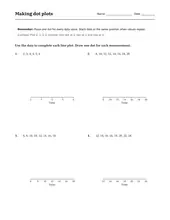
- Making dot plots Use the data to complete each line plot. Draw one dot for each measurement.
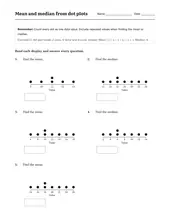
- Mean and median from dot plots Read each display and answer every question.
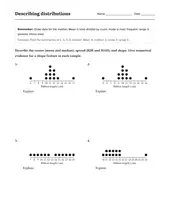
- Describing distributions Describe the center (mean and median), spread (IQR and MAD), and shape. Give numerical evidence for a shape feature in each sample.
Print math practice that never repeats. Every worksheet is generated fresh at print time: new numbers at the same difficulty, one skill per page, from counting to fractions, integers, and algebra. Each sheet prints with its answer key. Or build a quick drill with your own numbers.
Looking for English worksheets?
Browse English worksheets. Same free printables, same answer keys.