Expressions & equations worksheets

Integers, order of operations, like terms, inequalities, and equations from one step to variables on both sides.
Nothing in expressions & equations matches that. Search the whole site
Skip past the listIntegers 3 skills
- Absolute value Absolute value is a number's distance from zero, so it is never negative: |-8| and |8| both equal 8.
- Comparing & ordering integers Picture the number line. The number farther to the right is always greater, so every positive beats every negative, and −2 beats −9.
- Integers add & subtract Adding moves you right on the number line, subtracting moves you left, and subtracting a negative flips you right again.


Expressions & equations 33 skills
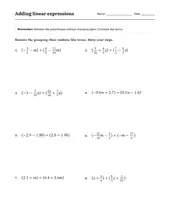
- Adding linear expressions Remove the parentheses without changing signs. Combine like terms.
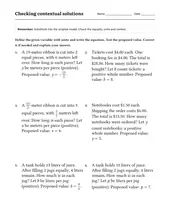
- Checking contextual solutions Substitute into the original model. A solution must make it true and fit the quantity and its units.
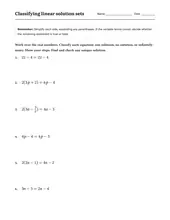
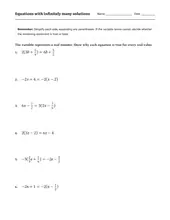
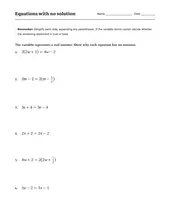
- Classifying linear solution sets Collect like terms on each side, then collect variable terms. A false constant equation means no solution; a true one means every real value is a solution.
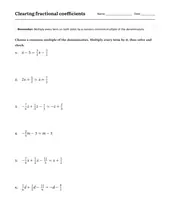
- Clearing fractional coefficients Multiply every term on both sides by a nonzero common multiple of the denominators.
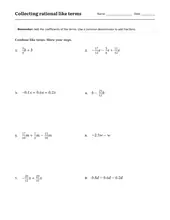
- Collecting rational like terms Add the coefficients of like terms. Use a common denominator to add fractions.
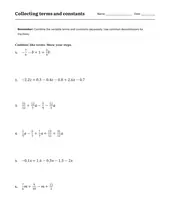
- Collecting terms and constants Combine the variable terms and constants separately. Use common denominators for fractions.
- Combining like terms Like terms have the same letter, so add their number parts: 3x + 2x makes 5x.
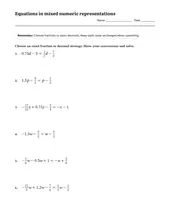
- Equations in mixed numeric representations Choose fractions or exact decimals. Keep each value unchanged when converting.
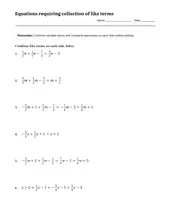
- Equations requiring collection of like terms Combine variable terms and constants separately on each side before solving.
- Equations with infinitely many solutions Collect like terms on each side, then collect variable terms. A false constant equation means no solution; a true one means every real value is a solution.
- Equations with no solution Collect like terms on each side, then collect variable terms. A false constant equation means no solution; a true one means every real value is a solution.
- Evaluating expressions Swap the letter for its number, then follow the order of operations.
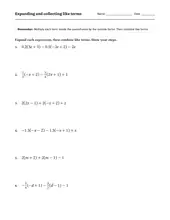
- Expanding and collecting like terms Multiply each term inside the parentheses by the outside factor. Then combine like terms.
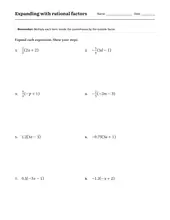
- Expanding with rational factors Multiply each term inside the parentheses by the outside factor.
- Exponents The small raised number tells how many times to use the base as a factor: 2^3 means 2 × 2 × 2.
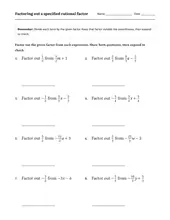
- Factoring out a specified rational factor Divide each term by the given factor. Keep that factor outside the parentheses, then expand to check.
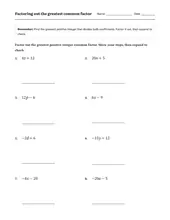
- Factoring out the greatest common factor Find the greatest positive integer that divides both coefficients. Factor it out, then expand to check.
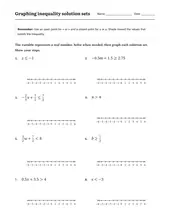
- Graphing inequality solution sets Use an open circle for < or > and a closed circle for ≤ or ≥. Shade toward the values that satisfy the inequality.
- Inequalities on a number line The open circle marks the boundary number, and the arrow points toward all the numbers that make the inequality true.
- One-step equations To find x, undo what was done to it: do the opposite operation to both sides.
- Order of operations Work inside parentheses first, then any exponents, then multiply and divide, then add and subtract.
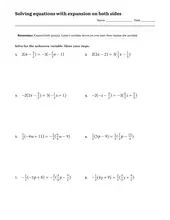
- Solving equations with expansion on both sides Expand both groups. Collect variable terms on one side, isolate the variable.
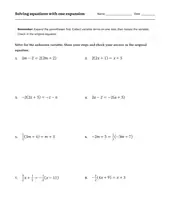
- Solving equations with one expansion Expand the parentheses first. Collect variable terms on one side, then isolate the variable. Check in the original equation.
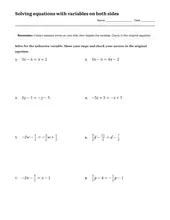
- Solving equations with variables on both sides Collect variable terms on one side, then isolate the variable. Check in the original equation.
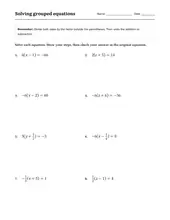
- Solving grouped equations Divide both sides by the factor outside the parentheses. Then undo the addition or subtraction.
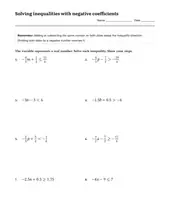
- Solving inequalities with negative coefficients Adding or subtracting preserves the direction. Dividing by a negative number reverses it.
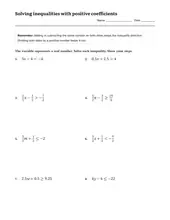
- Solving inequalities with positive coefficients Adding or subtracting preserves the direction. Dividing by a positive number also preserves it.
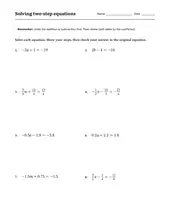
- Solving two-step equations Undo the addition or subtraction first. Then divide both sides by the coefficient.
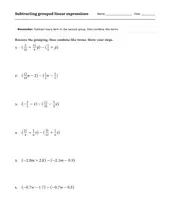
- Subtracting grouped linear expressions Subtract every term in the second group, then combine like terms.
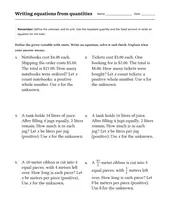
- Writing equations from quantities Define the unknown and its units. Repeated quantity plus fixed amount equals the total.
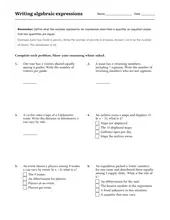
- Writing algebraic expressions Complete each problem. Show your reasoning where asked.
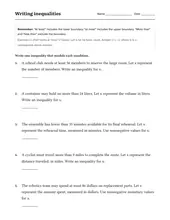
- Writing inequalities Write one inequality that models each condition.
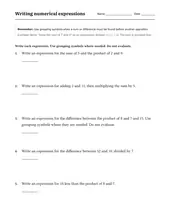
- Writing numerical expressions Write each expression. Use grouping symbols where needed. Do not evaluate.





All math worksheets →
More math topics: Counting & place value · Addition & subtraction · Multiplication & division · Word problems · Factors & patterns · Fractions · Decimals · Ratios & percents · Shapes & angles · Area & volume · Measurement · Data & graphing