2nd grade worksheets
Every 2nd grade skill we teach, one sheet each, free with its answer key. Pick a subject, or filter for a skill.
Nothing in 2nd grade matches that. Search every grade
English
Grammar 27 skills
Nouns
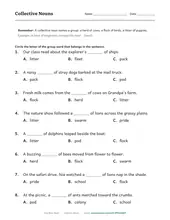
- Collective nouns A collective noun names a group: a herd of cows, a flock of birds, a litter of puppies.
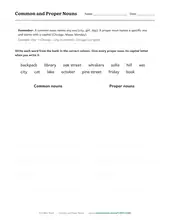
- Common and proper nouns A common noun names any one (city, girl, day). A proper noun names a specific one and starts with a capital (Chicago, Maya, Monday).
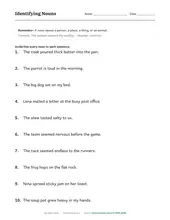
- Identifying nouns A noun names a person, a place, a thing, or an animal.
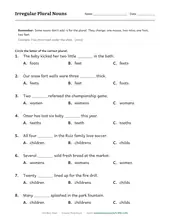
- Irregular plural nouns Some nouns don't add -s for the plural. They change: one mouse, two mice; one foot, two feet.
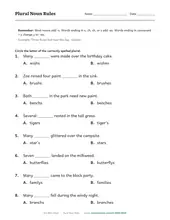
- Plural noun rules Most nouns add -s. Words ending in x, ch, sh, or s add -es. Words ending in consonant + y change y to -ies.
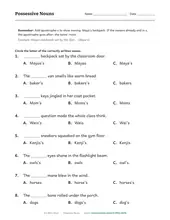
- Possessive nouns Add apostrophe-s to show owning: Maya's backpack. If the owners already end in s, the apostrophe goes after: the twins' room.
Verbs
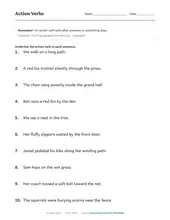
- Action verbs An action verb tells what someone or something does.
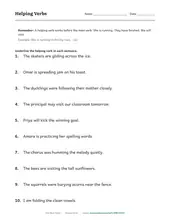
- Helping verbs A helping verb works before the main verb: She is running. They have finished. We will visit.
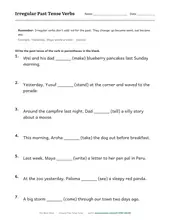
- Irregular past tense verbs Irregular verbs don't add -ed for the past. They change: go became went, eat became ate.
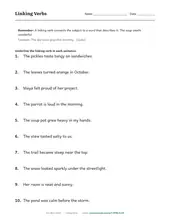
- Linking verbs A linking verb connects the subject to a word that describes it: The soup smells wonderful.
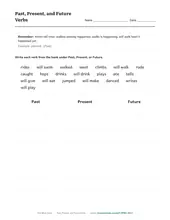
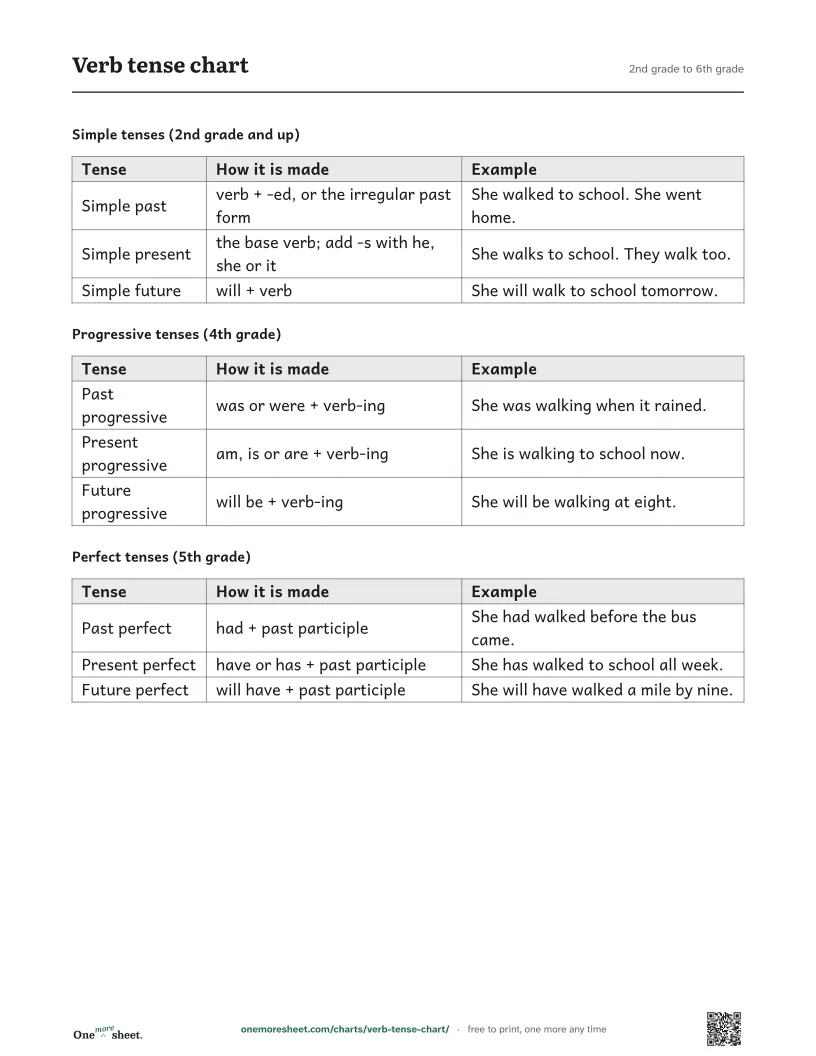
- Past, present, and future verbs Verbs tell time: walked already happened, walks is happening, will walk hasn't happened yet.
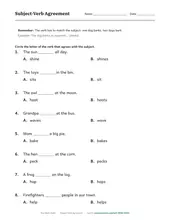
- Subject-verb agreement The verb has to match the subject: one dog barks, two dogs bark.
Adjectives
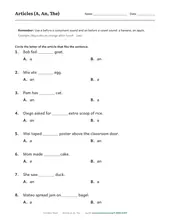
- Articles (a, an, the) Use a before a consonant sound and an before a vowel sound: a banana, an apple.
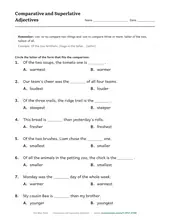
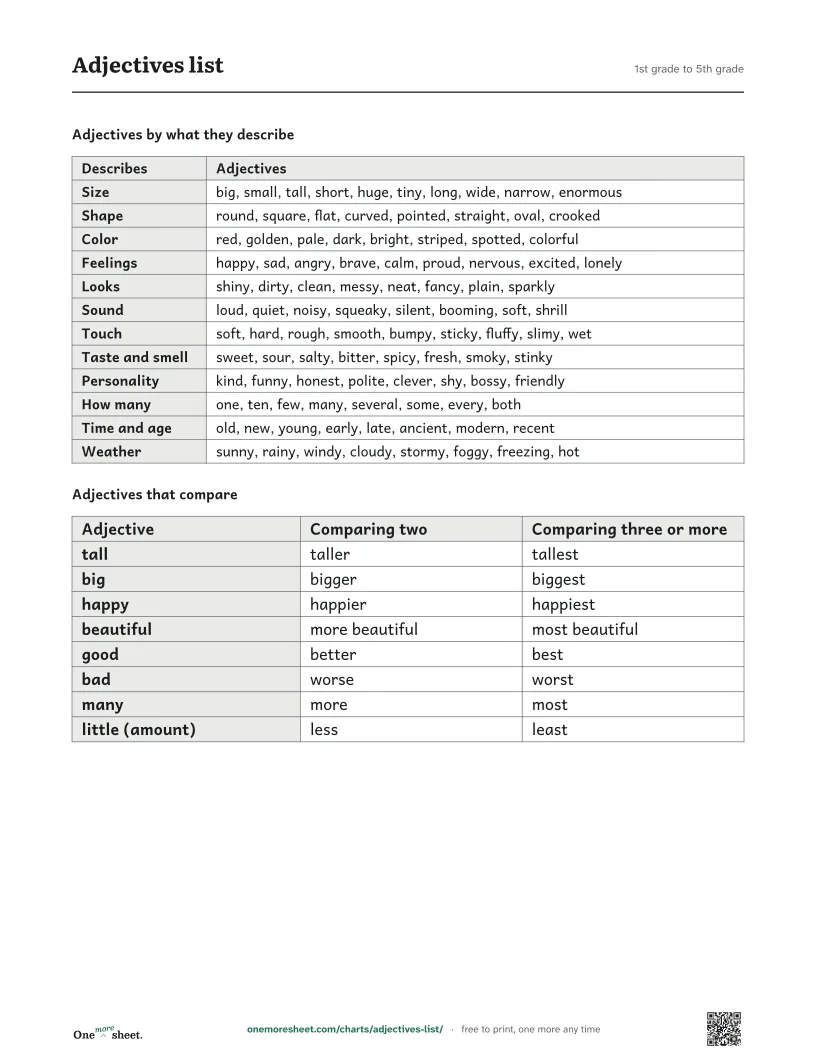
- Comparative and superlative adjectives Use -er to compare two things and -est to compare three or more: taller of the two, tallest of all.
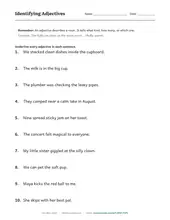
- Identifying adjectives An adjective describes a noun. It tells what kind, how many, or which one.
- This, that, these, and those This and these point to things close by; that and those point to things far away. This and that are for one; these and those are for more.
Adverbs
- Adjective or adverb? Adjectives describe nouns: a quick fox, the soup smells wonderful. Adverbs describe verbs: she runs quickly, stir gently. Ask what the word is describing.
- Adverbs of how, when, and where Adverbs answer three questions about an action: how (quietly), when (today), and where (outside).
- Identifying adverbs An adverb tells how, when, or where something happens.
Pronouns
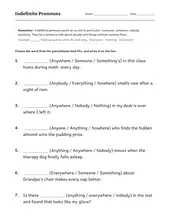
- Indefinite pronouns Indefinite pronouns point at no one in particular: everyone, someone, nobody, anything. They let a sentence talk about people and things without naming them.
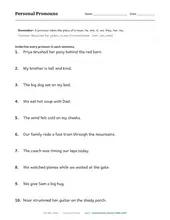
- Personal pronouns A pronoun takes the place of a noun: he, she, it, we, they, her, my.
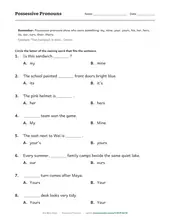
- Possessive pronouns Possessive pronouns show who owns something: my, mine, your, yours, his, her, hers, its, our, ours, their, theirs.
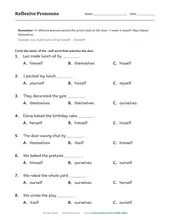
- Reflexive pronouns A reflexive pronoun points the action back at the doer: I made it myself; they helped themselves.
Prepositions
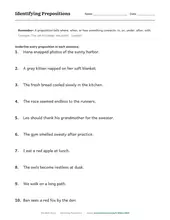
- Identifying prepositions A preposition tells where, when, or how something connects: in, on, under, after, with.
Conjunctions
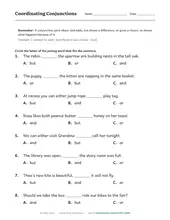
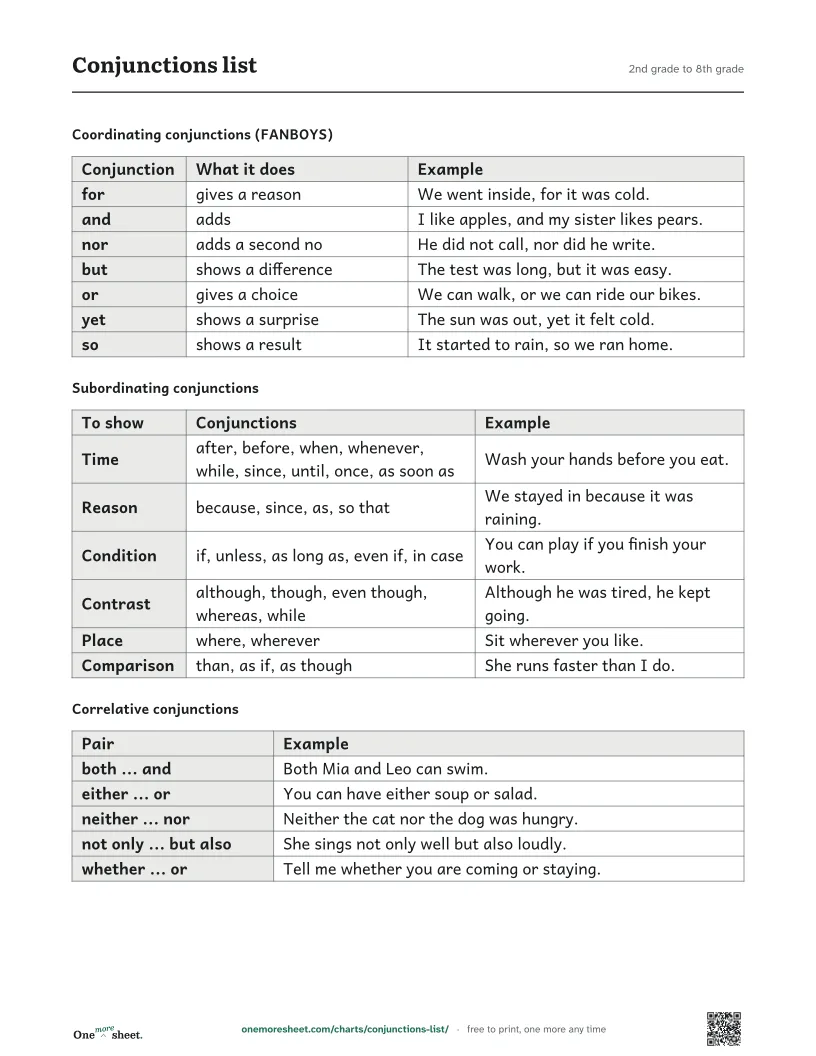
- Coordinating conjunctions A conjunction joins ideas: and adds, but shows a difference, or gives a choice, so shows what happens because of it.
Mixed parts of speech
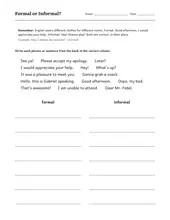
- Formal or informal? English wears different clothes for different rooms. Formal: Good afternoon; I would appreciate your help. Informal: Hey! Wanna play? Both are correct, in their place.
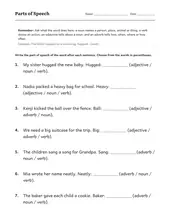
- Parts of speech, new Ask what the word does in this sentence: a noun names something, a verb shows an action or a state of being, an adjective describes a noun, an adverb tells how, when, where or how often, and a pronoun takes the place of a noun.
Sentence structure 8 skills
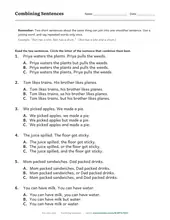
- Combining sentences Two short sentences about the same thing can join into one smoother sentence. Use a joining word, and say repeated words only once.
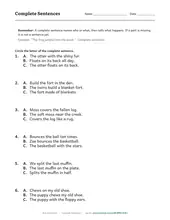
- Complete sentences A complete sentence names who or what, then tells what happens. If a part is missing, it is not a sentence yet.
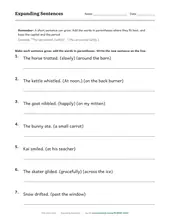
- Expanding sentences A short sentence can grow. Add the words in parentheses where they fit best, and keep the capital and the period.
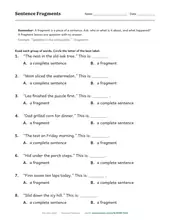
- Sentence fragments A fragment is a piece of a sentence. Find what it is missing: the naming part (subject) or the telling part (predicate).
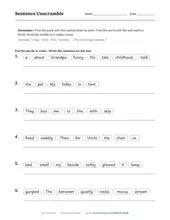
- Sentence unscramble Find the word with the capital letter to start. Find the word with the end mark to finish. Build the middle so it makes sense.
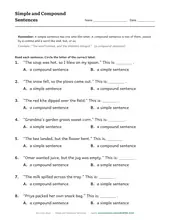
- Simple and compound sentences A simple sentence has one who-did-what. A compound sentence is two of them, joined by a comma and a word like and, but, or so.
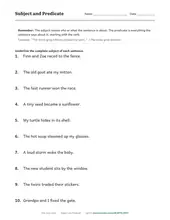
- Subject and predicate The subject names who or what the sentence is about. The predicate is everything the sentence says about it, starting with the verb.
- Types of sentences A statement tells. A question asks. A command orders. An exclamation bursts with feeling.

Capitalization 2 skills
- Capitalizing names and dates Names of people, days, and months always get capital letters: Maya visits on Monday in June.
- Capitalizing places and holidays Names of places and holidays get capitals on every important word: Main Street, Lake Erie, Thanksgiving. Little joiners like of stay small.


Punctuation 5 skills
- Commas in dates A comma separates the day from the year: July 4, 2019. A weekday gets one too: Monday, June 8.
- Commas in letters A friendly letter needs two commas: one after the greeting (Dear Grandma,) and one after the closing (Love, Maya).
- Commas in a series When you list three or more things, put a comma after each one before the last: hats, mittens, and boots.
- Contractions A contraction squeezes two words into one. The apostrophe sits exactly where letters dropped out: do not becomes don't.
- End punctuation A telling sentence ends with a period. An asking sentence ends with a question mark. A strong-feeling sentence ends with an exclamation point.


Spelling 4 skills
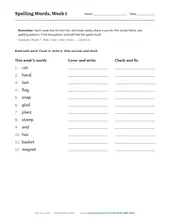
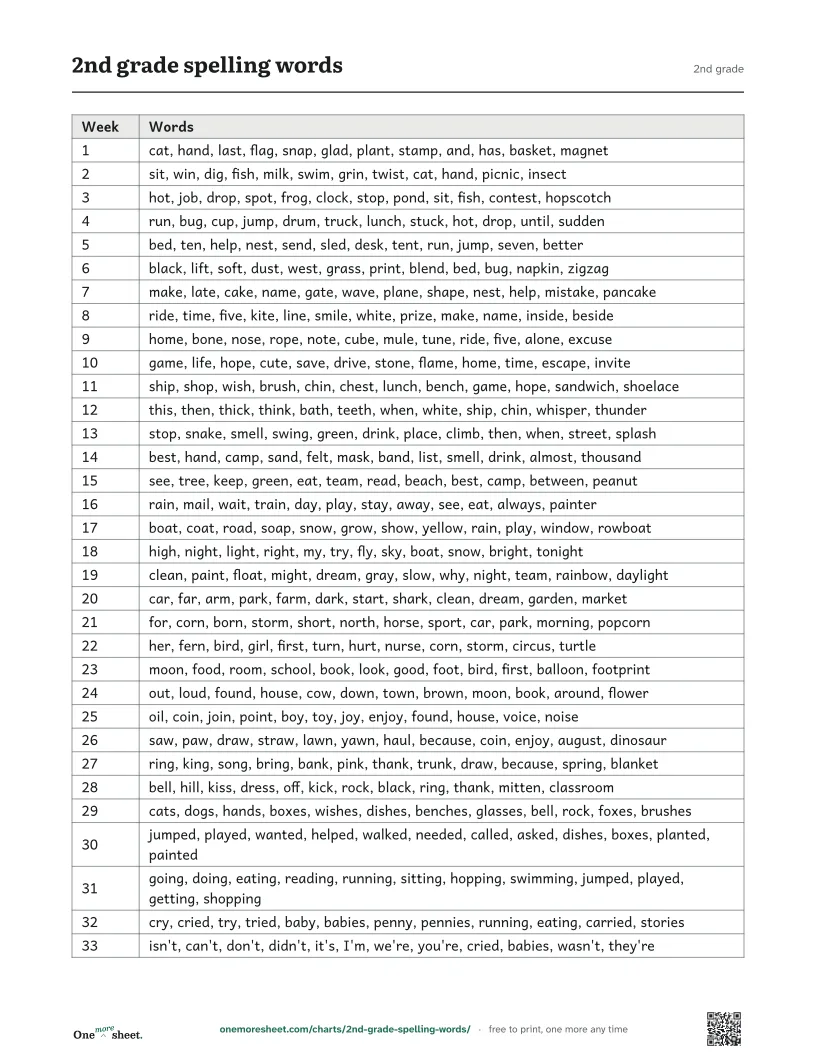
- Spelling words Each week has its own list, and most weeks share a secret: the words follow one spelling pattern. Find the pattern and half the list spells itself.
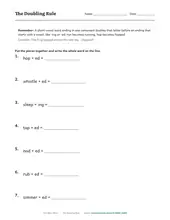
- The doubling rule A short-vowel word ending in one vowel and one consonant doubles that consonant before an ending that starts with a vowel, like -ing or -ed: run becomes running, hop becomes hopped. X never doubles: fix becomes fixed, box becomes boxing.
- The drop-e rule A silent e usually steps aside before an ending that starts with a vowel: bake becomes baking, smile becomes smiled. It usually stays before an ending that starts with a consonant: hopeful.
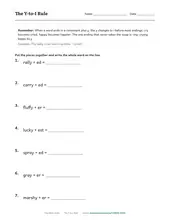
- The y-to-i rule When a word ends in a consonant plus y, the y changes to i before most endings: cry becomes cried, happy becomes happier. The one ending that never takes the swap is -ing: crying keeps its y.

Phonics 30 skills
Sight words
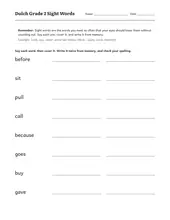
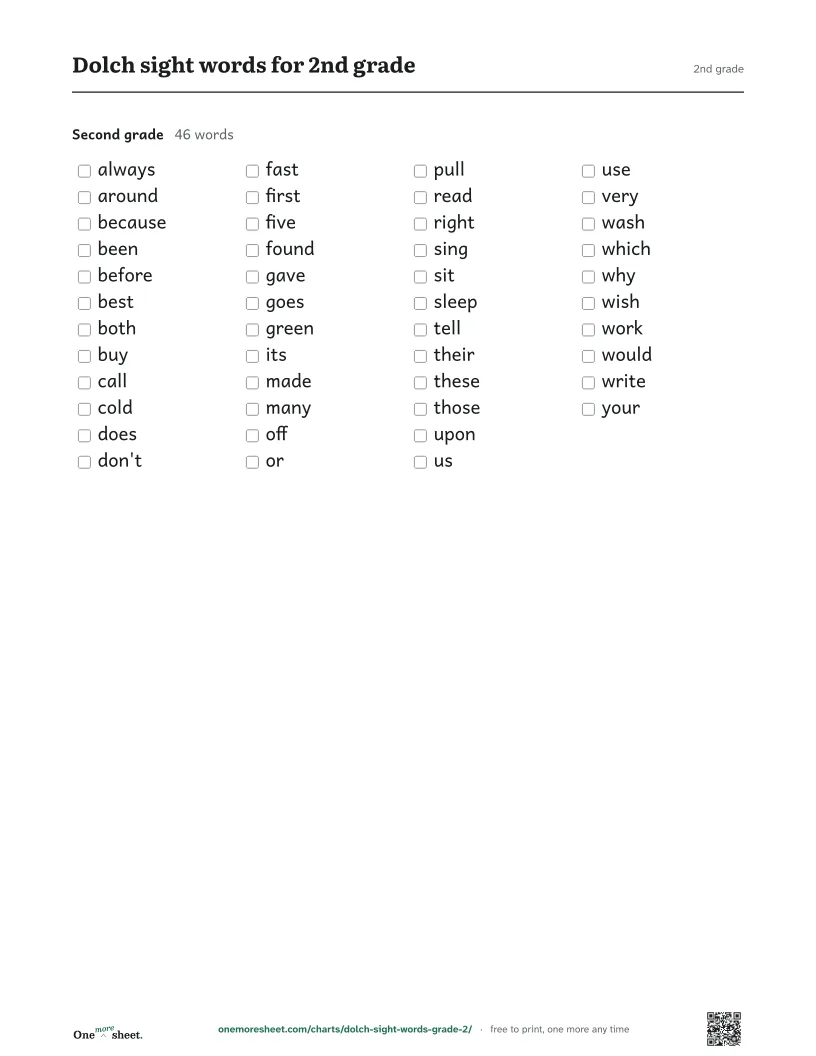
- Dolch grade 2 sight words Sight words are the words you meet so often that your eyes should know them without sounding out. Say each one, cover it, and write it from memory.
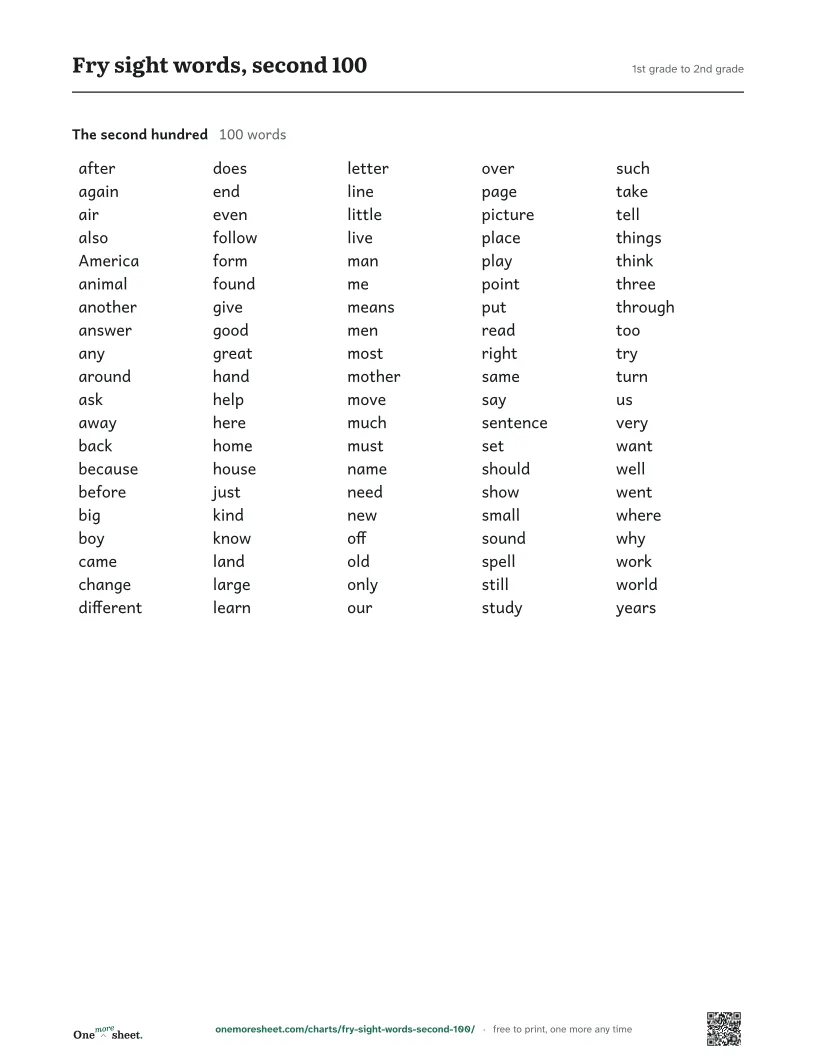
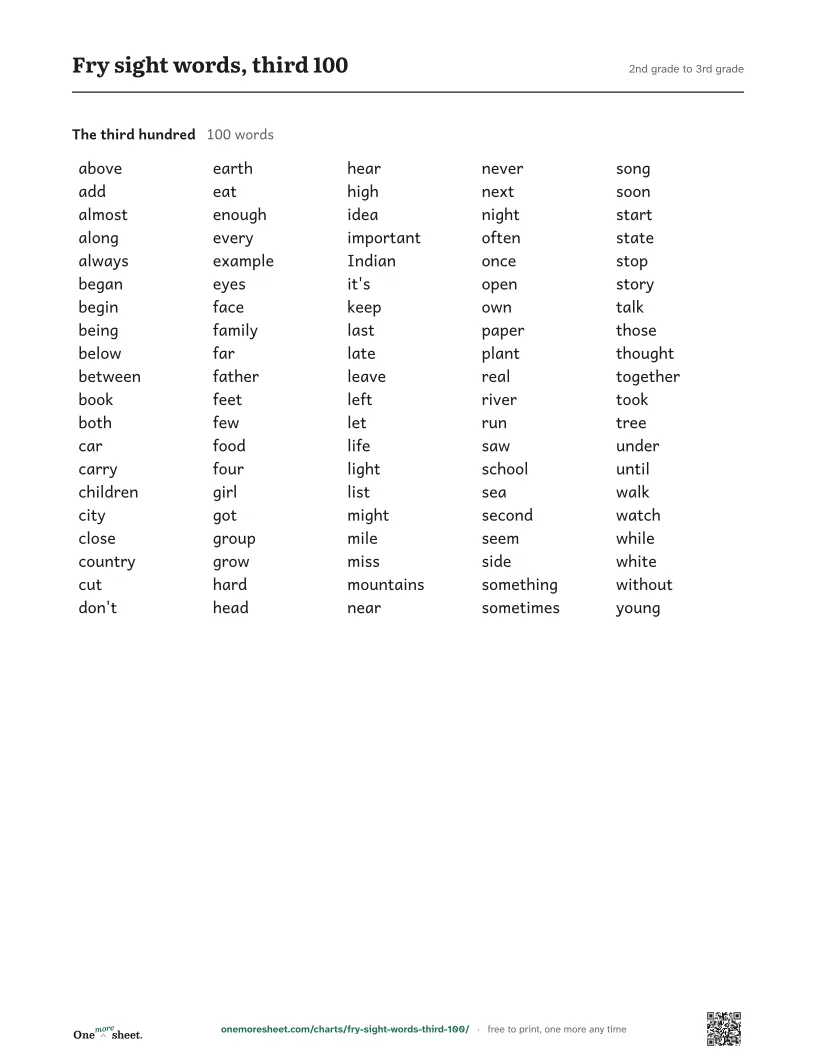
- Fry instant words Fry words are the words you meet most often in books. Know them on sight and reading speeds up.
- Sight words Sight words are the little words you see everywhere. Sound out the parts you can, learn the tricky part by heart, and practice until you know the word in a snap.


Vowel teams
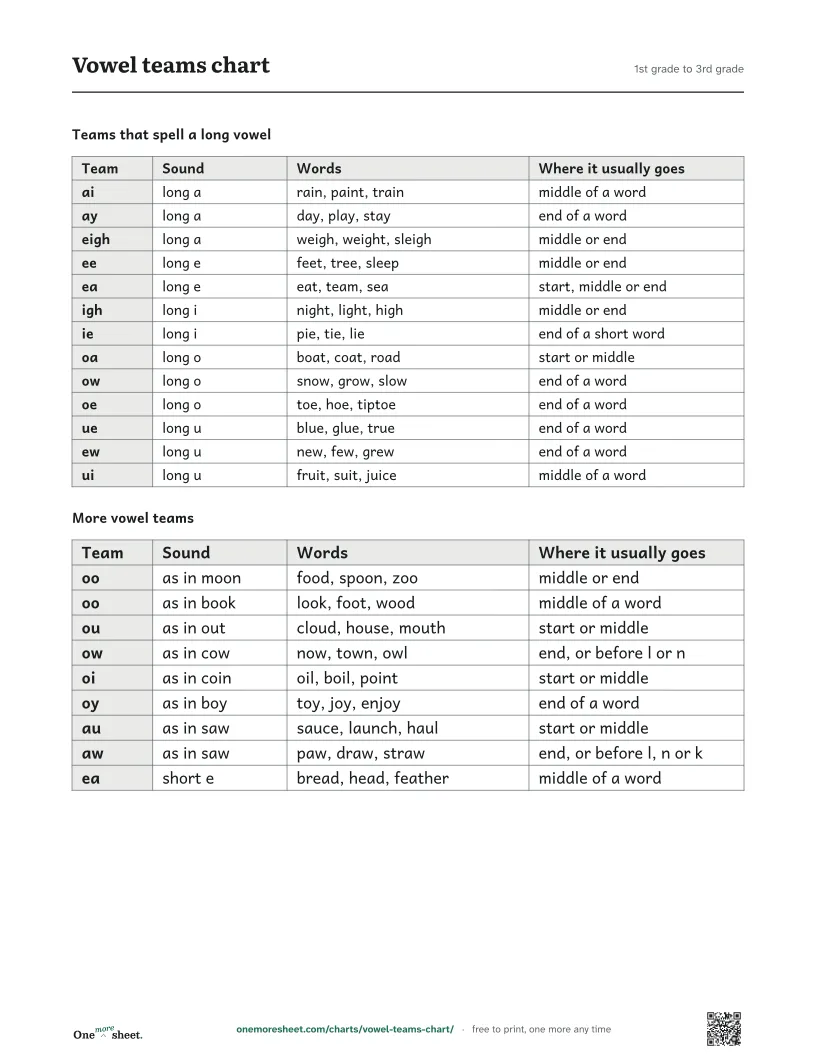
- Long a vowel teams (ai, ay) Two vowels can team up to say one long sound. Ai and ay both say the long a, and position picks the team: ay ends a word (play, day), ai works inside it (rain, train).
- Long e vowel teams (ee, ea) Ee and ea both say the long e sound: see, eat. The tricky part is remembering which team each word uses.
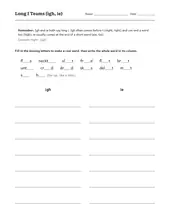
- Long i teams (igh, ie) Igh and ie both say long i. Igh often comes before t (night, light) and can end a word too (high); ie usually comes at the end of a short word (pie, tie).
- Long o vowel teams (oa, ow) Oa and ow both say the long o sound: boat, snow. Oa works inside words; ow usually takes the end.
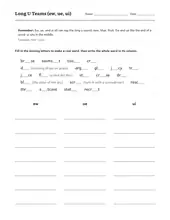
- Long u teams (ew, ue, ui) Ew, ue, and ui all can say the long u sound: new, blue, fruit. Ew and ue like the end of a word; ui sits in the middle.
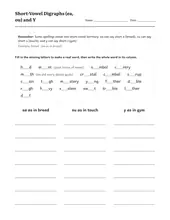
- Short-vowel digraphs (ea, ou) and y Some spellings sneak into short-vowel territory: ea can say short e (bread), ou can say short u (touch), and y can say short i (gym).
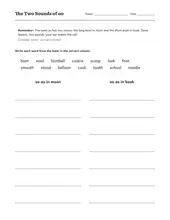
- The two sounds of oo The team oo has two voices: the long howl in moon and the short push in book. Same letters, two sounds; your ear makes the call.
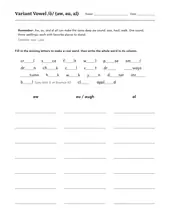
- Variant vowel /ô/ (aw, au, al) Aw, au, and al all can make the same deep aw sound: saw, haul, walk. One sound, three spellings, each with favorite places to stand.



R-controlled vowels
- R-controlled vowels (ar, or, er) When r follows a vowel, it bosses the sound around: car, corn, and bird don't use their short vowels.
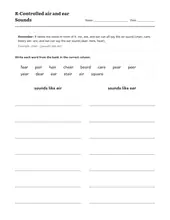
- R-controlled air and ear sounds R bends the vowel in front of it. Air, are, and ear can all say the air sound (chair, care, bear); eer, ere, and ear can say the ear sound (deer, here, hear).

Syllables
- Counting syllables Syllables are the beats in a word. Clap them out: cat has one, apple has two, banana has three.
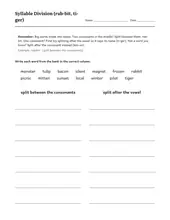
- Syllable division (rab-bit, ti-ger) Big words break into beats. Two consonants in the middle? Split between them: rab-bit. One consonant? First try splitting after the vowel so it says its name (ti-ger). Not a word you know? Split after the consonant instead (lem-on).
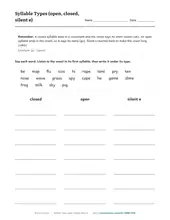
- Syllable types (open, closed, silent e) A closed syllable ends in a consonant and the vowel says its short sound (cat). An open syllable ends in the vowel, so it says its name (go). Silent e reaches back to make the vowel long (cake).
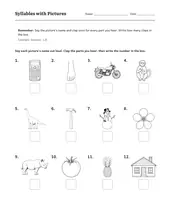
- Syllables with pictures, new Say the picture's name and clap once for every part you hear. Write how many claps in the box.

Consonant blends
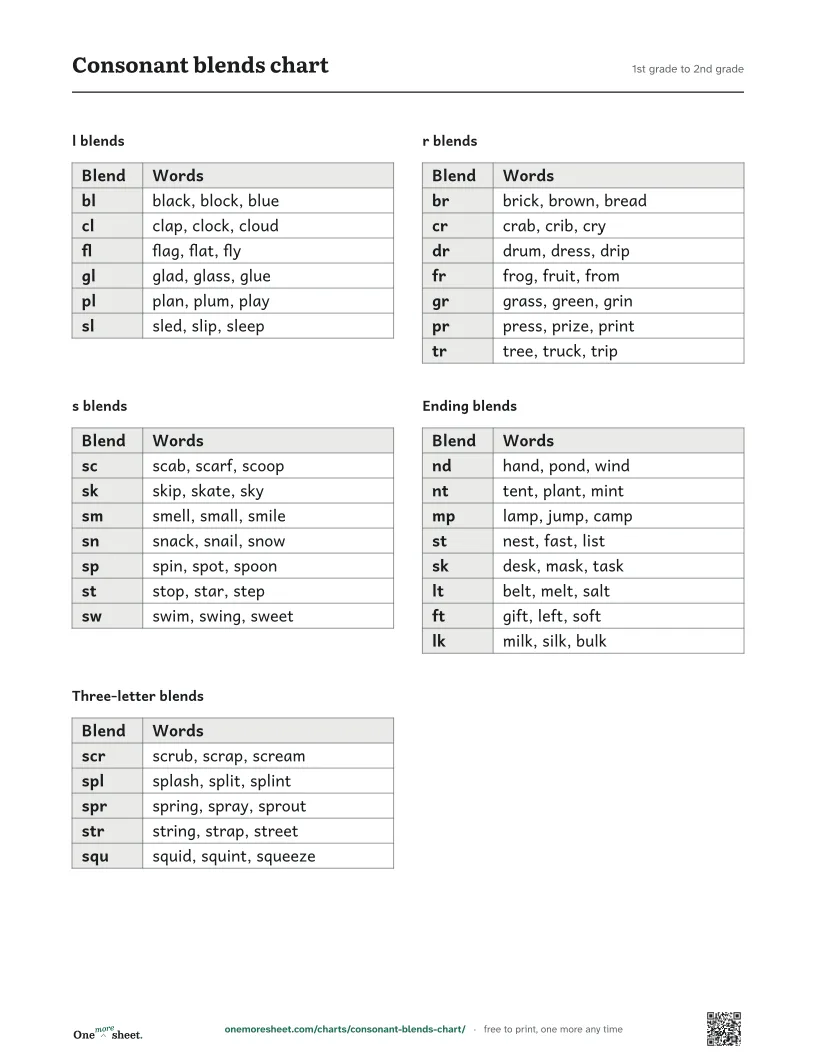
- Beginning blends (bl, cr, st) A blend is two consonants that work side by side, and you can still hear both: bl in black, cr in crab, st in star.
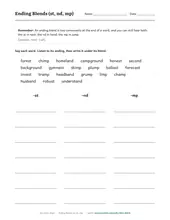
- Ending blends (st, nd, mp) An ending blend is two consonants at the end of a word, and you can still hear both: the st in nest, the nd in hand, the mp in jump.
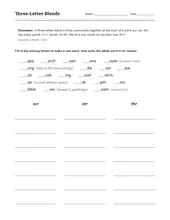
- Three-letter blends A three-letter blend is three consonants together at the start of a word: scr, str, thr. Say every sound: s-t-r, street. In thr, the th is one sound, so you hear two: th-r.

Alphabet & letter sounds
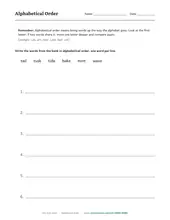
- Alphabetical order Alphabetical order means lining words up the way the alphabet goes. Look at the first letter; if two words share it, move one letter deeper and compare again.
Vowel patterns
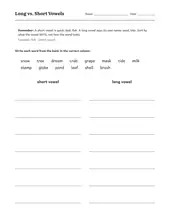
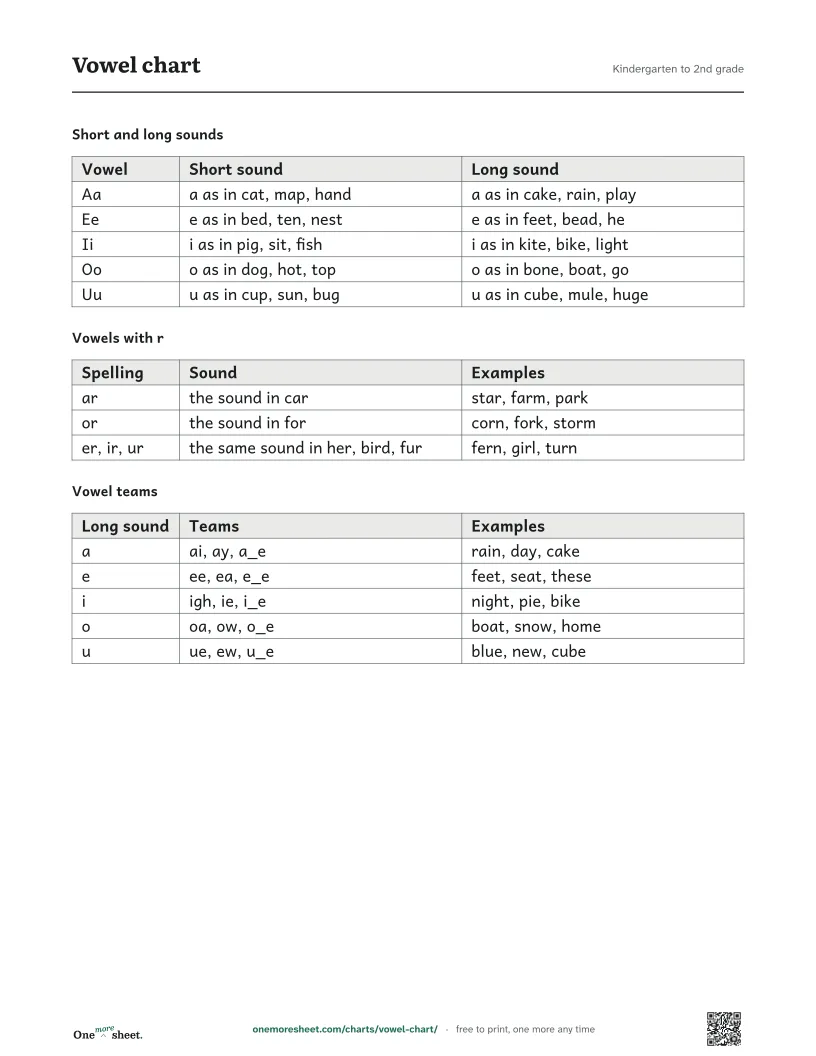
- Long vs. short vowels A short vowel is quick: bed, fish. A long vowel says its own name: seed, kite. Sort by what the vowel SAYS, not how the word looks.
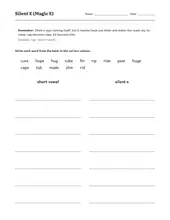
- Silent e (magic e) Silent e says nothing itself, but it reaches back one letter and makes the vowel say its name: cap becomes cape, kit becomes kite.
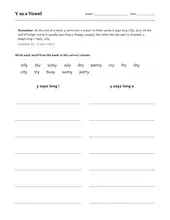
- Y as a vowel At the end of a word, y turns into a vowel. In little words it says long i (fly, sky). At the end of longer words it usually says long e (happy, puppy), but when the last part is stressed, y keeps long i: reply, July.
Diphthongs
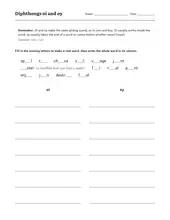
- Diphthongs oi and oy Oi and oy make the same gliding sound, as in coin and boy. Oi usually works inside the word; oy usually takes the end of a word or comes before another vowel (royal).
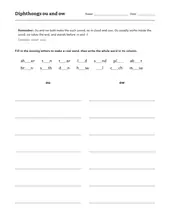
- Diphthongs ou and ow Ou and ow both make the ouch sound, as in cloud and cow. Ou usually works inside the word; ow takes the end, and stands before -n and -l.
Consonant patterns
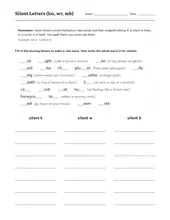
- Silent letters (kn, wr, mb) Some letters wrote themselves into words and then stopped talking. K is silent in knee, w in write, b in lamb. You spell them; you never say them.
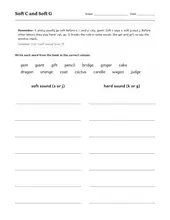
- Soft c and soft g C and g usually go soft before e, i, and y: city, giant. Soft c says s; soft g says j. Before other letters they stay hard: cat, go. G breaks the rule in some words, like get and girl, so say the word to check.
Word endings
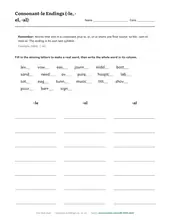
- Consonant-le endings (-le, -el, -al) Words that end in a consonant plus le, el, or al share one final sound: ta-ble, cam-el, med-al. The ending is its own last syllable.
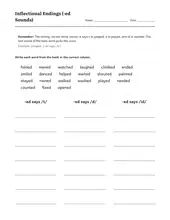
- Inflectional endings (-ed sounds) The ending -ed has three voices: it says t in jumped, d in played, and id in wanted. The last sound of the base word picks the voice.
Vocabulary 13 skills
Word relationships
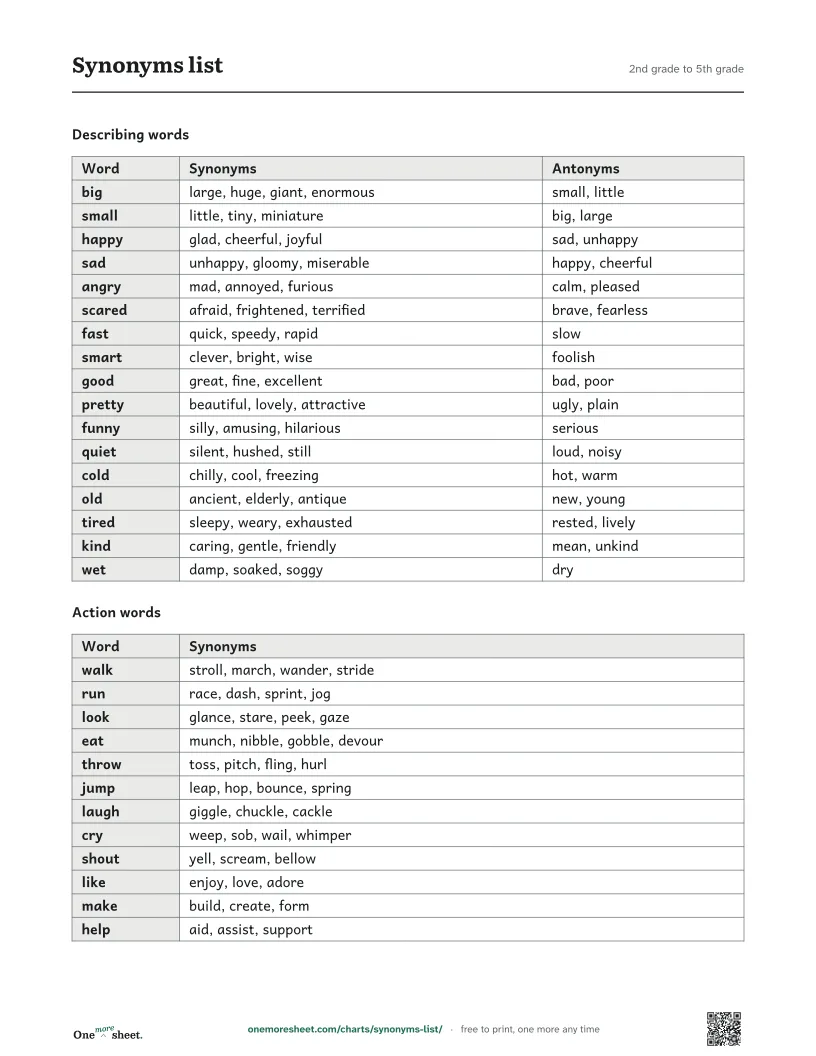
- Antonyms Antonyms are opposites: hot and cold, up and down, open and closed.
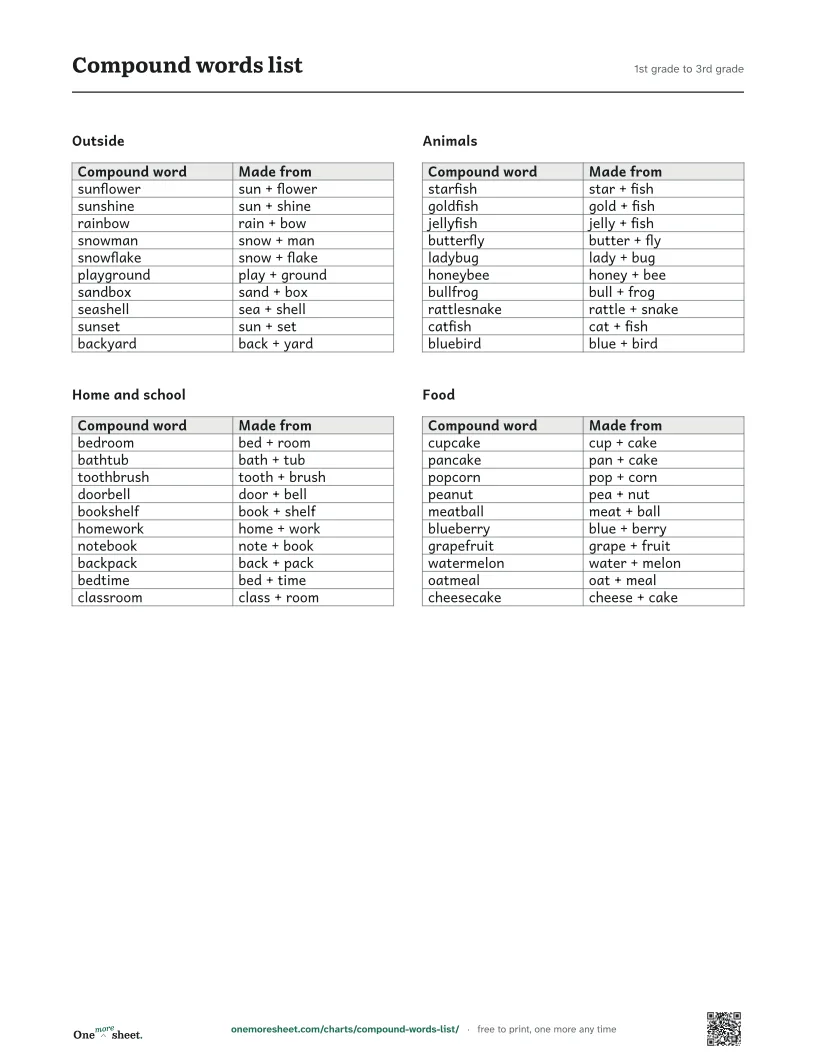
- Compound words A compound word is two words joined into one new meaning: sun + flower = sunflower.
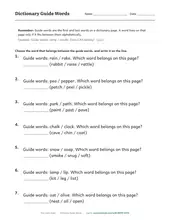
- Dictionary guide words Guide words are the first and last words on a dictionary page. A word lives on that page only if it fits between them alphabetically.
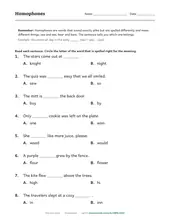
- Homophones Homophones are words that sound exactly alike but are spelled differently and mean different things: sea and see, bear and bare. The sentence tells you which one belongs.
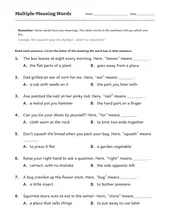
- Multiple-meaning words, new Some words carry more than one meaning: a bat flies at night, and a bat hits a baseball. The rest of the sentence tells you which meaning is on duty.
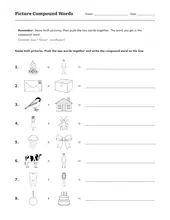
- Picture compound words, new Name both pictures, then push the two words together. The word you get is the compound word.
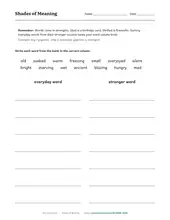
- Shades of meaning Words come in strengths. Glad is a birthday card; thrilled is fireworks. Sorting everyday words from their stronger cousins tunes your word volume knob.
- Synonyms Synonyms are words that mean almost the same thing: happy and glad, big and large.
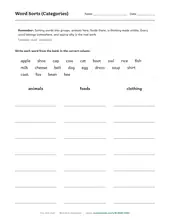
- Word sorts (categories) Sorting words into groups, animals here, foods there, is thinking made visible. Every word belongs somewhere, and saying why is the real work.



Prefixes and suffixes
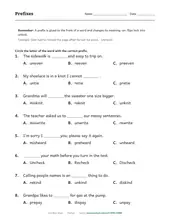
- Prefixes A prefix is glued to the front of a word and changes its meaning: un- flips lock into unlock.
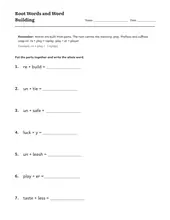
- Root words and word building Words are built from parts. The root carries the meaning: play. Prefixes and suffixes snap on: re + play = replay, play + er = player.
- Suffixes A suffix is glued to the end of a word and changes its job: care becomes careful, careless, or carefully.

Context clues
- Context clues, new The sentence around a hard word usually hides its meaning. Read past the word, find the clue, then decide: The arid desert had not seen rain for months, so arid must mean very dry.
Reading comprehension 22 skills
Reading passages
- Animal reading comprehension, new An animal passage tells how an animal's body and habits help it live. Answer from the passage, not from what you already know about the animal.
- Author's purpose, new Every writer has a reason for writing. The three big reasons are easy to remember as PIE: to Persuade (change your mind), to Inform (teach you facts), or to Entertain (tell you a fun story). To find the purpose, ask what the writer wants you to do after reading.
- Fact vs opinion A fact can be checked and proven: a spider has eight legs. An opinion tells what someone thinks or feels: spiders are creepy. Ask the test question: could we look this up and settle it?
- Fiction reading comprehension The answers hide in the story. Read it once for fun, then go back and point to the exact sentence that proves each answer.
- Main idea and details The main idea is what the whole passage is about, in one sentence. The details are the smaller facts that back it up.
- Making inferences, new An inference is a smart guess the writer never says out loud. You mix a clue from the text with what you already know: if a character shivers and rubs her hands, you can infer she is cold.
- Nonfiction reading comprehension Nonfiction is true information. Read to find out what the passage teaches, and be ready to point to the fact that answers each question.
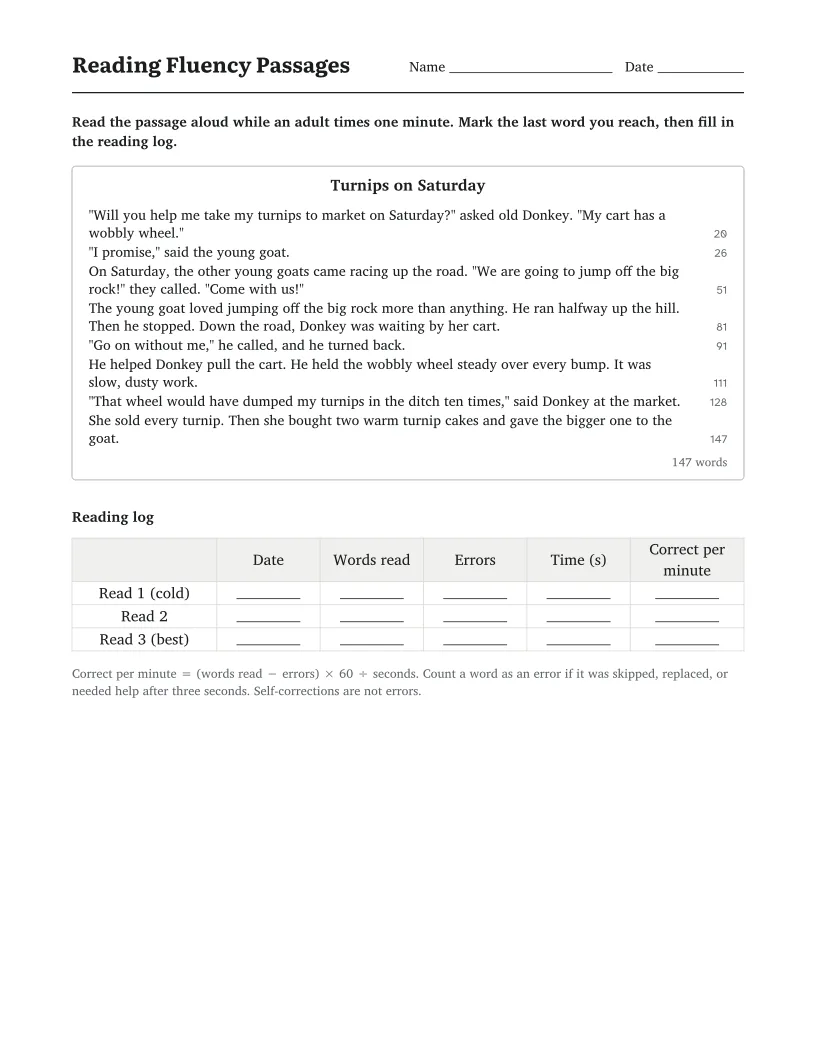
- Reading fluency passages Read the passage out loud for one minute. Read it the way you would talk: smooth, at a steady pace, and with the feeling the sentences call for. Fast is not the goal; smooth and accurate is.
- Science reading comprehension, new A science passage explains how something in the world works. Find the sentence that answers each question, even when it surprises you.

Comprehension skills
- Cause and effect A cause is why something happened. An effect is what happened because of it. Ask: what happened, and what made it happen?
- Character traits A trait is what a person is like on the inside, and actions are the proof. The story never says the word; it shows you, and you name it.
- Characters and setting Every story answers three questions: who is it about, where does it happen, and when? The characters are the who. The setting is the where and when.
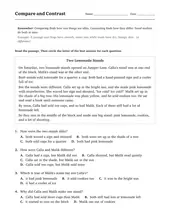
- Compare and contrast, new Comparing finds how two things are alike. Contrasting finds how they differ. Good readers do both at once.
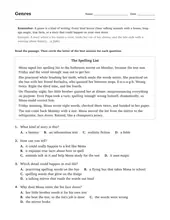
- Genres A genre is a kind of writing. Every kind leaves clues: talking animals with a lesson, long-ago magic, true facts, or a story that could happen on your own street.
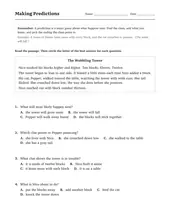
- Making predictions A prediction is a smart guess about what happens next. Find the clues, add what you know, and pick the ending the clues point to.
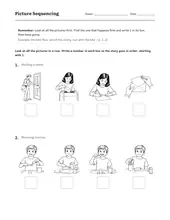
- Picture sequencing, new Look at all the pictures first. Find the one that happens first and write 1 in its box, then keep going.
- Plot A plot is the shape of a story: how it starts, what goes wrong, the moment things turn, and how it all works out.
- Point of view, new Point of view is who tells the story. A character inside it says I. A narrator outside it says he, she, and names.
- Problem and solution Find what is going wrong, and find what fixes it. The best stories also show tries that failed before the fix that worked.
- Sequencing Events in a passage happen in order. Keep track of what happened first, next, and last, and watch for time words that tell you.
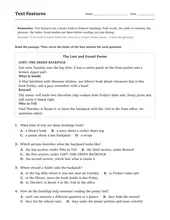
- Text features Text features are a book's built-in helpers: headings, bold words, the table of contents, the glossary, the index. Good readers use them before reading, not just during.
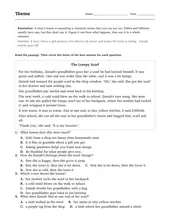
- Theme, new The theme is what a story teaches about life, said in a full sentence. Not what the story is about, but what it shows you.
Handwriting 3 skills
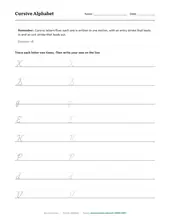
- Cursive alphabet Cursive letters flow: each one is written in one motion, with an entry stroke that leads in and an exit stroke that leads out.
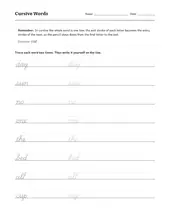
- Cursive words In cursive the whole word is one line: the exit stroke of each letter becomes the entry stroke of the next, so the pencil stays down from the first letter to the last.
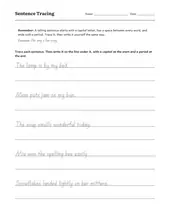
- Sentence tracing, new A telling sentence starts with a capital letter, has a space between every word, and ends with a period. Trace it, then write it yourself the same way.
Writing 5 skills
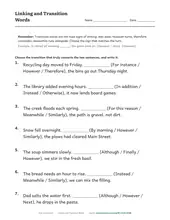
- Linking and transition words Transition words are the road signs of writing: also adds, however turns, therefore concludes, meanwhile runs alongside. Choose the sign that matches the turn.
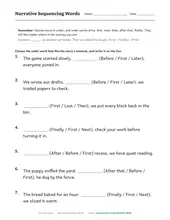
- Narrative sequencing words Stories move in order, and order words drive: first, next, then, after that, finally. They tell the reader where in the journey you are.
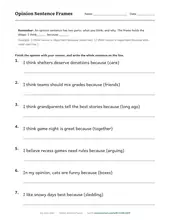
- Opinion sentence frames An opinion sentence has two parts: what you think, and why. The frame holds the shape: I think ___ because ___.
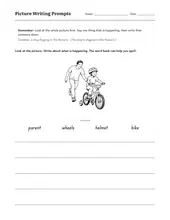
- Picture writing prompts, new Look at the whole picture first. Say one thing that is happening, then write that sentence down.
- Sentence writing A sentence needs a capital at the front, an idea in the middle, and an end mark: a period, or a question mark if it asks. Take the two words, build the idea, write it whole.
Math
Counting & place value 6 skills
Counting & number sense
- Greater than, less than Compare the biggest place first: the open side of the symbol faces the bigger number.
- Ordering numbers Compare the numbers place by place, then write them in the order asked.
- Skip counting to 1,000 Find the step first: does the row go up by 5, by 10, or by 100? Then keep that step for every blank.


Place value & rounding
- 10 or 100 more or less Ten more or less moves the tens digit. One hundred more or less moves the hundreds digit. The other digits stay put.
- Expanded form Expanded form stretches a number out to show what each digit is worth, like 358 = 300 + 50 + 8.
- Hundreds, tens & ones A 3-digit number is made of hundreds, tens, and ones. Count each kind, then write the digits in order.


Addition & subtraction 12 skills
Facts & fluency
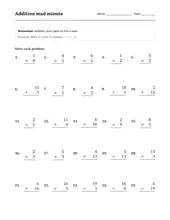
- Addition mad minute Work fast and left to right. Skip a hard one and come back; the clock does not wait.
- Addition within 20 Make a ten first when you can. It turns hard facts like 9 + 6 into easy ones like 10 + 5.
- Balancing equations The equal sign means both sides are the same amount, so check that they balance.
- Fact families The three numbers in the roof are a family. Write all four facts they make together.
- Missing addends Find the number that makes the equation true. Count up from the part you already know.
- Subtraction within 20 Think addition to subtract: for 13 − 8, ask what you add to 8 to make 13.


Multi-digit addition & subtraction
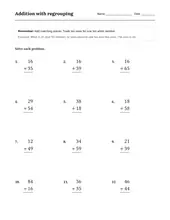
- Addition with regrouping Add the ones first. When they make ten or more, write the ones digit and carry the ten to the next column.
- Mental math Turn hard numbers into friendly ones: to add 29, add 30 and then take 1 back.
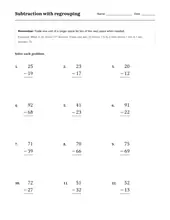
- Subtraction with regrouping If the top digit is smaller, borrow: take one ten from the next column and add ten to the digit you are subtracting from.
- Three-digit addition & subtraction Check the sign first, then work one column at a time starting from the ones.
- Two-digit addition Add the ones first. If they make ten or more, carry a ten to the tens column.
- Two-digit subtraction with regrouping If the top ones digit is too small, trade one ten for ten ones before you subtract.



Multiplication & division 1 skills
- Multiplication facts 0–12 Multiplication is repeated addition. When you know your times tables, you can solve problems quickly without counting on your fingers.

Word problems 7 skills
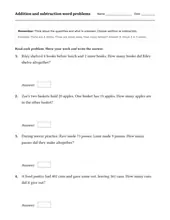
- Addition & subtraction word problems Read the whole story before you pick a sign. Does it put amounts together, or take some away?
- Addition word problems Read the whole story, then find the question. If groups are coming together, add.
- Measurement word problems Look for the units in the story. Your answer needs a unit too, so write it every time.
- Money word problems Count the coins from the biggest value down. When the story asks for change, start at the cost and count up.
- Multiplication word problems Look for equal groups in the story. Same-size groups, counted in one move: that is multiplication.
- Subtraction word problems Read the story and find the question. If something goes away, or two amounts get compared, subtract.
- Two-step word problems Read each story. Show how you find the missing quantity.
Factors & patterns 1 skills
- Even & odd numbers Even numbers split into pairs with none left over. Check the ones digit: 0, 2, 4, 6, and 8 mean even.

Fractions 1 skills
- Unit fractions & parts of a whole The bottom number counts the equal parts in the whole. The top number counts the shaded parts.

Shapes & angles 4 skills
- Identifying 3d shapes Solid shapes take up space. Name the whole solid, not just the flat face you can see.
- Partitioning shapes Equal shares means every piece is exactly the same size, a fair share for everyone.
- Sides & vertices Sides are the straight edges and vertices are the corners. Mark where you start so you count each one just once.
- Partitioning rectangles Finish each grid with equal squares. Then count the squares.


Measurement 7 skills
- Counting coins Count the coins that are worth the most first, then count on. A dime is small, but it is worth 10 cents.
- Making change Start at the cost and count up to the money paid. What you count along the way is the change.
- Measuring length Find where the bar starts and where it ends. The length is the distance between them.
- Telling time The short hand tells the hour and the long hand tells the minutes. Read the short hand first.
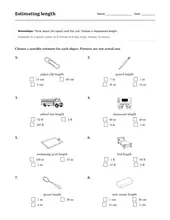
- Estimating length Choose a sensible estimate for each object. Pictures are not actual size.
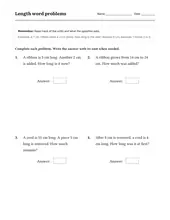
- Length word problems Complete each problem. Write the answer with its unit when needed.
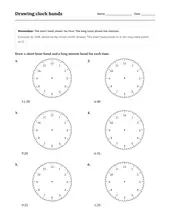
- Drawing clock hands Draw a short hour hand and a long minute hand for each time.


Data & graphing 3 skills
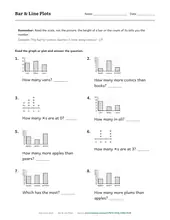
- Bar & line plots Read the scale, not the picture: the height of a bar or the count of Xs tells you the number.
- Pictographs Read the key first. Count the symbols, then multiply by what each one stands for.
- Tally charts Count tally bundles by fives. The stroke that crosses the group is the fifth mark, not an extra one.


Charts and lists for 2nd grade, new
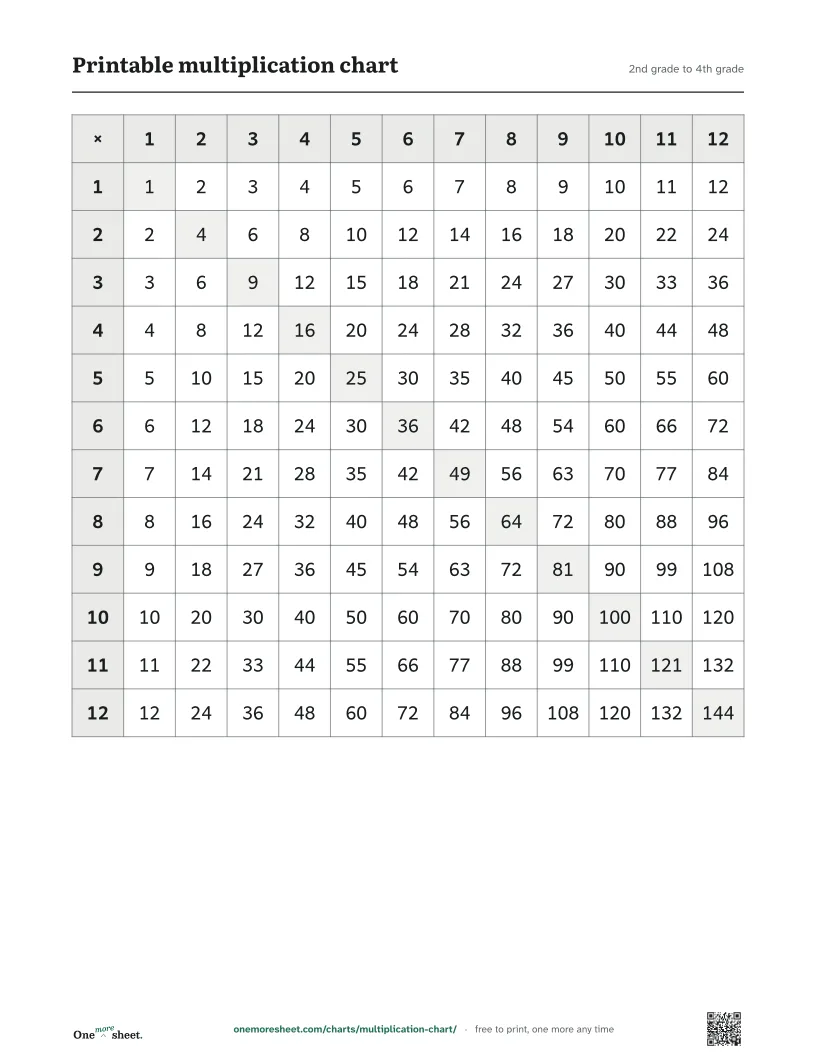
- Printable multiplication chart 2nd grade to 4th grade
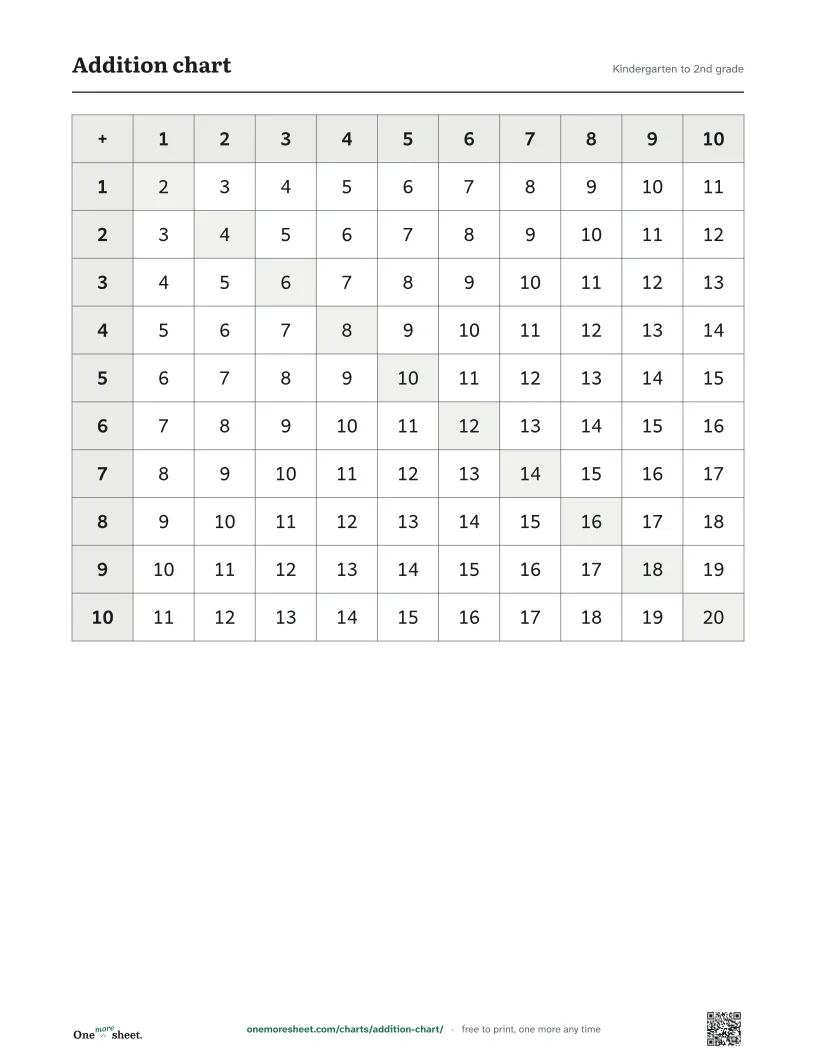
- Addition chart, new Kindergarten to 2nd grade
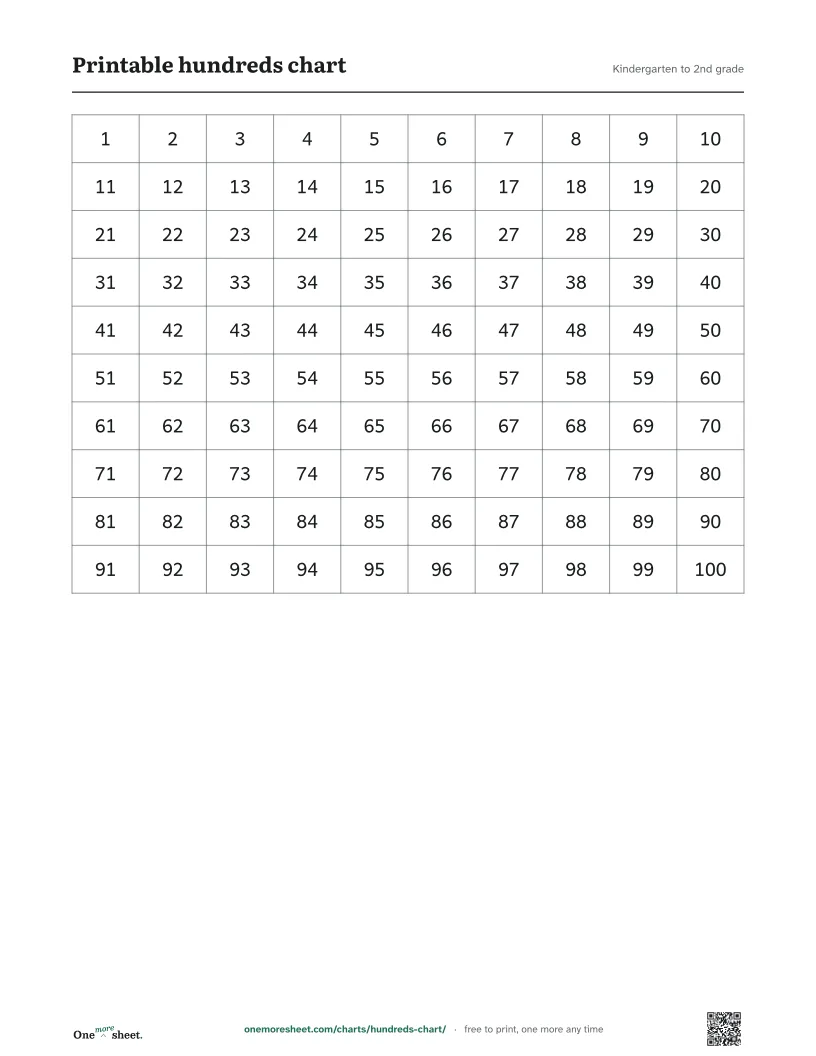
- Printable hundreds chart Kindergarten to 2nd grade
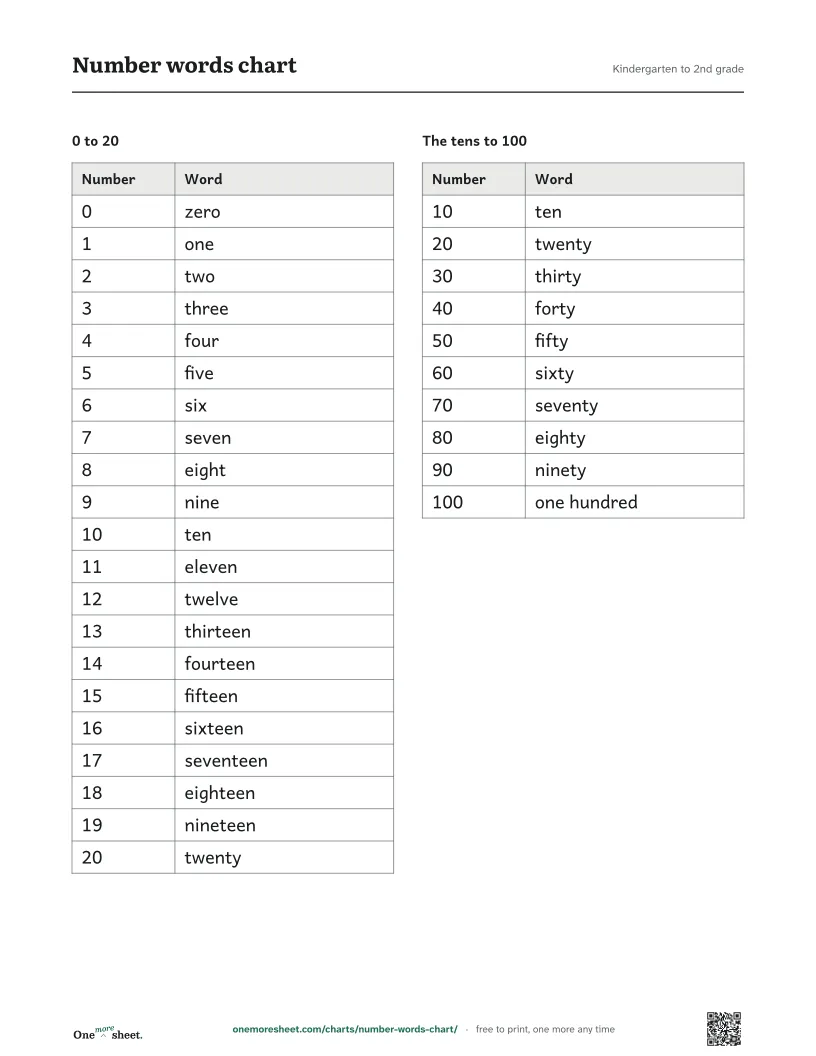
- Number words chart, new Kindergarten to 2nd grade
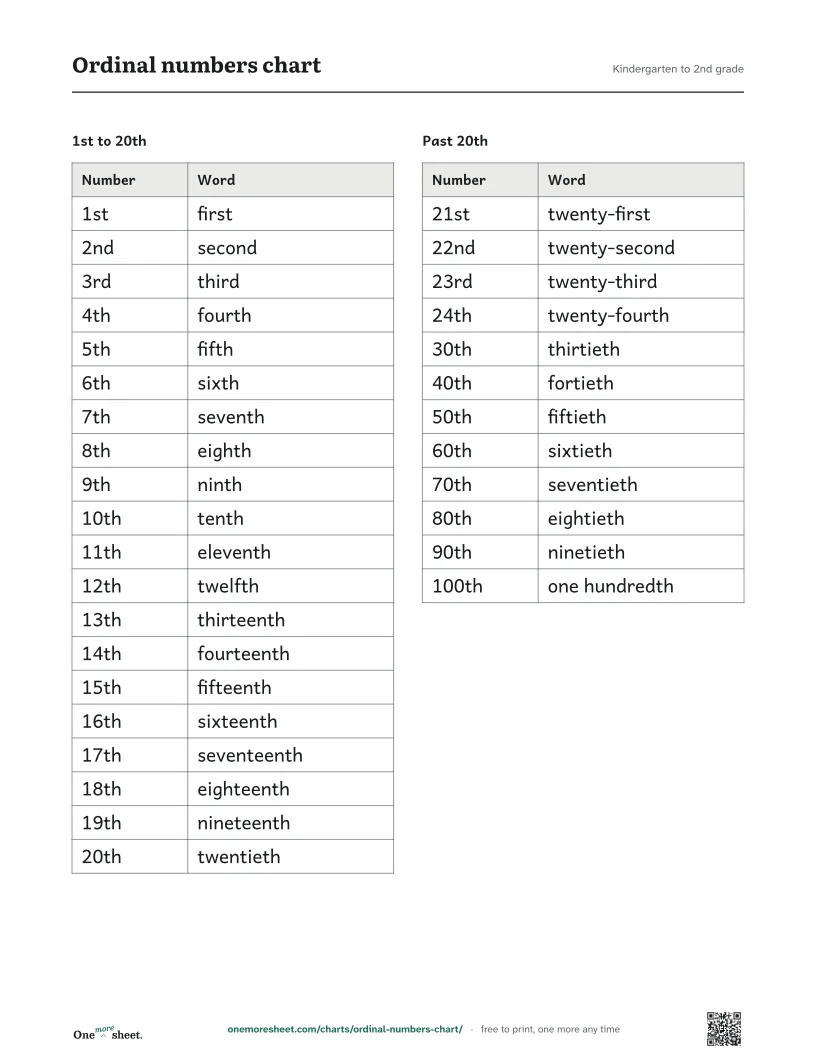
- Ordinal numbers chart, new Kindergarten to 2nd grade
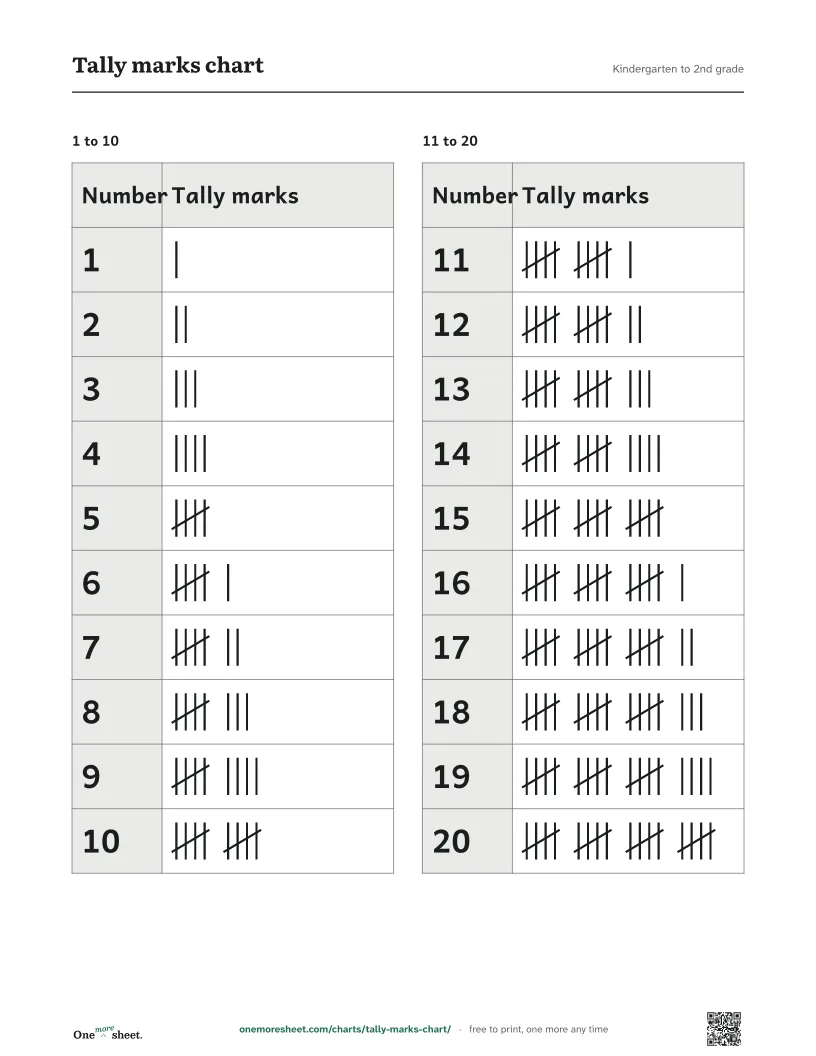
- Tally marks chart, new Kindergarten to 2nd grade
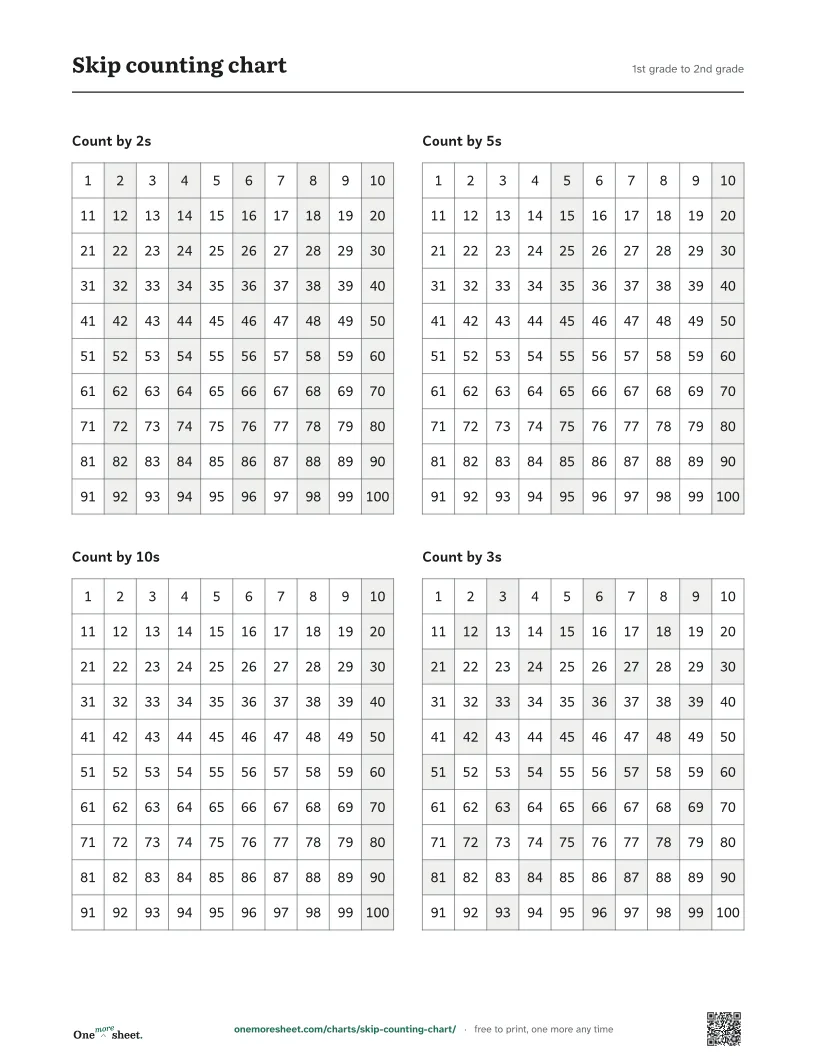
- Skip counting chart, new 1st grade to 2nd grade
- Printable place value chart 2nd grade to 5th grade
- Cursive letters chart 2nd grade to 4th grade
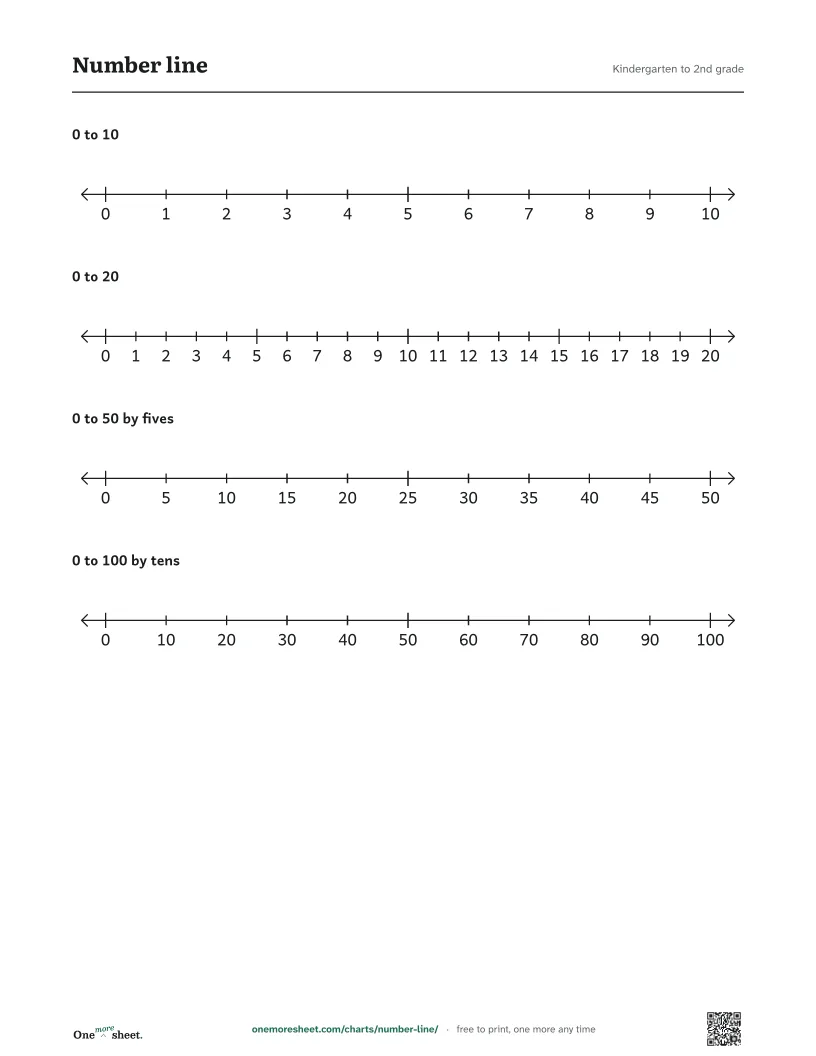
- Number line, new Kindergarten to 2nd grade
- Adjectives list, new 1st grade to 5th grade
- Compound words list, new 1st grade to 3rd grade
- Conjunctions list, new 2nd grade to 8th grade
- Consonant blends chart, new 1st grade to 2nd grade
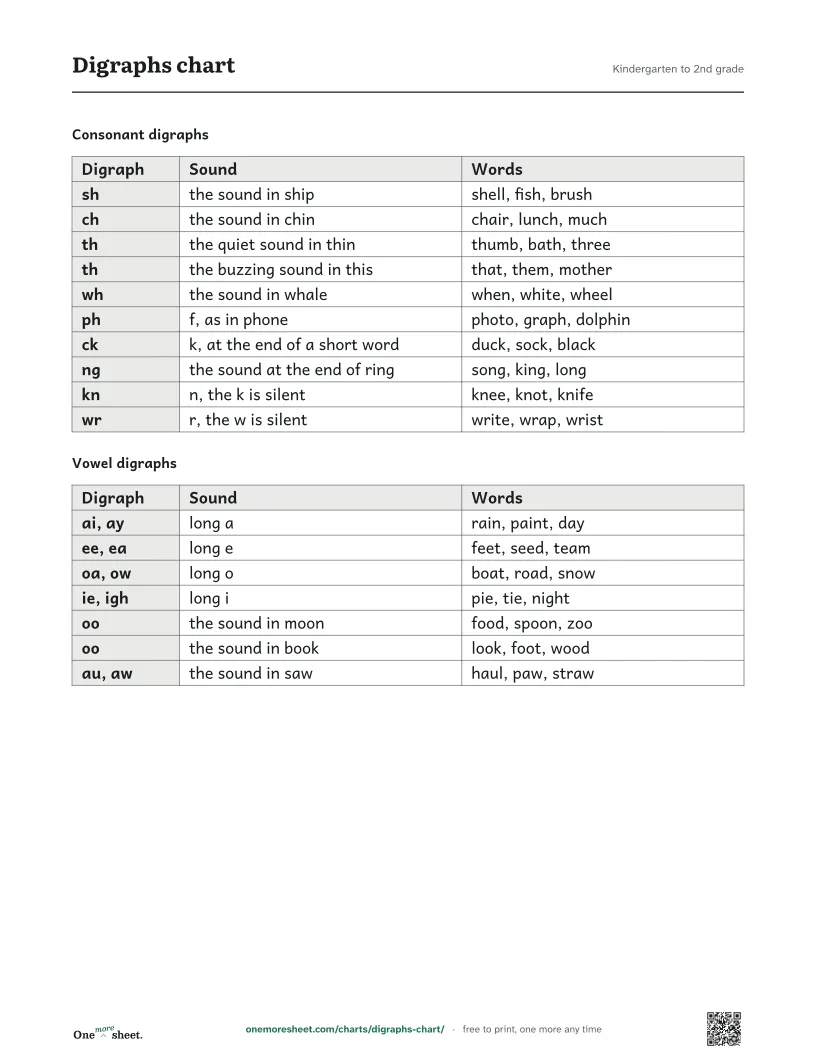
- Digraphs chart, new Kindergarten to 2nd grade
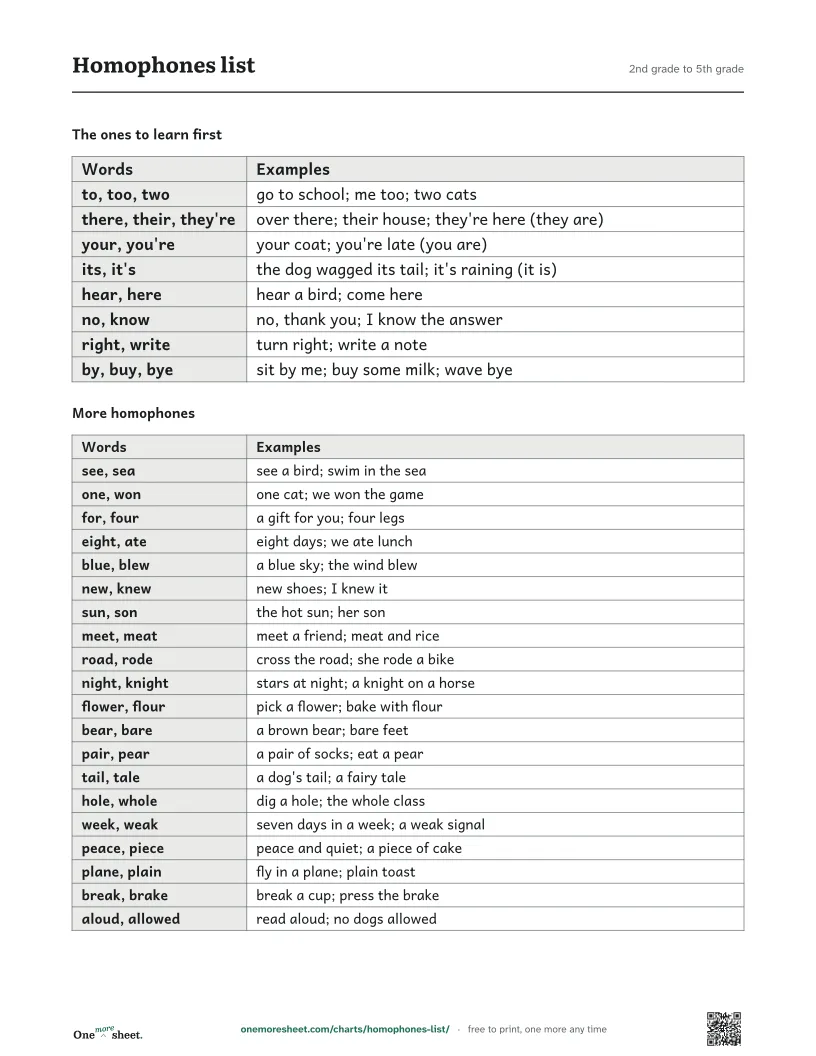
- Homophones list, new 2nd grade to 5th grade
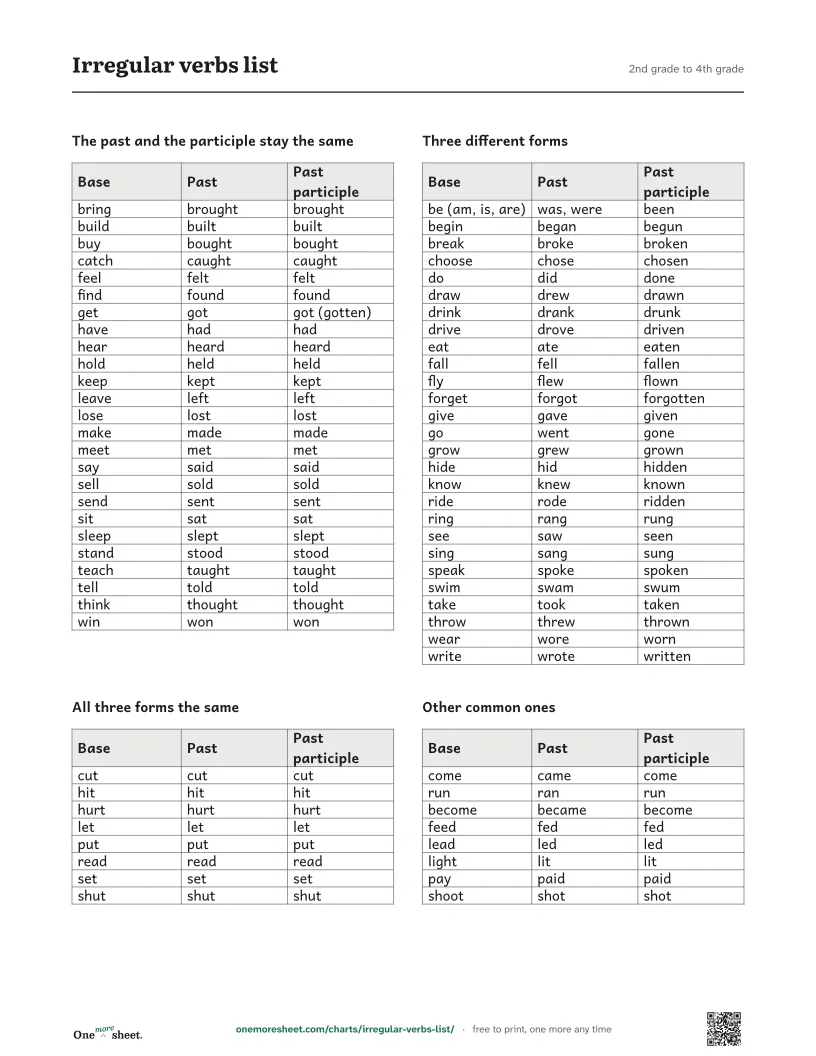
- Irregular verbs list 2nd grade to 4th grade
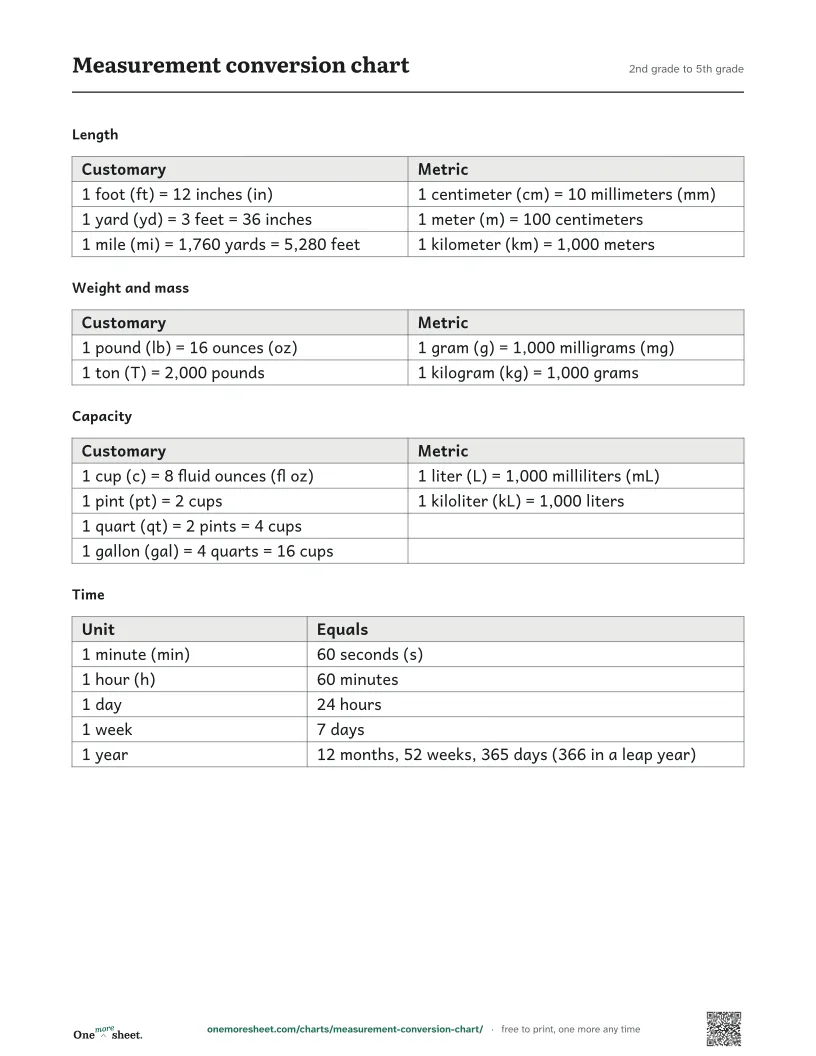
- Measurement conversion chart, new 2nd grade to 5th grade
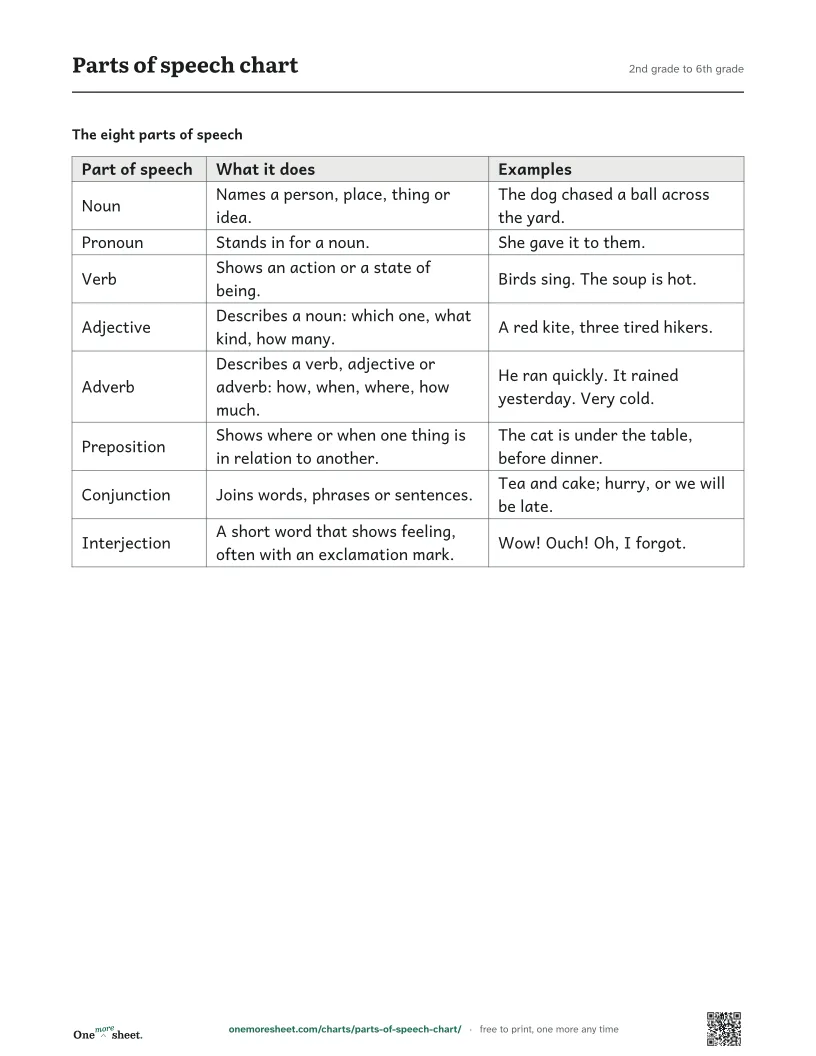
- Parts of speech chart, new 2nd grade to 6th grade
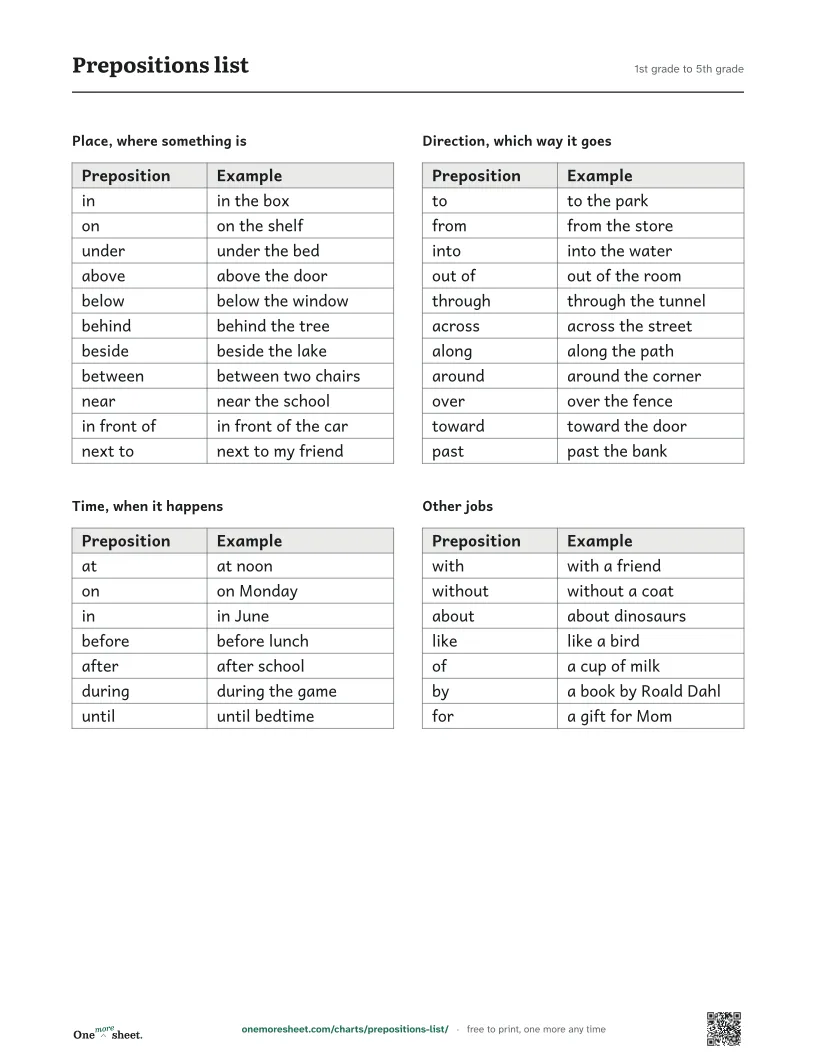
- Prepositions list, new 1st grade to 5th grade
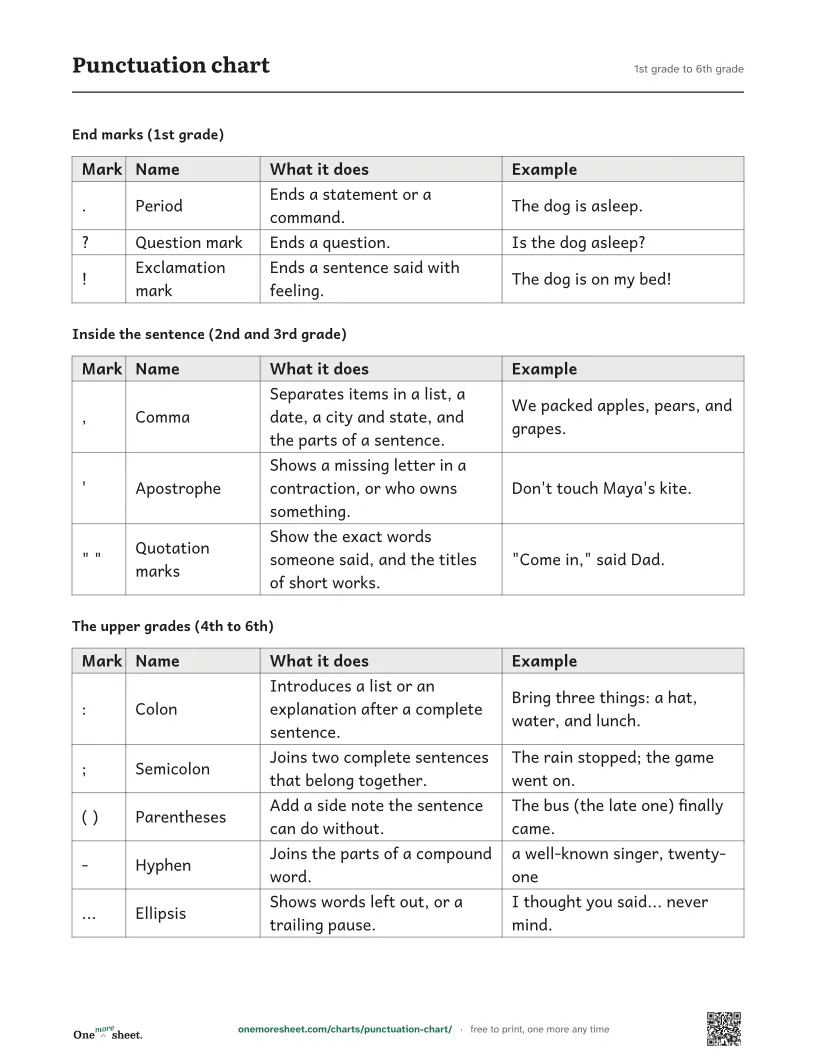
- Punctuation chart, new 1st grade to 6th grade
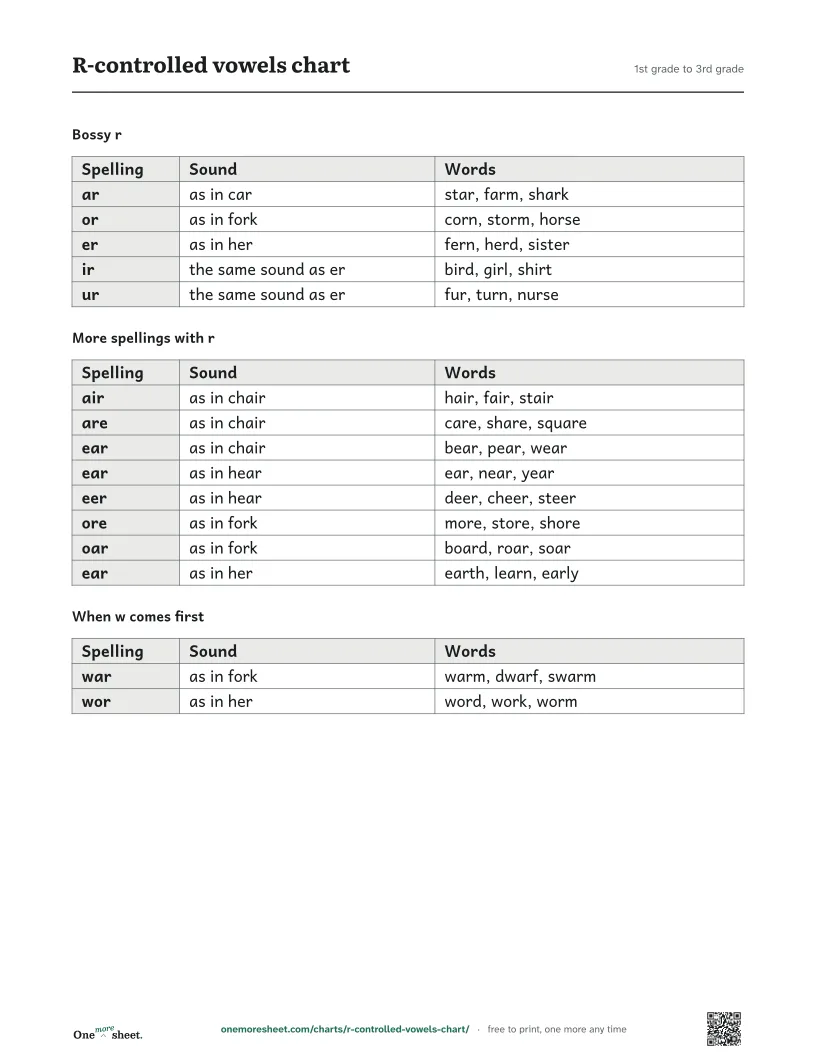
- R-controlled vowels chart, new 1st grade to 3rd grade
- Synonyms list, new 2nd grade to 5th grade
- Verb tense chart, new 2nd grade to 6th grade
- Vowel chart, new Kindergarten to 2nd grade
- Vowel teams chart, new 1st grade to 3rd grade
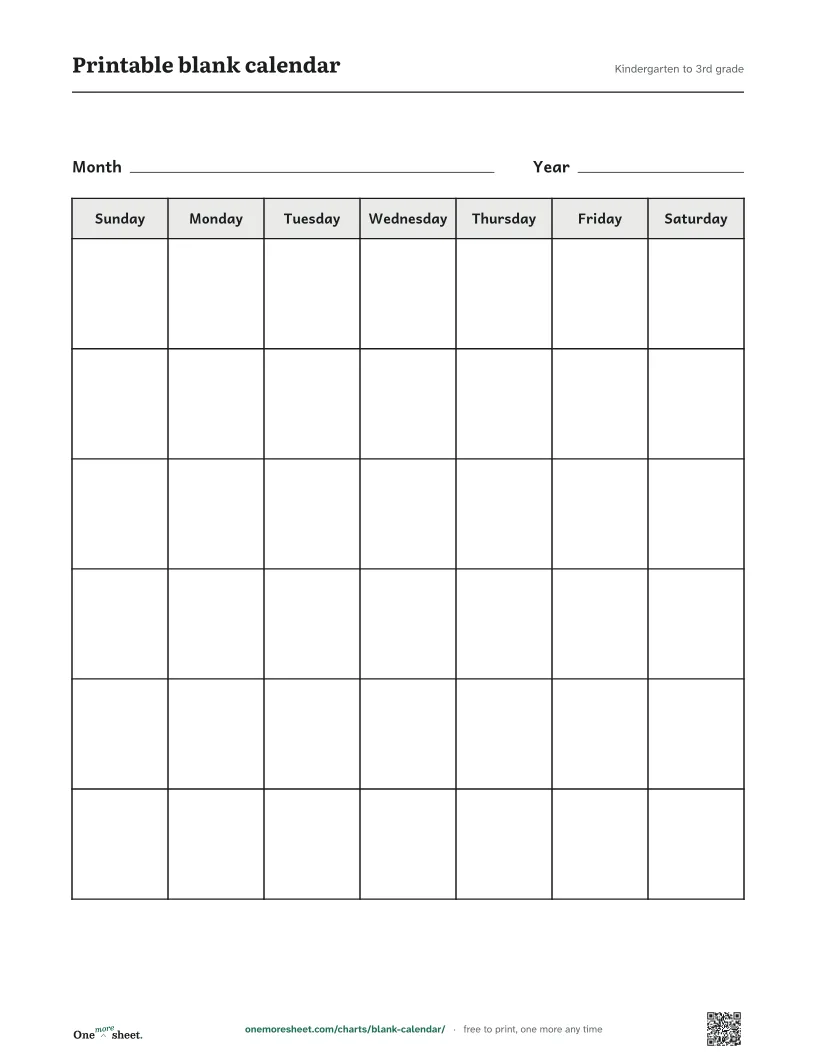
- Printable blank calendar, new Kindergarten to 3rd grade
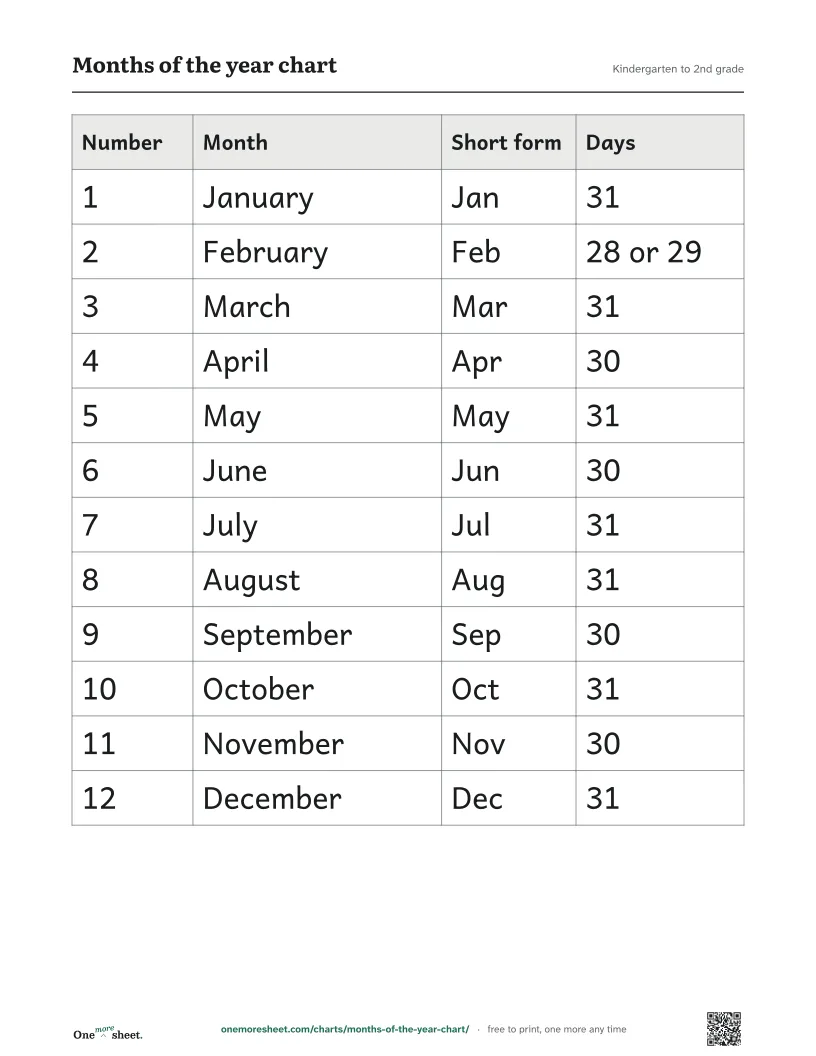
- Months of the year chart, new Kindergarten to 2nd grade
- Handwriting paper preschool to 3rd grade
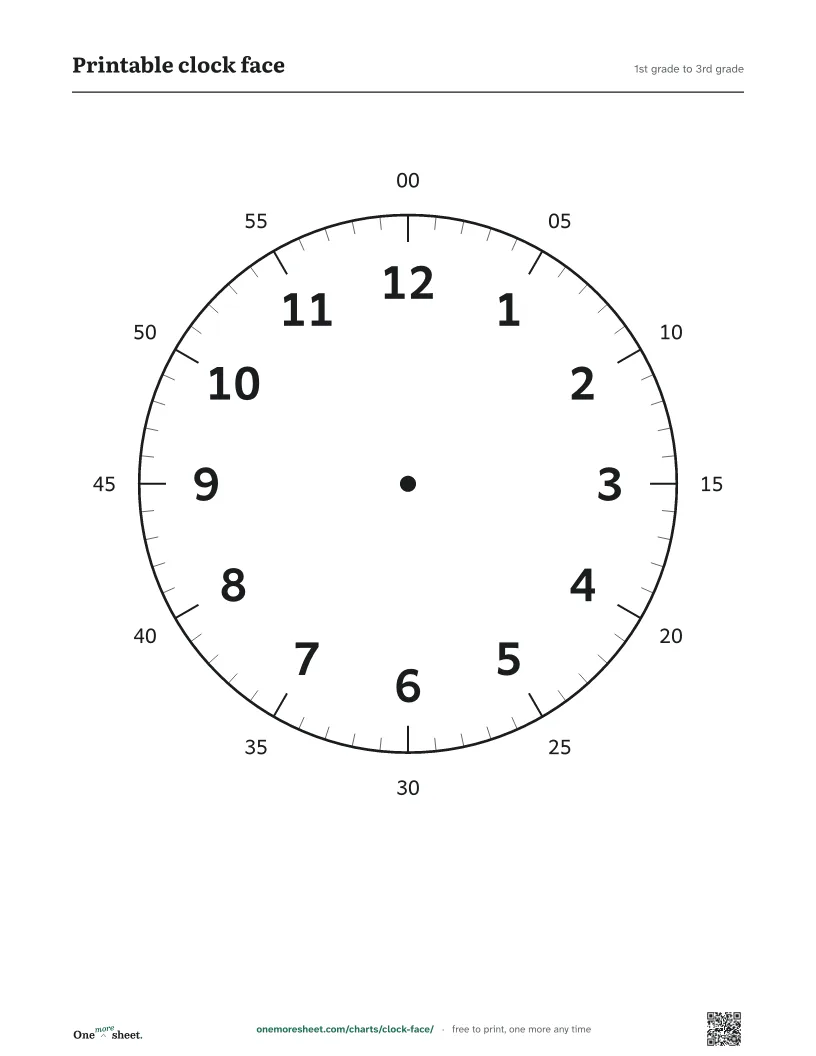
- Printable clock face, new 1st grade to 3rd grade
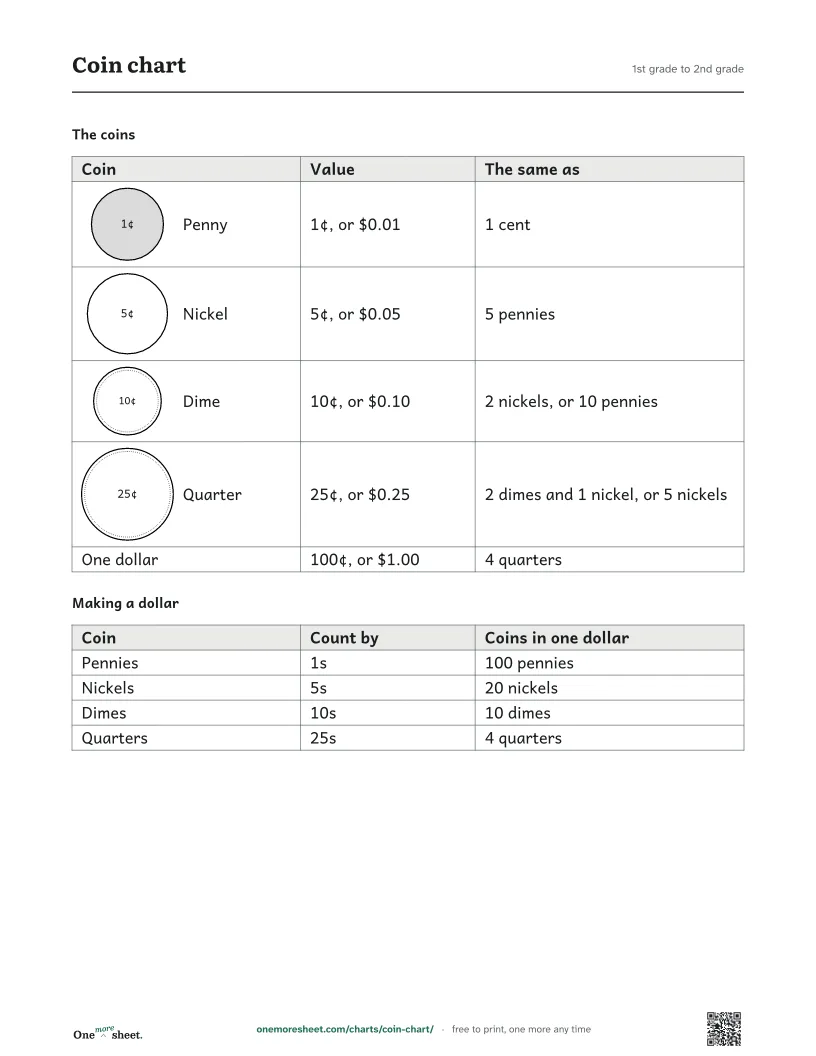
- Coin chart, new 1st grade to 2nd grade
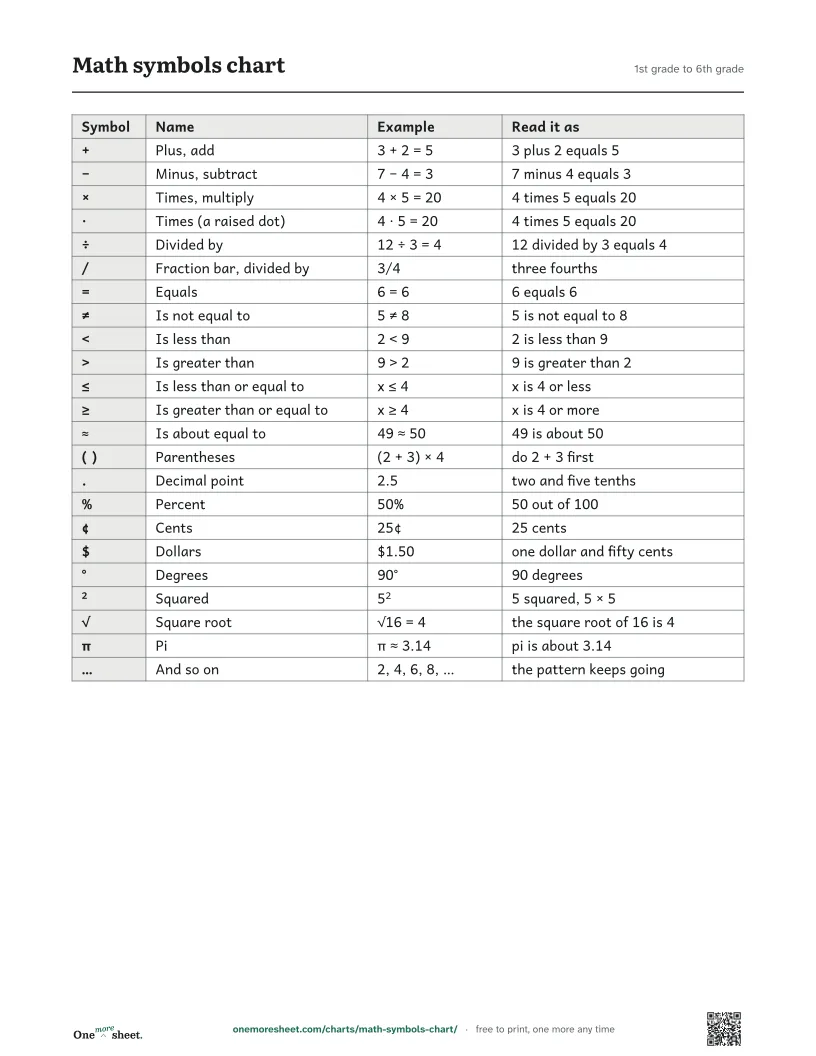
- Math symbols chart, new 1st grade to 6th grade
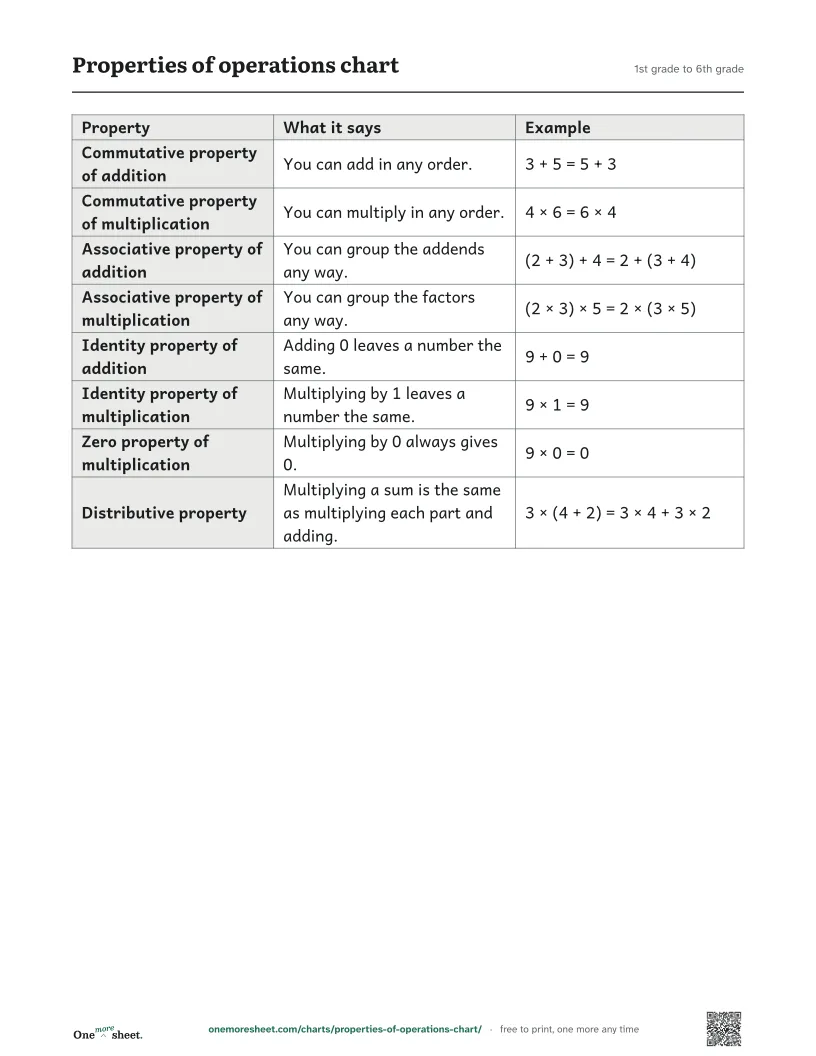
- Properties of operations chart, new 1st grade to 6th grade
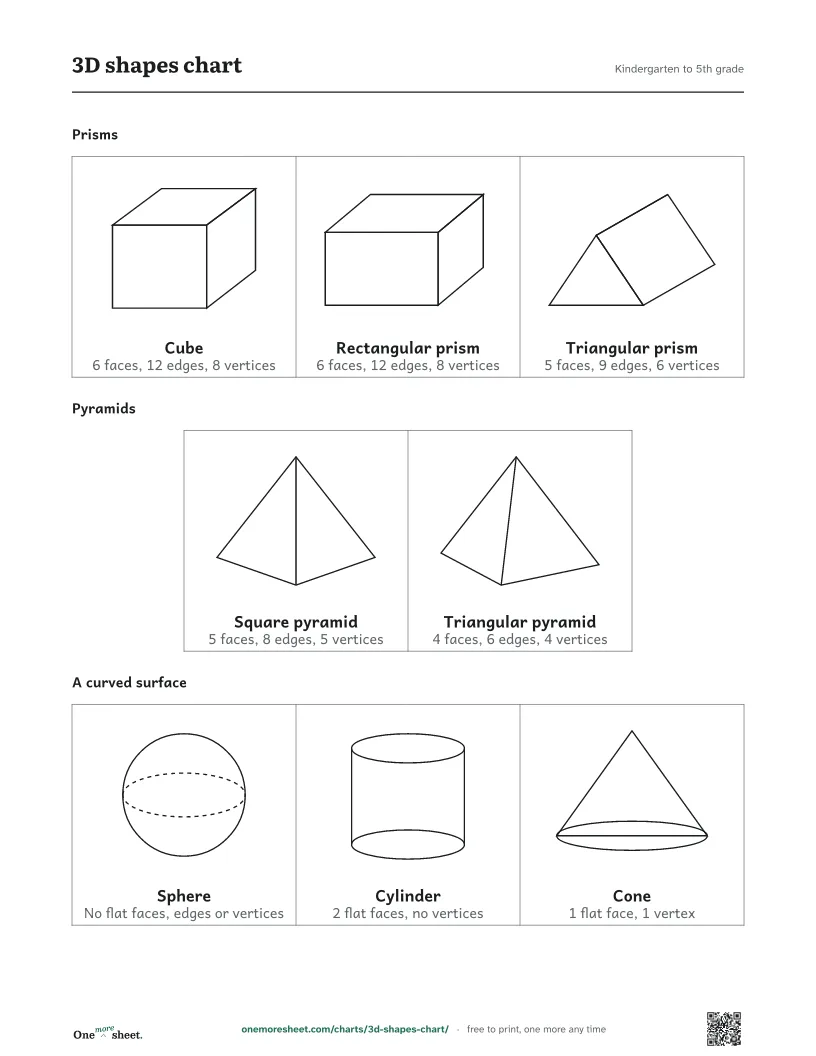
- 3D shapes chart, new Kindergarten to 5th grade
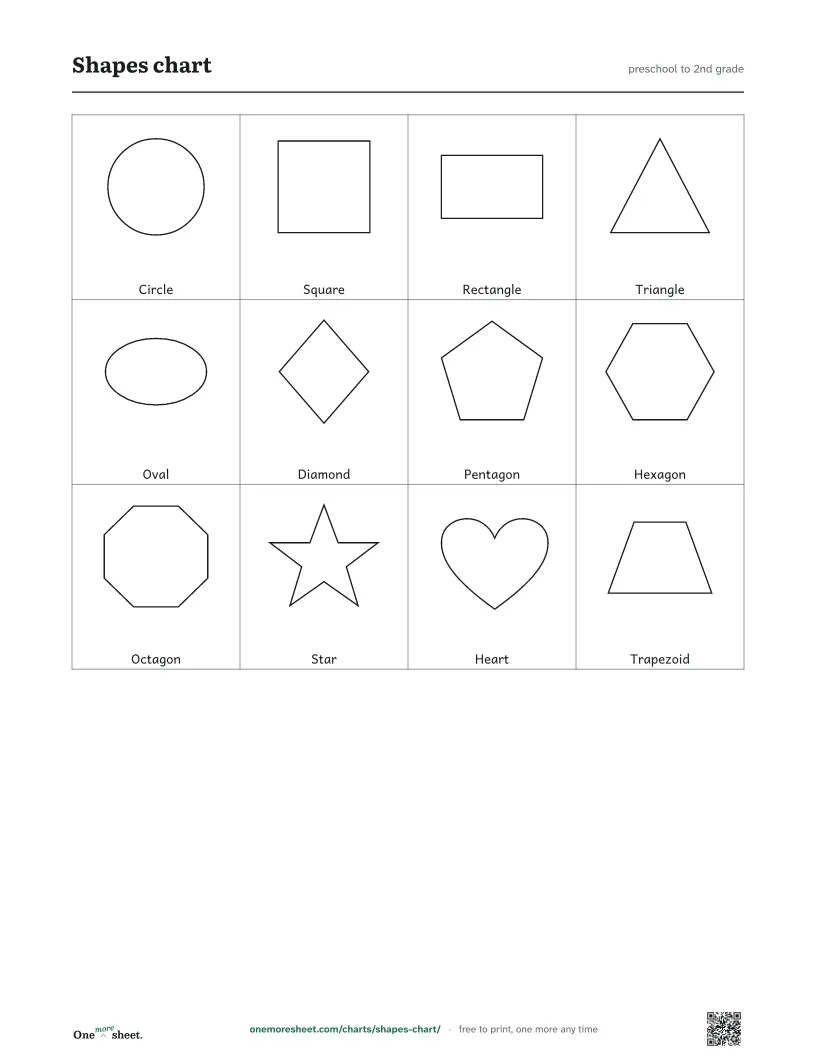
- Shapes chart, new preschool to 2nd grade
- Dolch sight words for 2nd grade 2nd grade
- Fry sight words, second 100 1st grade to 2nd grade
- Fry sight words, third 100 2nd grade to 3rd grade
- 2nd grade spelling words 2nd grade



Start with one of these
Good first picks for 2nd grade. One skill each, answer key included.