Punctuation worksheets

Periods, commas, apostrophes, and quotation marks in the right places.
Nothing in punctuation matches that. Search the whole site
Skip past the listEnd punctuation 1 skills
- End punctuation A telling sentence ends with a period. An asking sentence ends with a question mark. A strong-feeling sentence ends with an exclamation point.

Apostrophes 3 skills
- Contractions A contraction squeezes two words into one. The apostrophe sits exactly where letters dropped out: do not becomes don't.
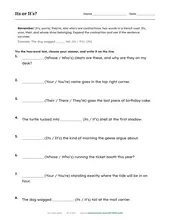
- Contractions or possessives? It's, you're, they're, and who's are contractions: two words in a trench coat. Its, your, their, and whose show belonging. Expand the contraction and see if the sentence still makes sense.
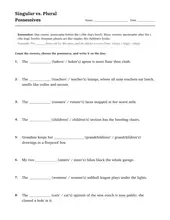
- Singular vs. plural possessives One owner: apostrophe before the s (the dog's bowl). Many owners: apostrophe after the s (the dogs' bowls). Irregular plurals act like singles: the children's books.

Commas 9 skills
- Commas after introductory phrases When a sentence starts with a warm-up phrase, a comma marks where the real sentence begins: After the storm, we raked the yard.
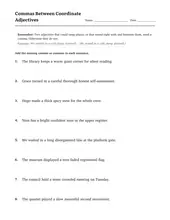
- Commas between coordinate adjectives Two adjectives that could swap places, or that sound right with and between them, need a comma. Otherwise they do not.
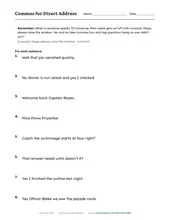
- Commas for direct address When a sentence speaks TO someone, their name gets set off with commas: Maya, please close the window. Yes and no take commas too, and tag questions hang on one: didn't you?
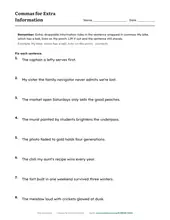
- Commas for extra detail Extra information rides in the sentence wrapped in commas: My bike, which has a bell, lives on the porch. Lift it out and you still know which bike.
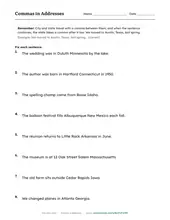
- Commas in addresses City and state travel with a comma between them, and when the sentence continues, the state takes a comma after it too: We moved to Austin, Texas, last spring.
- Commas in compound sentences When two complete sentences join with and, but, or, so, or yet, a comma goes before the joining word: It rained, so we read inside.
- Commas in dates A comma separates the day from the year: July 4, 2019. A weekday gets one too: Monday, June 8.
- Commas in letters A friendly letter needs two commas: one after the greeting (Dear Grandma,) and one after the closing (Love, Maya).
- Commas in a series When you list three or more things, put a comma after each one before the last: hats, mittens, and boots.



Quotation marks 2 skills
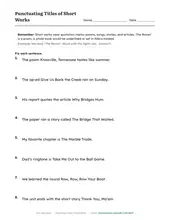
- Punctuating titles of short works Short works wear quotation marks: poems, songs, stories, and articles. 'The Raven' is a poem; a whole book would be underlined or set in italics instead.
- Quotation marks in dialogue Quotation marks hug the exact words someone says, and the comma stays inside the hug: "Let's go," said Maya.

Semicolons, colons, and dashes, new 3 skills
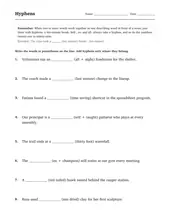
- Hyphens When two or more words work together as one describing word in front of a noun, join them with hyphens: a ten-minute break. Self-, ex- and all- always take a hyphen, and so do the numbers twenty-one to ninety-nine.
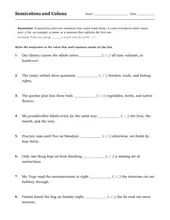
- Semicolons and colons A semicolon joins two sentences that could stand alone. A colon introduces what comes next: a list, an example, a name, or a sentence that explains the first one.
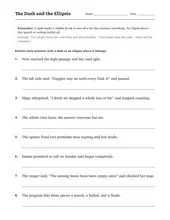
- The dash and the ellipsis A dash marks a sudden break or sets off a list that renames something. An ellipsis shows that speech or writing trailed off.
All English worksheets →
More English topics: Grammar · Sentence structure · Capitalization · Spelling · Phonics · Vocabulary · Reading comprehension · Handwriting · Writing