2nd grade grammar worksheets
27 grammar skills at 2nd grade, one sheet each, free with its answer key: action verbs, adjective or adverb, adverbs of how, when, and where, and more.
Nothing in 2nd grade grammar matches that. Search every grade
Nouns
- Collective nouns A collective noun names a group: a herd of cows, a flock of birds, a litter of puppies.
- Common and proper nouns A common noun names any one (city, girl, day). A proper noun names a specific one and starts with a capital (Chicago, Maya, Monday).
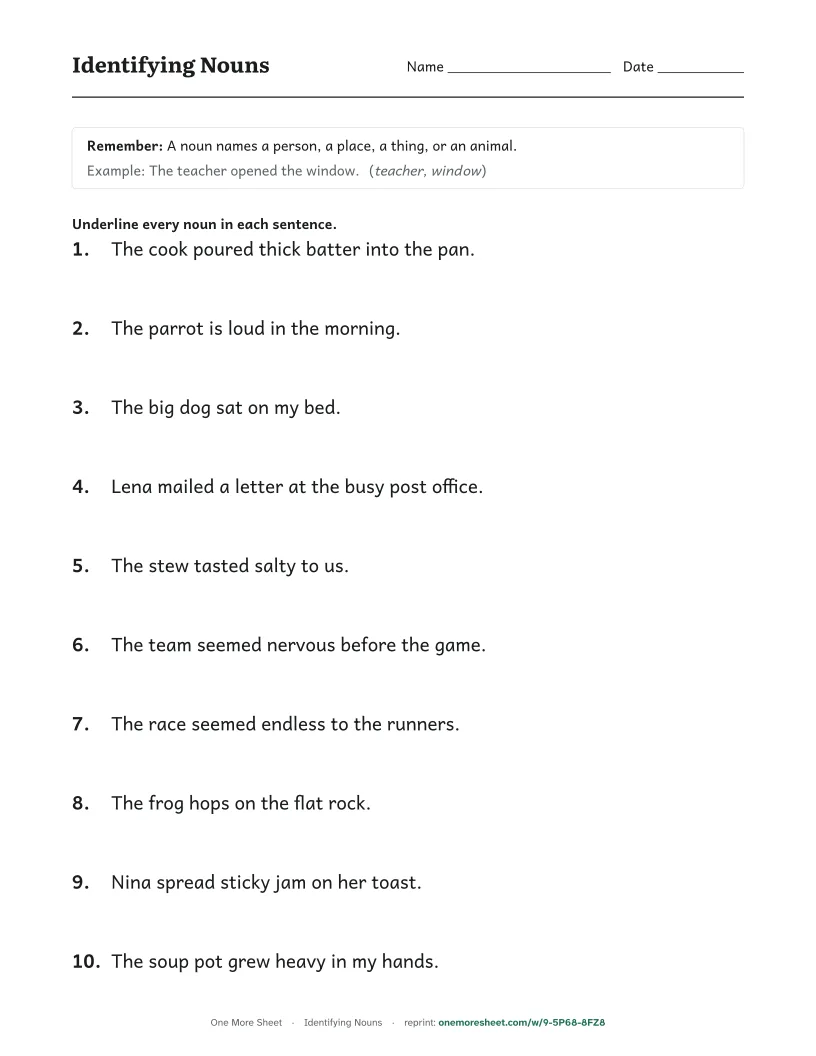
- Identifying nouns A noun names a person, a place, a thing, or an animal.
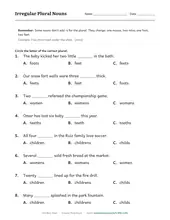
- Irregular plural nouns Some nouns don't add -s for the plural. They change: one mouse, two mice; one foot, two feet.
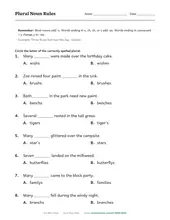
- Plural noun rules Most nouns add -s. Words ending in x, ch, sh, or s add -es. Words ending in consonant + y change y to -ies.
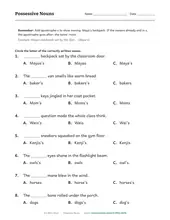
- Possessive nouns Add apostrophe-s to show owning: Maya's backpack. If the owners already end in s, the apostrophe goes after: the twins' room.
Verbs
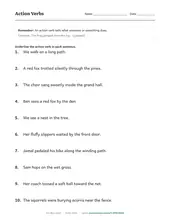
- Action verbs An action verb tells what someone or something does.
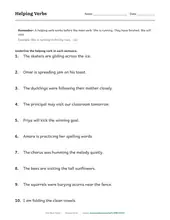
- Helping verbs A helping verb works before the main verb: She is running. They have finished. We will visit.
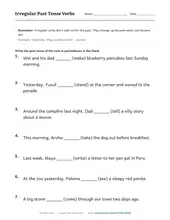
- Irregular past tense verbs Irregular verbs don't add -ed for the past. They change: go became went, eat became ate.
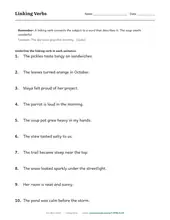
- Linking verbs A linking verb connects the subject to a word that describes it: The soup smells wonderful.
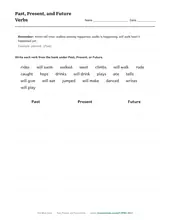
- Past, present, and future verbs Verbs tell time: walked already happened, walks is happening, will walk hasn't happened yet.
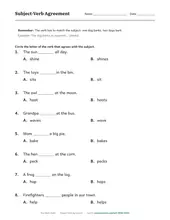
- Subject-verb agreement The verb has to match the subject: one dog barks, two dogs bark.
Adjectives
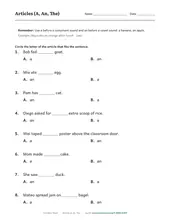
- Articles (a, an, the) Use a before a consonant sound and an before a vowel sound: a banana, an apple.
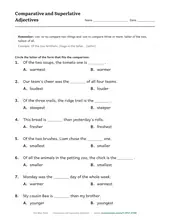
- Comparative and superlative adjectives Use -er to compare two things and -est to compare three or more: taller of the two, tallest of all.
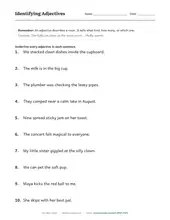
- Identifying adjectives An adjective describes a noun. It tells what kind, how many, or which one.
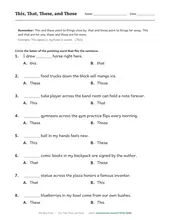
- This, that, these, and those This and these point to things close by; that and those point to things far away. This and that are for one; these and those are for more.
Adverbs
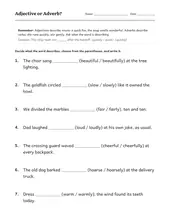
- Adjective or adverb? Adjectives describe nouns: a quick fox, the soup smells wonderful. Adverbs describe verbs: she runs quickly, stir gently. Ask what the word is describing.
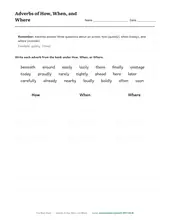
- Adverbs of how, when, and where Adverbs answer three questions about an action: how (quietly), when (today), and where (outside).
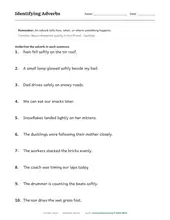
- Identifying adverbs An adverb tells how, when, or where something happens.
Pronouns
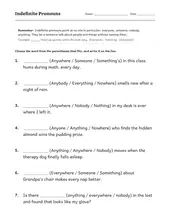
- Indefinite pronouns Indefinite pronouns point at no one in particular: everyone, someone, nobody, anything. They let a sentence talk about people and things without naming them.
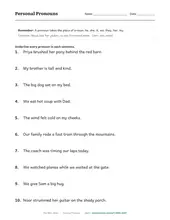
- Personal pronouns A pronoun takes the place of a noun: he, she, it, we, they, her, my.
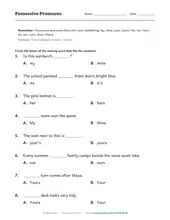
- Possessive pronouns Possessive pronouns show who owns something: my, mine, your, yours, his, her, hers, its, our, ours, their, theirs.
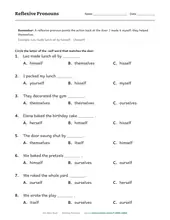
- Reflexive pronouns A reflexive pronoun points the action back at the doer: I made it myself; they helped themselves.
Prepositions
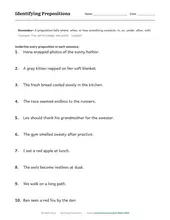
- Identifying prepositions A preposition tells where, when, or how something connects: in, on, under, after, with.
Conjunctions
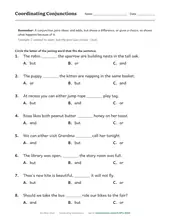
- Coordinating conjunctions A conjunction joins ideas: and adds, but shows a difference, or gives a choice, so shows what happens because of it.
Mixed parts of speech
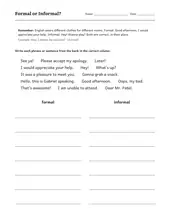
- Formal or informal? English wears different clothes for different rooms. Formal: Good afternoon; I would appreciate your help. Informal: Hey! Wanna play? Both are correct, in their place.
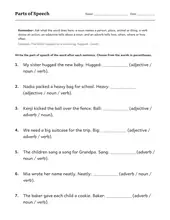
- Parts of speech, new Ask what the word does in this sentence: a noun names something, a verb shows an action or a state of being, an adjective describes a noun, an adverb tells how, when, where or how often, and a pronoun takes the place of a noun.
All 2nd grade English worksheets →
More 2nd grade English: Sentence structure · Capitalization · Punctuation · Spelling · Phonics · Vocabulary · Reading comprehension · Handwriting · Writing
Grammar at other grades: K · 1st · 3rd · 4th · 5th · 6th · 7th · 8th