2nd grade math worksheets
2nd grade math meets multiplication for the first time, as equal groups and arrays with the 2s, 5s, and 10s, alongside first fractions, money word problems, and reading bar graphs.
Nothing in 2nd grade math matches that. Search every grade
Counting & place value 6 skills
Counting & number sense
- Greater than, less than Compare the biggest place first: the open side of the symbol faces the bigger number.
- Ordering numbers Compare the numbers place by place, then write them in the order asked.
- Skip counting to 1,000 Find the step first: does the row go up by 5, by 10, or by 100? Then keep that step for every blank.


Place value & rounding
- 10 or 100 more or less Ten more or less moves the tens digit. One hundred more or less moves the hundreds digit. The other digits stay put.
- Expanded form Expanded form stretches a number out to show what each digit is worth, like 358 = 300 + 50 + 8.
- Hundreds, tens & ones A 3-digit number is made of hundreds, tens, and ones. Count each kind, then write the digits in order.


Addition & subtraction 12 skills
Facts & fluency
- Addition mad minute Work fast and left to right. Skip a hard one and come back; the clock does not wait.
- Addition within 20 Make a ten first when you can. It turns hard facts like 9 + 6 into easy ones like 10 + 5.
- Balancing equations The equal sign means both sides are the same amount, so check that they balance.
- Fact families The three numbers in the roof are a family. Write all four facts they make together.
- Missing addends Find the number that makes the equation true. Count up from the part you already know.
- Subtraction within 20 Think addition to subtract: for 13 − 8, ask what you add to 8 to make 13.


Multi-digit addition & subtraction
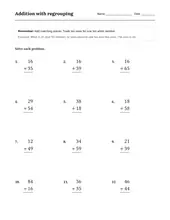
- Addition with regrouping Add the ones first. When they make ten or more, write the ones digit and carry the ten to the next column.
- Mental math Turn hard numbers into friendly ones: to add 29, add 30 and then take 1 back.
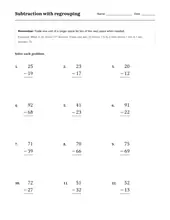
- Subtraction with regrouping If the top digit is smaller, borrow: take one ten from the next column and add ten to the digit you are subtracting from.
- Three-digit addition & subtraction Check the sign first, then work one column at a time starting from the ones.
- Two-digit addition Add the ones first. If they make ten or more, carry a ten to the tens column.
- Two-digit subtraction with regrouping If the top ones digit is too small, trade one ten for ten ones before you subtract.



Multiplication & division 1 skills
- Multiplication facts 0–12 Multiplication is repeated addition. When you know your times tables, you can solve problems quickly without counting on your fingers.

Word problems 7 skills
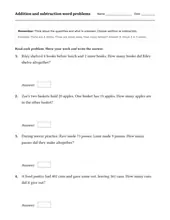
- Addition & subtraction word problems Read the whole story before you pick a sign. Does it put amounts together, or take some away?
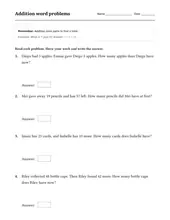
- Addition word problems Read the whole story, then find the question. If groups are coming together, add.
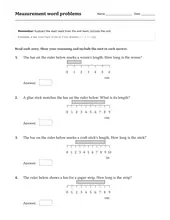
- Measurement word problems Look for the units in the story. Your answer needs a unit too, so write it every time.
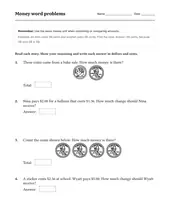
- Money word problems Count the coins from the biggest value down. When the story asks for change, start at the cost and count up.
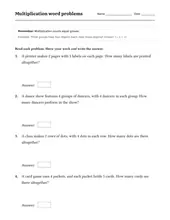
- Multiplication word problems Look for equal groups in the story. Same-size groups, counted in one move: that is multiplication.
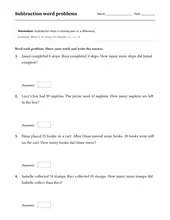
- Subtraction word problems Read the story and find the question. If something goes away, or two amounts get compared, subtract.
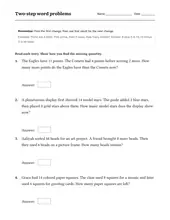
- Two-step word problems Read each story. Show how you find the missing quantity.
Factors & patterns 1 skills
- Even & odd numbers Even numbers split into pairs with none left over. Check the ones digit: 0, 2, 4, 6, and 8 mean even.

Fractions 1 skills
- Unit fractions & parts of a whole The bottom number counts the equal parts in the whole. The top number counts the shaded parts.

Shapes & angles 4 skills
- Identifying 3d shapes Solid shapes take up space. Name the whole solid, not just the flat face you can see.
- Partitioning shapes Equal shares means every piece is exactly the same size, a fair share for everyone.
- Sides & vertices Sides are the straight edges and vertices are the corners. Mark where you start so you count each one just once.
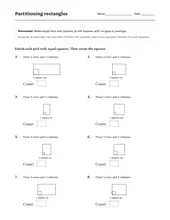
- Partitioning rectangles Finish each grid with equal squares. Then count the squares.


Measurement 7 skills
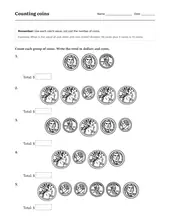
- Counting coins Count the coins that are worth the most first, then count on. A dime is small, but it is worth 10 cents.
- Making change Start at the cost and count up to the money paid. What you count along the way is the change.
- Measuring length Find where the bar starts and where it ends. The length is the distance between them.
- Telling time The short hand tells the hour and the long hand tells the minutes. Read the short hand first.
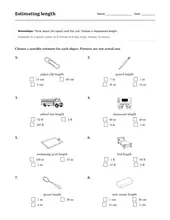
- Estimating length Choose a sensible estimate for each object. Pictures are not actual size.
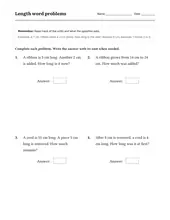
- Length word problems Complete each problem. Write the answer with its unit when needed.
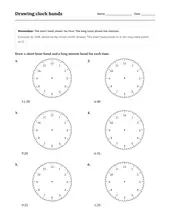
- Drawing clock hands Draw a short hour hand and a long minute hand for each time.


Data & graphing 3 skills
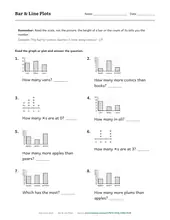
- Bar & line plots Read the scale, not the picture: the height of a bar or the count of Xs tells you the number.
- Pictographs Read the key first. Count the symbols, then multiply by what each one stands for.
- Tally charts Count tally bundles by fives. The stroke that crosses the group is the fifth mark, not an extra one.


About 2nd grade math
Each worksheet prints free with its answer key and new numbers on every print.
Start-of-year review
Second grade moves fast once the facts are automatic. These 1st grade sheets are the quickest way to check addition, subtraction, and place value are still warm.
Math at other grades
All math worksheets: every grade, every topic.
Also for 2nd grade: 2nd grade English worksheets.