3rd grade math worksheets

3rd grade math is the fluency year: multiplication and division facts through 12, unit fractions, word problems for every operation, and first area and perimeter.
Nothing in 3rd grade math matches that. Search every grade
Counting & place value 3 skills
- Expanded form Expanded form stretches a number out to show what each digit is worth, like 358 = 300 + 50 + 8.
- Place value to thousands The place tells the value: the same digit 7 can be worth 7, 70, 700, or 7,000 depending on where it sits.
- Rounding to the nearest 10 and 100 Look at the digit one place to the right: 5 or more rounds up, 4 or less rounds down.


Addition & subtraction 6 skills
Facts & fluency
- Fact families The three numbers in the roof are a family. Write all four facts they make together.

Multi-digit addition & subtraction
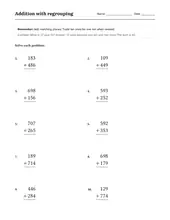
- Addition with regrouping Add the ones first. When they make ten or more, write the ones digit and carry the ten to the next column.
- Mental math Turn hard numbers into friendly ones: to add 29, add 30 and then take 1 back.
- Subtracting across zeros When a zero can't lend, keep moving left until you find a digit that can.
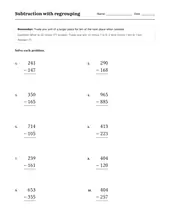
- Subtraction with regrouping If the top digit is smaller, borrow: take one ten from the next column and add ten to the digit you are subtracting from.
- Three-digit addition & subtraction Check the sign first, then work one column at a time starting from the ones.



Multiplication & division 20 skills
Multiplication
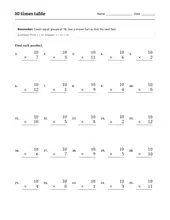
- 10 times table Ten times a number is the number with a 0 on the end.
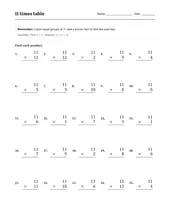
- 11 times table Eleven times a single digit repeats the digit: 11 × 4 = 44. For 11 and 12, add the number to ten times itself.
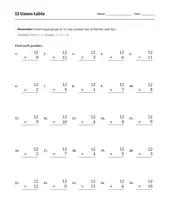
- 12 times table Twelve times a number is ten times the number plus two times the number.
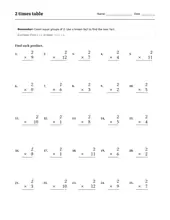
- 2 times table The 2 times table is doubling. Two times a number is the number plus itself.
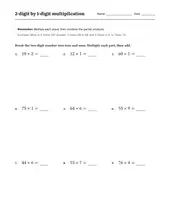
- 2-digit by 1-digit multiplication Multiply the ones first, carry if you need to, then multiply the tens and add the carry.
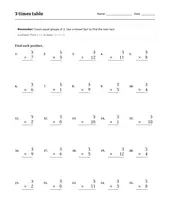
- 3 times table Three times a number is the number added three times. Count by threes: 3, 6, 9, 12.
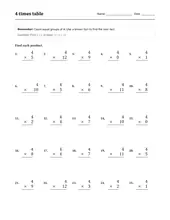
- 4 times table Four times a number is double, then double again.
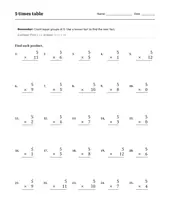
- 5 times table Five times a number ends in 0 or 5. Count by fives, or take half of ten times the number.
- 6 times table Six times a number is the 5s fact plus one more of the number. For even numbers, the answer ends in the same digit you started with.
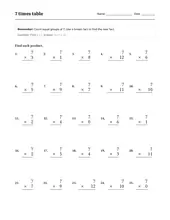
- 7 times table The 7s have no shortcut, so learn them as facts. Remember 5, 6, 7, 8: 56 = 7 × 8.
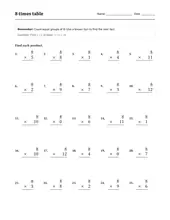
- 8 times table Eight times a number is double, double, double.
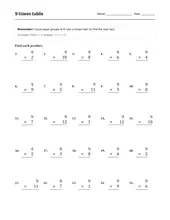
- 9 times table Nine times a number: the tens digit is one less than the number, and the two digits add up to 9.
- Multiplication facts 0–12 Multiplication is repeated addition. When you know your times tables, you can solve problems quickly without counting on your fingers.
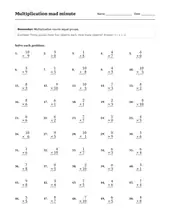
- Multiplication mad minute Answer fast and in order. Skip one you are stuck on and come back at the end.
- Multiplying by multiples of 10 Use the basic fact, then think in tens: 4 × 30 is 4 × 3 tens, and 12 tens are 120.
- Properties of multiplication You can turn factors around, group them differently, or split one apart. The answer stays the same.
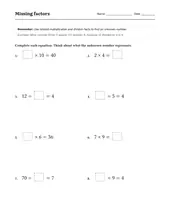
- Missing factors Complete each equation. Think about what the unknown number represents.



Division
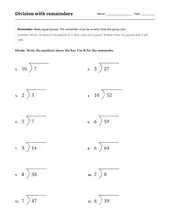
- Division facts Division is sharing into equal groups. When there are leftovers we call them remainders.
- Division with remainders Find the biggest fact that fits, then say what is left over. The leftover must be smaller than the number you divided by.

Mixed operations
- Mixed operations review Read the sign before you touch the numbers. Every problem on this page could be add, subtract, multiply, or divide.

Word problems 9 skills
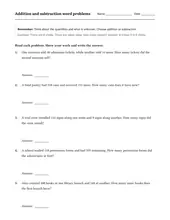
- Addition & subtraction word problems Read the whole story before you pick a sign. Does it put amounts together, or take some away?
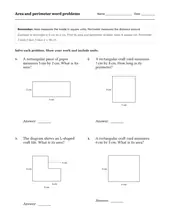
- Area & perimeter word problems Decide what the story asks for first. Covering the inside is area. Going around the edge is perimeter.
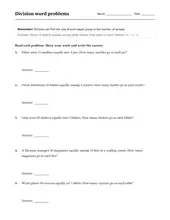
- Division word problems Look for a total being split into equal parts. Sharing fairly or making equal groups means divide.
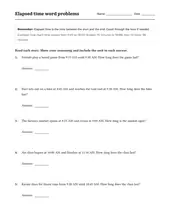
- Elapsed time word problems Find the times in the story, then count up from the earlier one. Jump to the next o'clock first, then add the extra minutes.
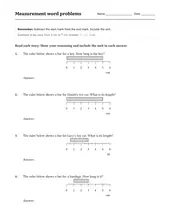
- Measurement word problems Look for the units in the story. Your answer needs a unit too, so write it every time.
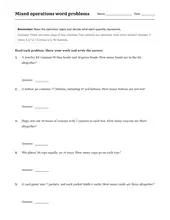
- Mixed operations word problems Read the whole story, find the question, and name the operation before you touch the numbers. Any of the four can show up.
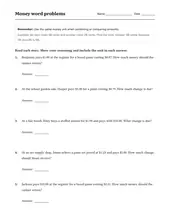
- Money word problems Count the coins from the biggest value down. When the story asks for change, start at the cost and count up.
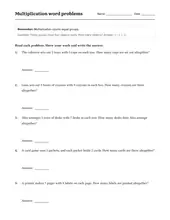
- Multiplication word problems Look for equal groups in the story. Same-size groups, counted in one move: that is multiplication.
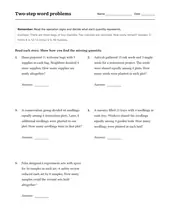
- Two-step word problems Read each story. Show how you find the missing quantity.
Factors & patterns 1 skills
- Number patterns Find what changes from one number to the next. That rule tells you what comes after.

Fractions 6 skills
- Comparing fractions If the bottom numbers match, the bigger top wins. If the top numbers match, the smaller bottom wins, because fewer cuts means bigger pieces.
- Equivalent fractions Multiply the top and the bottom by the same number, and the fraction keeps the same value.
- Fractions on a number line Count the equal parts to get the bottom number, then count the hops from 0 to the point to get the top.
- Unit fractions & parts of a whole The bottom number counts the equal parts in the whole. The top number counts the shaded parts.
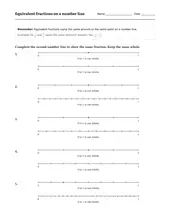
- Equivalent fractions on a number line Complete each problem. Use the models and show your reasoning where asked.
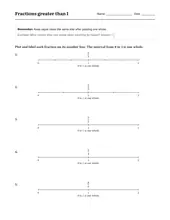
- Fractions greater than 1 Complete each problem. Use the models and show your reasoning where asked.


Shapes & angles 1 skills
- Classifying quadrilaterals A shape can hold more than one name at once. Every square is also a rectangle, a rhombus, and a quadrilateral.

Area & volume 3 skills
- Area & perimeter Area is the space inside a shape. Perimeter is the distance around the outside. For rectangles, area = length × width and perimeter = 2 × (length + width).
- Rectilinear area Split the shape into two rectangles and add their areas, or find the big rectangle and take the notch off.
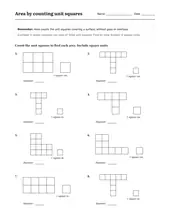
- Area by counting unit squares Count the unit squares to find each area. Include square units.


Measurement 6 skills
- Elapsed time Count up from the start time. Jump to the next o'clock first, then add the minutes left to go.
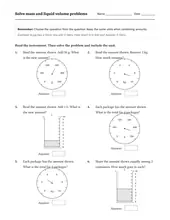
- Liquid volume and mass Read the scale carefully: find the marked numbers, work out what one small tick is worth, and count from the last marked number. For estimates, picture the object next to something whose measure you know.
- Making change Start at the cost and count up to the money paid. What you count along the way is the change.
- Measuring length Find where the bar starts and where it ends. The length is the distance between them.
- Telling time The short hand tells the hour and the long hand tells the minutes. Read the short hand first.
- Drawing clock hands Draw a short hour hand and a long minute hand for each time.



Data & graphing 4 skills
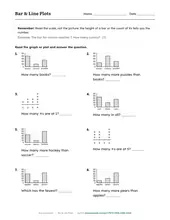
- Bar & line plots Read the scale, not the picture: the height of a bar or the count of Xs tells you the number.
- Pictographs Read the key first. Count the symbols, then multiply by what each one stands for.
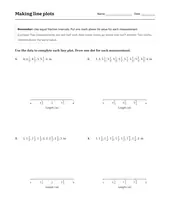
- Making line plots Use the data to complete each line plot. Draw one dot for each measurement.
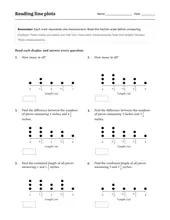
- Reading line plots Read each display and answer every question.

About 3rd grade math
Every sheet is one skill, free to print with an answer key, and never the same problems twice.
Start-of-year review
Before the multiplication year begins, make sure the 2nd grade foundations hold: two-digit adding and subtracting, place value, and a first look at the facts.
Math at other grades
All math worksheets: every grade, every topic.
Also for 3rd grade: 3rd grade English worksheets.