5th grade math worksheets

5th grade math goes deeper into fractions and computation: multiplying fractions, adding and subtracting with unlike denominators, two-digit by two-digit multiplication, and multi-step-sized word problems.
Nothing in 5th grade math matches that. Search every grade
Counting & place value 1 skills
- Powers of 10 The exponent counts the tens: 10^3 means 10 × 10 × 10. Multiplying shifts digits left; dividing shifts them right.

Multiplication & division 8 skills
- 3-digit by 2-digit multiplication Multiply by the ones digit, then by the tens digit on a second line shifted left. Add the two lines.
- Double-digit multiplication Multiply by the ones digit, then by the tens digit on a new line shifted one place left. Add the two lines.
- Long division Divide, multiply, subtract, bring down. Repeat until the digits run out, and whatever is left over is the remainder.
- Long division with remainders Divide, multiply, subtract, bring down. When nothing is left to bring down, what remains is the remainder: write it as r.
- Long division with two-digit divisors Estimate first: round the divisor to a friendly number like 20, guess the quotient digit, then multiply to check and adjust.
- Long division without remainders Divide, multiply, subtract, bring down. Repeat until nothing is left to bring down. Every answer here comes out even.
- Mixed operations review Read the sign before you touch the numbers. Every problem on this page could be add, subtract, multiply, or divide.
- Multi-digit multiplication Break the problem into parts you know, multiply, then add the partial products. Regroup when a product is 10 or more.




Word problems 8 skills
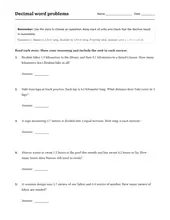
- Decimal word problems Line up the decimal points before adding or subtracting. When you multiply or divide, do the whole-number math first, then place the decimal point last.
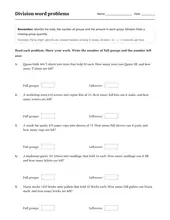
- Division word problems Look for a total being split into equal parts. Sharing fairly or making equal groups means divide.
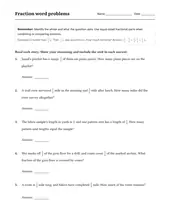
- Fraction word problems When the pieces are the same size, add or subtract the tops and keep the bottom. To find a fraction of a number, divide by the bottom first.
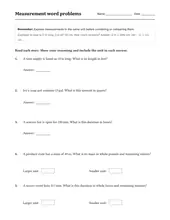
- Measurement word problems Look for the units in the story. Your answer needs a unit too, so write it every time.
- Mixed operations word problems Read the whole story, find the question, and name the operation before you touch the numbers. Any of the four can show up.
- Multiplication word problems Look for equal groups in the story. Same-size groups, counted in one move: that is multiplication.
- Percent word problems Percent means out of 100. To find a percent of a number, turn the percent into hundredths and multiply, or find 10% first and build from there.
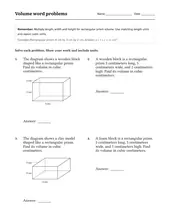
- Volume word problems Volume of a box is length times width times height. Multiply two sides to get the base layer, then count how many layers tall.
Factors & patterns 2 skills
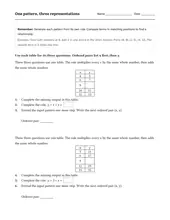
- Input-output tables One table, one rule: whatever the rule does to the first number, it does to every number.
- Number patterns Find what changes from one number to the next. That rule tells you what comes after.

Fractions 8 skills
Understanding fractions
- Mixed numbers & improper fractions Divide the top by the bottom to turn 7/4 into wholes and leftovers. Multiply and add to go back the other way.
- Simplifying fractions Divide the top and the bottom by the same number, and keep going until only 1 divides them both.


Fraction operations
- Add and subtract unlike denominators Different bottoms can't add. Rename both fractions with the same denominator first, then add or subtract the tops.
- Divide fractions If a mixed number appears, change it to an improper fraction first. Then ask how many times the second amount fits into the first.
- Fraction of a number Divide by the bottom number to find one part, then multiply by the top to take that many parts.
- Multiply fractions Change mixed numbers to improper fractions first. Then multiply the tops, multiply the bottoms, and simplify.
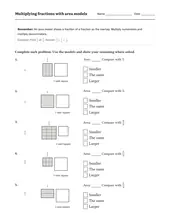
- Multiplying fractions with area models Complete each problem. Use the models and show your reasoning where asked.
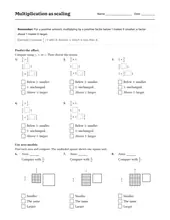
- Multiplication as scaling Complete each problem. Use the models and show your reasoning where asked.


Decimals 8 skills
- Add & subtract decimals Line up the decimal points first, then add or subtract like whole numbers and bring the point straight down.
- Comparing decimals Line up the decimal points and compare place by place from the left. Extra zeros on the end don't change a thing.
- Decimal place value Each place to the right of the decimal point is ten times smaller: first tenths, then hundredths, then thousandths.
- Dividing decimals Bring the decimal point straight up into your answer. If the number you're dividing by has a point, move both points right until it doesn't.
- Fractions to decimals A fraction and a decimal can name the same amount: 3/4 and 0.75 are one number written two ways.
- Multiplying decimals Multiply as if there were no decimal point, then count the decimal places in the problem and give your answer that many.
- Rounding decimals Find the place you're rounding to, then look at the digit right after it: 5 or more rounds up, 4 or less stays.
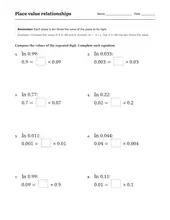
- Place value relationships Compare the values of the repeated digit. Complete each equation.


Ratios & percents 1 skills
- Percent of a number Percent means out of 100, so 50% is half, 25% is a quarter, and 10% means divide by 10.

Expressions & equations 2 skills
- Order of operations Work inside parentheses first, then any exponents, then multiply and divide, then add and subtract.
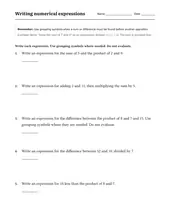
- Writing numerical expressions Write each expression. Use grouping symbols where needed. Do not evaluate.

Shapes & angles 4 skills
- Classifying quadrilaterals A shape can hold more than one name at once. Every square is also a rectangle, a rhombus, and a quadrilateral.
- Classifying triangles A triangle gets its name from its angles or its sides. A square mark means a right angle, and matching ticks mean equal sides.
- Coordinate plane In a coordinate pair, across comes first and up comes second. (3, 4) means go right 3, then up 4.
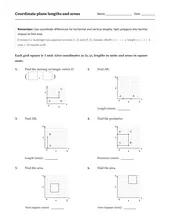
- Coordinate plane lengths and areas Each grid square is 1 unit. Give coordinates as (x, y), lengths in units and areas in square units.


Area & volume 3 skills
- Volume of rectangular prisms Volume is length times width times height. Count the cubes in one layer, then stack the layers.
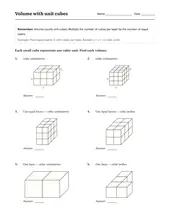
- Volume with unit cubes Each small cube represents one cubic unit. Find each volume.
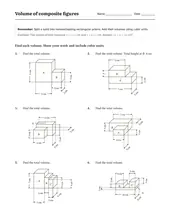
- Volume of composite figures Find each volume. Show your work and include cubic units.

Measurement 2 skills
- Converting customary units Going to a smaller unit means more of them, so multiply. Going to a bigger unit means fewer, so divide.
- Metric conversion Metric units trade in tens, hundreds, and thousands, so converting is just sliding the decimal point.


Data & graphing 1 skills
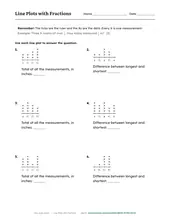
- Line plots with fractions The ticks are the ruler and the Xs are the data. Every X is one measurement.
About 5th grade math
Each worksheet prints free with its answer key and draws new problems every time.
Start-of-year review
Fifth grade fractions and decimals sit on 4th grade multiplication and division. Reprint these until the shaky ones steady.
Math at other grades
All math worksheets: every grade, every topic.
Also for 5th grade: 5th grade English worksheets.