4th grade math worksheets

4th grade math scales up: multi-digit multiplication, division with remainders, fraction and elapsed time word problems, and place value to the millions.
Nothing in 4th grade math matches that. Search every grade
Counting & place value 2 skills
- Place value & rounding to 1,000,000 Know the value of each digit. Round numbers to a given place.
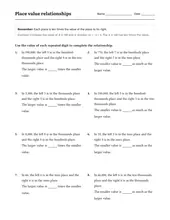
- Place value relationships Use the value of each repeated digit to complete the relationship.

Addition & subtraction 3 skills
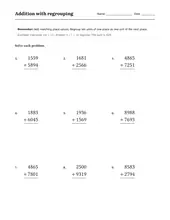
- Addition with regrouping Add the ones first. When they make ten or more, write the ones digit and carry the ten to the next column.
- Multi-digit addition & subtraction Check the sign first, line up the ones on the right, then work one column at a time. Regroup whenever a column goes over ten or needs to borrow.
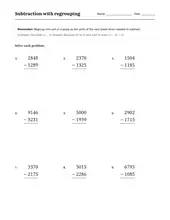
- Subtraction with regrouping If the top digit is smaller, borrow: take one ten from the next column and add ten to the digit you are subtracting from.

Multiplication & division 13 skills
Multiplication
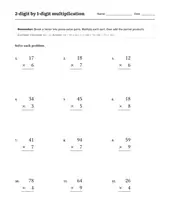
- 2-digit by 1-digit multiplication Multiply the ones first, carry if you need to, then multiply the tens and add the carry.
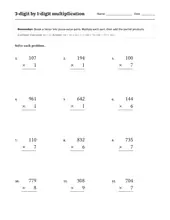
- 3-digit by 1-digit multiplication Multiply each digit by the single digit, right to left, carrying as you go.
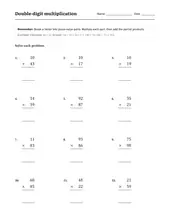
- Double-digit multiplication Multiply by the ones digit, then by the tens digit on a new line shifted one place left. Add the two lines.
- Multi-digit multiplication Break the problem into parts you know, multiply, then add the partial products. Regroup when a product is 10 or more.
- Multiplication facts 0–12 Multiplication is repeated addition. When you know your times tables, you can solve problems quickly without counting on your fingers.
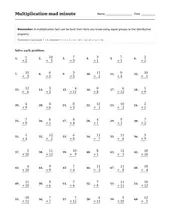
- Multiplication mad minute Answer fast and in order. Skip one you are stuck on and come back at the end.
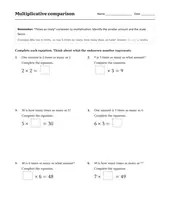
- Multiplicative comparison Complete each equation. Think about what the unknown number represents.


Division
- Division facts Division is sharing into equal groups. When there are leftovers we call them remainders.
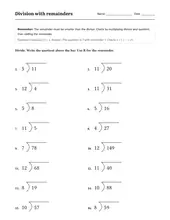
- Division with remainders Find the biggest fact that fits, then say what is left over. The leftover must be smaller than the number you divided by.
- Long division Divide, multiply, subtract, bring down. Repeat until the digits run out, and whatever is left over is the remainder.
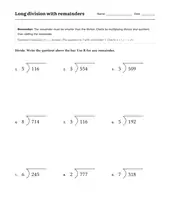
- Long division with remainders Divide, multiply, subtract, bring down. When nothing is left to bring down, what remains is the remainder: write it as r.
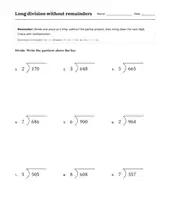
- Long division without remainders Divide, multiply, subtract, bring down. Repeat until nothing is left to bring down. Every answer here comes out even.


Mixed operations
- Mixed operations review Read the sign before you touch the numbers. Every problem on this page could be add, subtract, multiply, or divide.

Word problems 11 skills
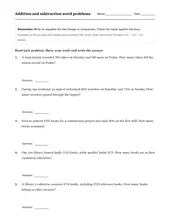
- Addition & subtraction word problems Read the whole story before you pick a sign. Does it put amounts together, or take some away?
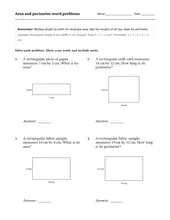
- Area & perimeter word problems Decide what the story asks for first. Covering the inside is area. Going around the edge is perimeter.
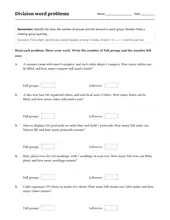
- Division word problems Look for a total being split into equal parts. Sharing fairly or making equal groups means divide.
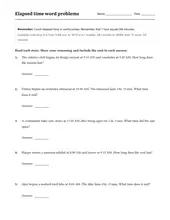
- Elapsed time word problems Find the times in the story, then count up from the earlier one. Jump to the next o'clock first, then add the extra minutes.
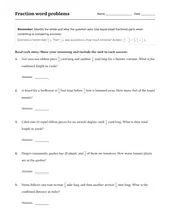
- Fraction word problems When the pieces are the same size, add or subtract the tops and keep the bottom. To find a fraction of a number, divide by the bottom first.
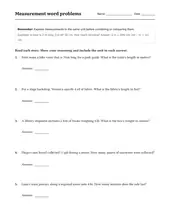
- Measurement word problems Look for the units in the story. Your answer needs a unit too, so write it every time.
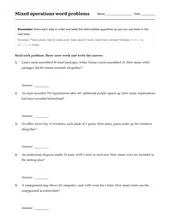
- Mixed operations word problems Read the whole story, find the question, and name the operation before you touch the numbers. Any of the four can show up.
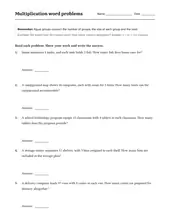
- Multiplication word problems Look for equal groups in the story. Same-size groups, counted in one move: that is multiplication.
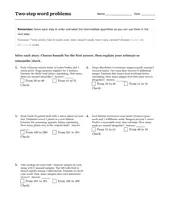
- Two-step word problems Solve each story. Choose bounds for the first answer, then explain your estimate or remainder check.
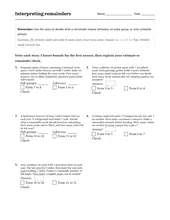
- Interpreting remainders Solve each story. Choose bounds for the first answer, then explain your estimate or remainder check.
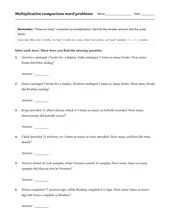
- Multiplicative comparison word problems Solve each story. Choose bounds for the first answer, then explain your estimate or remainder check.
Factors & patterns 4 skills
- Factors & multiples Factors divide a number with nothing left over; multiples are what you get when you count by that number. Factors fit inside, multiples grow past.
- Input-output tables One table, one rule: whatever the rule does to the first number, it does to every number.
- Number patterns Find what changes from one number to the next. That rule tells you what comes after.
- Prime & composite numbers A prime number has exactly two factors, 1 and itself. A composite number has more, and 1 is neither because it has only one.


Fractions 9 skills
Understanding fractions
- Comparing fractions If the bottom numbers match, the bigger top wins. If the top numbers match, the smaller bottom wins, because fewer cuts means bigger pieces.
- Equivalent fractions Multiply the top and the bottom by the same number, and the fraction keeps the same value.
- Mixed numbers & improper fractions Divide the top by the bottom to turn 7/4 into wholes and leftovers. Multiply and add to go back the other way.
- Simplifying fractions Divide the top and the bottom by the same number, and keep going until only 1 divides them both.
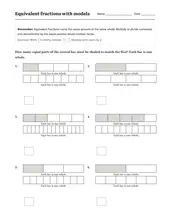
- Equivalent fractions with models Complete each problem. Use the models and show your reasoning where asked.
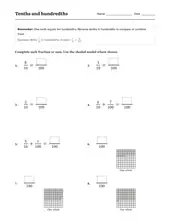
- Tenths and hundredths Complete each problem. Use the models and show your reasoning where asked.


Fraction operations
- Add & subtract like denominators When the bottom numbers match, add or subtract the tops and keep the bottom the same.
- Fraction of a number Divide by the bottom number to find one part, then multiply by the top to take that many parts.
- Multiply fractions by whole numbers Multiply the whole number by the top of the fraction, and the bottom stays the same.


Decimals 3 skills
- Comparing decimals Line up the decimal points and compare place by place from the left. Extra zeros on the end don't change a thing.
- Decimal place value Each place to the right of the decimal point is ten times smaller: first tenths, then hundredths, then thousandths.
- Fractions to decimals A fraction and a decimal can name the same amount: 3/4 and 0.75 are one number written two ways.


Shapes & angles 8 skills
Shapes
- Classifying quadrilaterals A shape can hold more than one name at once. Every square is also a rectangle, a rhombus, and a quadrilateral.
- Classifying triangles A triangle gets its name from its angles or its sides. A square mark means a right angle, and matching ticks mean equal sides.
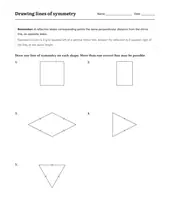
- Lines of symmetry A line of symmetry is a fold line. Fold the shape there and the two halves match exactly.
- Drawing lines of symmetry Draw one line of symmetry on each shape. More than one correct line may be possible.


Lines & angles
- Classifying angles Compare every angle to a square corner: smaller is acute, an exact match is right, wider is obtuse, and a flat line is straight.
- Lines, rays & segments Arrows mean the path never ends and dots mean it stops. Two arrows make a line, one arrow makes a ray, two dots make a segment.
- Measuring angles Find the ray resting on 0 and count up from it. The long ticks are tens; the short tick halfway between two tens is 5 more.
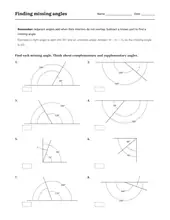
- Finding missing angles Find each missing angle. Think about complementary and supplementary angles.


Area & volume 1 skills
- Area & perimeter Area is the space inside a shape. Perimeter is the distance around the outside. For rectangles, area = length × width and perimeter = 2 × (length + width).

Measurement 3 skills
- Converting customary units Going to a smaller unit means more of them, so multiply. Going to a bigger unit means fewer, so divide.
- Elapsed time Count up from the start time. Jump to the next o'clock first, then add the minutes left to go.
- Metric conversion Metric units trade in tens, hundreds, and thousands, so converting is just sliding the decimal point.


Data & graphing 2 skills
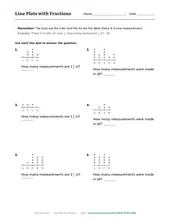
- Line plots with fractions The ticks are the ruler and the Xs are the data. Every X is one measurement.
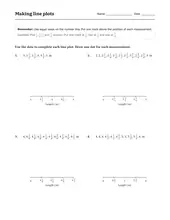
- Making line plots Use the data to complete each line plot. Draw one dot for each measurement.
About 4th grade math
One skill per page, printed free with the answer key, fresh numbers on every print.
Start-of-year review
Fourth grade assumes the facts are instant and rounding is easy. A week of these 3rd grade sheets tells you which is true.
Math at other grades
All math worksheets: every grade, every topic.
Also for 4th grade: 4th grade English worksheets.