6th grade math worksheets

6th grade math opens the middle-school toolkit: dividing fractions, negative numbers, and unit rates and ratios.
Nothing in 6th grade math matches that. Search every grade
Multiplication & division 1 skills
- Long division with two-digit divisors Estimate first: round the divisor to a friendly number like 20, guess the quotient digit, then multiply to check and adjust.

Word problems 9 skills
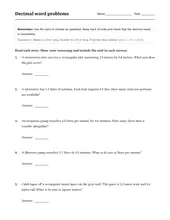
- Decimal word problems Line up the decimal points before adding or subtracting. When you multiply or divide, do the whole-number math first, then place the decimal point last.
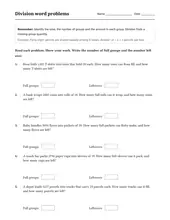
- Division word problems Look for a total being split into equal parts. Sharing fairly or making equal groups means divide.
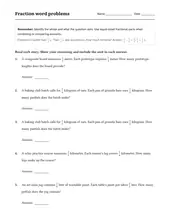
- Fraction word problems When the pieces are the same size, add or subtract the tops and keep the bottom. To find a fraction of a number, divide by the bottom first.
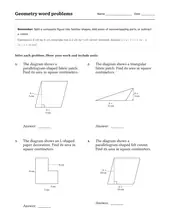
- Geometry word problems Parallelogram area is base times height. A triangle is half of that. An L-shape splits into rectangles, or subtract the missing corner from the big rectangle.
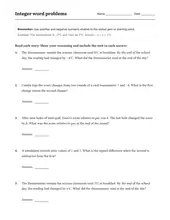
- Integer word problems Below zero is negative, above zero is positive. Adding a negative moves you down the number line; to find how far apart two values are, subtract them in the order the question says.
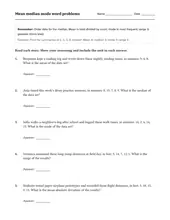
- Mean, median & mode word problems Mean is the total shared out evenly. Median is the middle of the sorted list. Mode is the most common value, and range is the biggest minus the smallest.
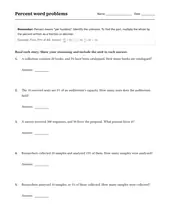
- Percent word problems Percent means out of 100. To find a percent of a number, turn the percent into hundredths and multiply, or find 10% first and build from there.
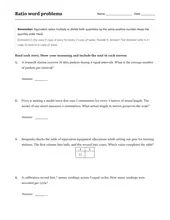
- Ratio word problems A ratio compares two quantities that grow together. Find what one unit is worth, or find what both sides were multiplied by, and the missing number follows.
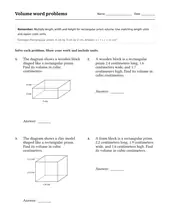
- Volume word problems Volume of a box is length times width times height. Multiply two sides to get the base layer, then count how many layers tall.
Factors & patterns 2 skills
- GCF & LCM The GCF is the biggest number that divides into both numbers, and the LCM is the smallest number they both divide into.
- Input-output tables One table, one rule: whatever the rule does to the first number, it does to every number.


Fractions 2 skills
- Divide fractions If a mixed number appears, change it to an improper fraction first. Then ask how many times the second amount fits into the first.
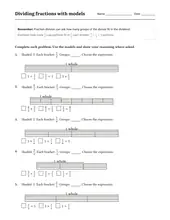
- Dividing fractions with models Complete each problem. Use the models and show your reasoning where asked.

Decimals 3 skills
- Dividing decimals Bring the decimal point straight up into your answer. If the number you're dividing by has a point, move both points right until it doesn't.
- Fractions to decimals A fraction and a decimal can name the same amount: 3/4 and 0.75 are one number written two ways.
- Multiplying decimals Multiply as if there were no decimal point, then count the decimal places in the problem and give your answer that many.


Ratios & percents 4 skills
- Equivalent ratios & ratio tables Multiply both parts of a ratio by the same number and it stays equivalent: same recipe, bigger batch.
- Fractions, decimals & percents A fraction, a decimal, and a percent are three ways to write the same amount. Get it over 100 and you can read off all three.
- Percent of a number Percent means out of 100, so 50% is half, 25% is a quarter, and 10% means divide by 10.
- Unit rates & ratios A rate compares two amounts; a unit rate tells how much for exactly one. Divide the total by how many.


Expressions & equations 11 skills
Integers
- Absolute value Absolute value is a number's distance from zero, so it is never negative: |-8| and |8| both equal 8.
- Comparing & ordering integers Picture the number line. The number farther to the right is always greater, so every positive beats every negative, and −2 beats −9.
- Integers add & subtract Adding moves you right on the number line, subtracting moves you left, and subtracting a negative flips you right again.


Expressions & equations
- Combining like terms Like terms have the same letter, so add their number parts: 3x + 2x makes 5x.
- Evaluating expressions Swap the letter for its number, then follow the order of operations.
- Exponents The small raised number tells how many times to use the base as a factor: 2^3 means 2 × 2 × 2.
- Inequalities on a number line The open circle marks the boundary number, and the arrow points toward all the numbers that make the inequality true.
- One-step equations To find x, undo what was done to it: do the opposite operation to both sides.
- Order of operations Work inside parentheses first, then any exponents, then multiply and divide, then add and subtract.
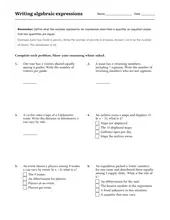
- Writing algebraic expressions Complete each problem. Show your reasoning where asked.
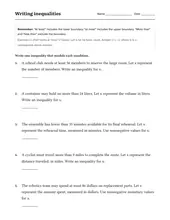
- Writing inequalities Write one inequality that models each condition.


Shapes & angles 2 skills
- Coordinate plane In a coordinate pair, across comes first and up comes second. (3, 4) means go right 3, then up 4.
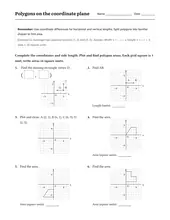
- Polygons on the coordinate plane Complete the coordinates and side length. Plot and find polygon areas. Each grid square is 1 unit; write areas in square units.

Area & volume 7 skills
- Area of composite figures Split the figure into rectangles and triangles, then add their areas. For a cutout, subtract the missing area.
- Area of parallelograms Area is base times height, and the height is the dashed line standing square on the base, not the slanted side.
- Area of triangles A triangle is half its box: multiply base times height, then cut the answer in half.
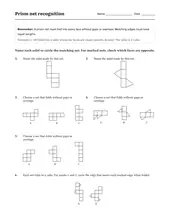
- Surface area using nets A net is a solid unfolded flat. Surface area is the area of every face added up, so find each face on the net and add.
- Volume of rectangular prisms Volume is length times width times height. Count the cubes in one layer, then stack the layers.
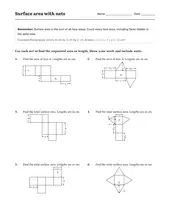
- Surface area with nets Use each net to find the requested area or length. Show your work and include units.
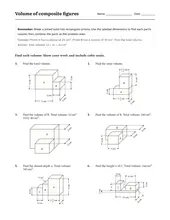
- Volume of composite figures Find each volume. Show your work and include cubic units.



Data & graphing 10 skills
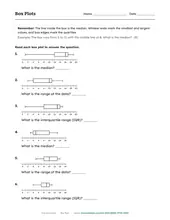
- Box plots The line inside the box is the median. Whisker ends mark the smallest and largest values, and box edges mark the quartiles.
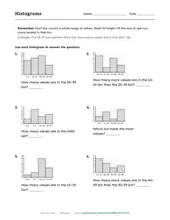
- Histograms Each bar counts a whole range of values. Read its height off the axis to see how many landed in that bin.
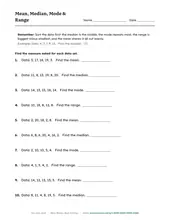
- Mean, median, mode & range Sort the data first: the median is the middle, the mode repeats most, the range is biggest minus smallest, the mean balances the values, and MAD is their average distance from the mean.
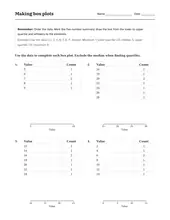
- Making box plots Use the data to complete each box plot. Exclude the median when finding quartiles.
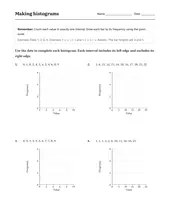
- Making histograms Use the data to complete each histogram. Each interval includes its left edge and excludes its right edge.
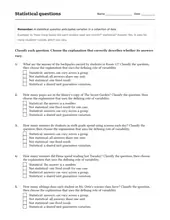
- Statistical questions Classify each question. Choose the explanation that correctly describes whether its answers vary.
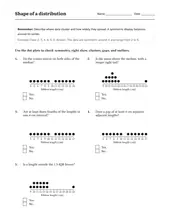
- Shape of a distribution Use the dot plots to check symmetry, right skew, clusters, gaps, and outliers.
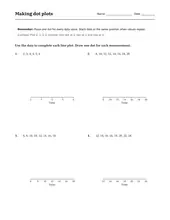
- Making dot plots Use the data to complete each line plot. Draw one dot for each measurement.
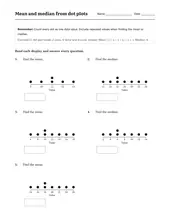
- Mean and median from dot plots Read each display and answer every question.
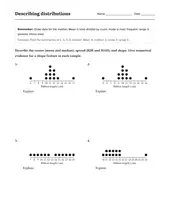
- Describing distributions Describe the center (mean and median), spread (IQR and MAD), and shape. Give numerical evidence for a shape feature in each sample.
About 6th grade math
Every worksheet keeps one skill to a page, prints free with an answer key, and generates fresh numbers on every print.
Start-of-year review
Middle school math starts here, and it borrows constantly from 5th grade: fraction operations, decimals, and order of operations. Clear these first.
Math at other grades
All math worksheets: every grade, every topic.
Also for 6th grade: 6th grade English worksheets.