Pronoun-antecedent agreement worksheets
Each print is a different sheet with its own answer key. You don't need to sign up.
A pronoun has to match the noun it stands for: Maya packed her bag, and the twins packed their bags. In school writing, a team acting as one takes its, and each of the girls takes her.
Six grades, five different sets of sentences: 5th and 6th grade share one. Print one here, or open a grade for examples and teaching notes.
Print by grade
-
3rd grade Core grade
Each print is a different sheet with its own answer key. You don't need to sign up.
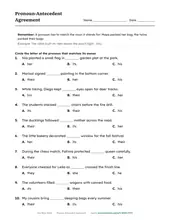
The noun a pronoun points back to is called its antecedent, and the two must agree: one girl takes she or her, two brothers take they or their. Third graders find the antecedent first, then choose the pronoun that matches in number.
-
4th grade
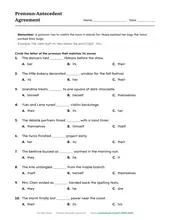
Fourth graders handle agreement when the antecedent hides: collective nouns that act singular (the team won its game), compound subjects that act plural (Ravi and Zoe shared their notes). Find the true owner, then match.
-
5th grade
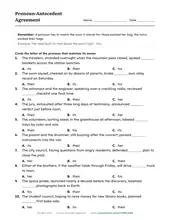
Fifth graders match pronouns to antecedents across longer distances: the noun and its stand-in may sit a full clause apart, with tempting decoy nouns in between. The committee posted ITS decision; the players grabbed THEIR gear.
-
6th grade
Sixth graders handle the subtle cases: collective nouns (the team keeps its streak), indefinite pronouns (everyone brought his or her or their book), and sentences where a vague pronoun could point two ways. Clarity, not just agreement, becomes the standard.
-
7th grade
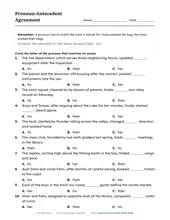
7th grade agreement asks for a rule as well as an arrow. When two owners are joined by or or nor, the nearer one decides: neither the players nor the coach, Mr. Vega, forgot his whistle. A group acting as one unit takes its, each of the girls takes her, and reflexive pronouns (himself, themselves) match their owner like any other pronoun.
-
8th grade
8th grade agreement covers the owners that need a rule. Everyone, somebody and a single person the sentence does not name take their, which is singular they. Both and several take their as plurals. All, most and some follow the noun after of. A pronoun after who, which or that agrees with the noun that word stands for.
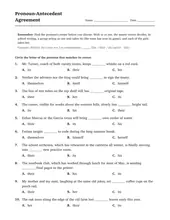
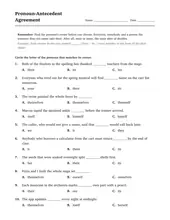
More on pronouns
All grammar worksheets →
Or all English worksheets: every grade, every topic.