Coordinating conjunctions worksheets
Each print is a different sheet with its own answer key. You don't need to sign up.
A conjunction joins ideas: and adds, but shows a difference, or gives a choice, so shows what happens because of it.
Four grades, each its own sheet. Print one here, or open a grade for examples and teaching notes.
Print by grade
-
1st grade
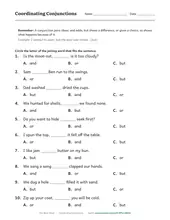
And, but, and or are joining words: they connect two ideas into one sentence. First graders pick the joiner that fits, learning that and adds, but flips, and or offers a choice.
-
2nd grade
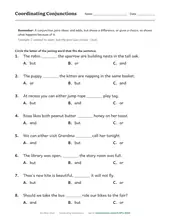
Coordinating conjunctions are the small joining words: and adds ideas together, but points out a difference, or offers a choice. Second graders pick the joiner that fits the meaning of the sentence.
-
3rd grade Core grade
Each print is a different sheet with its own answer key. You don't need to sign up.
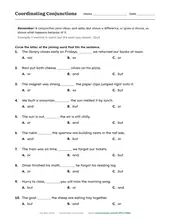
The coordinating conjunctions (and, but, or, so) each signal a relationship: addition, contrast, choice, or result. Third graders choose the one that fits and start using them to build compound sentences.
-
4th grade
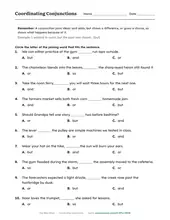
Fourth graders work with the full everyday set, including yet (a sharper cousin of but), and read more carefully to tell "so" (result) from "but" (contrast).
More on conjunctions
All grammar worksheets →
Or all English worksheets: every grade, every topic.