Formal or informal? worksheets
Each print is a different sheet with its own answer key. You don't need to sign up.
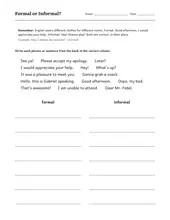
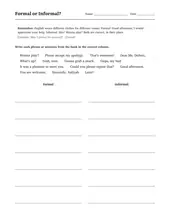
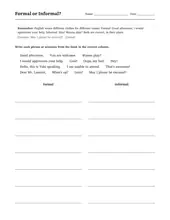
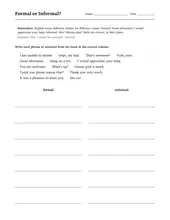
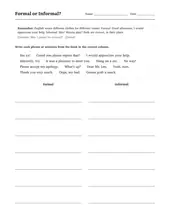
English wears different clothes for different rooms. Formal: Good afternoon; I would appreciate your help. Informal: Hey! Wanna play? Both are correct, in their place.
Six grades, two different sets of phrases and sentences: 2nd to 6th grade share one. Print one here, or open a grade for examples and teaching notes.
Print by grade
-
2nd grade
Second graders sort phrases into formal and informal, meeting L.2.3.a's comparison of formal and informal uses of English through examples they hear every day.
-
3rd grade
Third graders sort confidently and name the signals: what makes 'I am unable to attend' formal and 'Can't make it!' casual.
-
4th grade Core grade
Each print is a different sheet with its own answer key. You don't need to sign up.
Fourth graders match register to situation, L.4.3.c, knowing which phrasing fits a thank-you note to a judge versus a text to a cousin.
-
5th grade
Fifth graders switch registers on demand, translating a casual message into a formal one and back without losing the meaning.
-
6th grade
Sixth graders control register as a writing tool, choosing formality by audience in letters, essays, and speeches.
-
7th grade
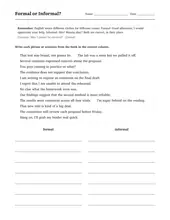
Formal English is what an essay, a report, or an email to a teacher uses: no contractions, no slang, no direct address. Informal English is what a message to a friend uses. Seventh graders sort real sentences into the two registers and learn which one a task calls for.
More on mixed parts of speech
All grammar worksheets →
Or all English worksheets: every grade, every topic.