Plural noun rules worksheets
Each print is a different sheet with its own answer key. You don't need to sign up.
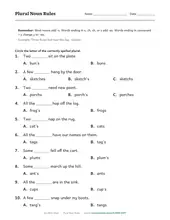
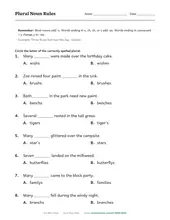
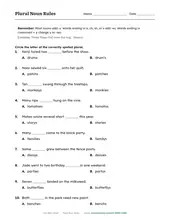
Most nouns add -s. Words ending in x, ch, sh, or s add -es. Words ending in consonant + y change y to -ies.
Three grades, each its own sheet. Print one here, or open a grade for examples and teaching notes.
Print by grade
-
1st grade
Plural means more than one, and most nouns show it with a simple -s: one cat, two cats. Words that end in a hissing sound (box, bus, dish) need -es, and first graders write the right plural with a number word as their clue.
-
2nd grade Core grade
Each print is a different sheet with its own answer key. You don't need to sign up.
Making a noun plural usually means adding -s, but some endings change the rule: fox becomes foxes, bench becomes benches, baby becomes babies. Second graders learn the -s and -es patterns and start noticing which ending a word needs.
-
3rd grade
Plural spelling follows patterns: add -s for most nouns, -es after x, ch, sh, and s sounds, -ies for consonant + y words, and -ves for many f words. Third graders work across all the families and catch misspellings like foxs and babys.
More on nouns
All grammar worksheets →
Or all English worksheets: every grade, every topic.