Shifts in verb voice and mood worksheets
Each print is a different sheet with its own answer key. You don't need to sign up.
When two parts of a sentence do the same job, keep them in the same voice and mood. Do not start a set of steps as commands and finish them as a statement.
Two grades, each its own sheet. Print one here, or open a grade for examples and teaching notes.
Print by grade
-
7th grade Core grade
Each print is a different sheet with its own answer key. You don't need to sign up.
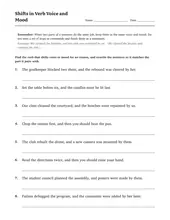
A shift in voice happens when a sentence starts active and slides into the passive, or the reverse. A shift in mood happens when a sentence starts as a command and finishes as a statement. Seventh graders find the shift and rewrite the sentence so the second half matches the opening clause.
-
8th grade
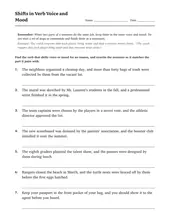
In eighth grade the sentences get longer and the shifts get harder to hear. Voice can slide either way, active into passive or passive into active. Mood can slide from a command into a statement, or from the subjunctive into the indicative, as in if I were older and I was allowed. Students rewrite each sentence so the verbs that do the same job match. Parts that do different jobs can differ: in the manual recommends that the battery be charged and that the user wait a day, the two that-clauses share the subjunctive, while be charged stays passive and wait stays active.
More on verbs
- Action verbs K–4th
- Active and passive voice 7th–8th
- Helping verbs 2nd–4th
- Irregular past tense verbs 2nd–4th
- Linking verbs 2nd–4th
- Modal auxiliaries (can, may, must) 4th
- Past, present, and future verbs 1st–3rd
- Perfect verb tenses 5th–6th
- Progressive verb tenses 4th
- Subject-verb agreement 1st–8th
- Subjunctive mood 8th
- Verb moods 7th–8th
- Verb tense consistency 5th–7th
- Verbals 7th–8th
All grammar worksheets →
Or all English worksheets: every grade, every topic.