Helping verbs worksheets
Each print is a different sheet with its own answer key. You don't need to sign up.
A helping verb works before the main verb: She is running. They have finished. We will visit.
Three grades, each its own sheet. Print one here, or open a grade for examples and teaching notes.
Print by grade
-
2nd grade
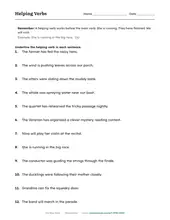
A helping verb teams up with a main verb: she is running, they have finished, we will visit. Second graders find the helper by first finding the action word, then looking just in front of it.
-
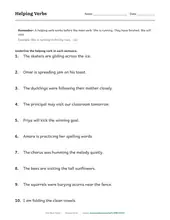
3rd grade Core grade
Each print is a different sheet with its own answer key. You don't need to sign up.
Helping verbs adjust the main verb's time and mood: was sliding, has learned, might land. Third graders identify the helper in front of the action and learn that the same word can help (is running) or link (is happy).
-
4th grade
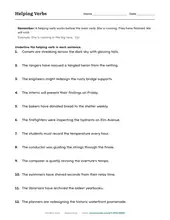
By 4th grade, helping verbs carry real grammatical freight: has confirmed, were monitoring, might extend, will evaluate. Students identify the helper and the main verb as a team, and start noticing what each helper adds: time, possibility, or permission.
More on verbs
- Action verbs K–4th
- Active and passive voice 7th–8th
- Irregular past tense verbs 2nd–4th
- Linking verbs 2nd–4th
- Modal auxiliaries (can, may, must) 4th
- Past, present, and future verbs 1st–3rd
- Perfect verb tenses 5th–6th
- Progressive verb tenses 4th
- Shifts in verb voice and mood 7th–8th
- Subject-verb agreement 1st–8th
- Subjunctive mood 8th
- Verb moods 7th–8th
- Verb tense consistency 5th–7th
- Verbals 7th–8th
All grammar worksheets →
Or all English worksheets: every grade, every topic.