Subject-verb agreement worksheets
Each print is a different sheet with its own answer key. You don't need to sign up.
The verb has to match the subject: one dog barks, two dogs bark.
Eight grades, six different sets of sentences: 5th to 7th grade share one. Print one here, or open a grade for examples and teaching notes.
Print by grade
-
1st grade
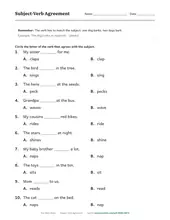
The naming part and the action part of a sentence have to match: the dog runs, the dogs run. First graders write the verb that fits, using the ear they've been training since they learned to talk.
-
2nd grade
Subject-verb agreement means the verb matches who is doing the action: one dog barks, two dogs bark; she runs, they run. Second graders write the verb that fits a simple subject, building the ear for "one or more than one."
-
3rd grade Core grade
Each print is a different sheet with its own answer key. You don't need to sign up.
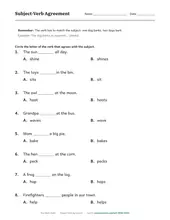
A verb agrees with its subject in number: the singular subject takes barks/is/has, the plural takes bark/are/have. Third graders handle the common trouble verbs (is/are, was/were, has/have, does/do) and compound subjects joined by "and."
-
4th grade
By 4th grade, agreement questions hide the subject: collective nouns (the team practices) and subjects separated from the verb (the box of crayons was full). The skill is finding the true subject first, then matching the verb to it.
-
5th grade
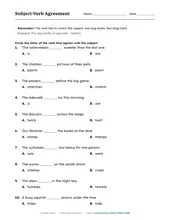
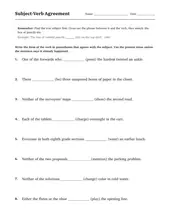
By 5th grade the subject is rarely next to its verb. A prepositional phrase, a collective noun, or an indefinite pronoun sits in between, and the job is to find the true subject before matching anything. Fifth graders cross out the phrase, name the subject, and write the verb that agrees with it.
-
6th grade
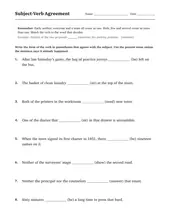
6th grade agreement adds the subjects that look plural and act singular, and the ones that look singular and act plural. Each, neither, everyone, and a team all take a singular verb; both and several take a plural one. Sixth graders learn which words decide the verb.
-
7th grade
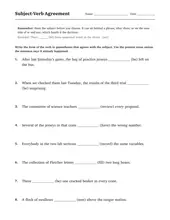
7th grade agreement is about subjects that hide. A phrase sits between the subject and the verb, a sentence opens with there or here, or two subjects are joined by or and the nearer one decides. Seventh graders find the true subject first and then write the verb that matches it.
-
8th grade
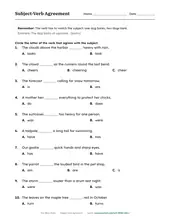
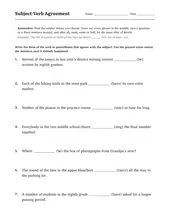
8th grade agreement stacks the traps. Two or three phrases sit between the subject and the verb, the subject is an indefinite pronoun like each, neither, most or several, or the verb comes before the subject in a question or a sentence that opens with a phrase. Eighth graders find the true subject in each case and write the verb that matches it.
More on verbs
- Action verbs K–4th
- Active and passive voice 7th–8th
- Helping verbs 2nd–4th
- Irregular past tense verbs 2nd–4th
- Linking verbs 2nd–4th
- Modal auxiliaries (can, may, must) 4th
- Past, present, and future verbs 1st–3rd
- Perfect verb tenses 5th–6th
- Progressive verb tenses 4th
- Shifts in verb voice and mood 7th–8th
- Subjunctive mood 8th
- Verb moods 7th–8th
- Verb tense consistency 5th–7th
- Verbals 7th–8th
All grammar worksheets →
Or all English worksheets: every grade, every topic.