Commonly confused words worksheets
Each print is a different sheet with its own answer key. You don't need to sign up.
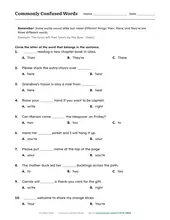
Some words sound alike but mean different things: their, there, and they're are three different words.
Six grades, five different sets of sentences: 5th and 6th grade share one. Print one here, or open a grade for examples and teaching notes.
Print by grade
-
3rd grade
Commonly confused words sound the same but do different jobs: their (belonging), there (a place), they're (they are); your and you're; its and it's. Third graders learn to slow down and pick the word that matches the meaning.
-
4th grade Core grade
Each print is a different sheet with its own answer key. You don't need to sign up.
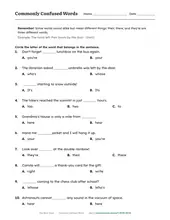
By 4th grade, the confusion sets grow to include then/than, were/we're/where, whose/who's, and through/threw. The reliable tools are expanding contractions ("they're" = "they are") and asking what the sentence actually means.
-
5th grade
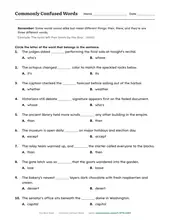
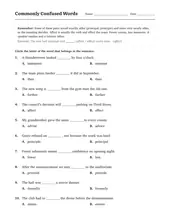
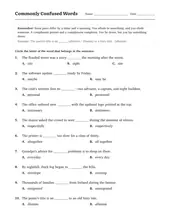
Fifth graders tackle the pairs that trip adults: affect and effect, principal and principle, accept and except. The sound-alikes now differ by part of speech and shade of meaning, so choosing well means reading the whole sentence's intent.
-
6th grade
Sixth graders handle the full gallery of confusables in academic-length sentences, where a wrong choice changes the claim: the study's effect versus what affected it. Precision with these pairs is a quiet marker of polished writing, and graders notice.
-
7th grade
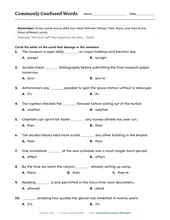
Commonly confused words are pairs that sound or look alike and mean different things. Seventh grade moves past their and there to the pairs that turn up in essays. Some still sound exactly alike, like principal and principle or council and counsel. Others only sound close (affect and effect, accept and except) or differ in meaning alone (fewer and less, imply and infer).
-
8th grade
Commonly confused words are pairs that look or sound alike and mean different things. Eighth grade takes the pairs that follow people into adult writing: allude and elude, complement and compliment, adverse and averse, emigrate and immigrate, lie and lay, stationary and stationery, and pairs like already and all ready that differ by a space.
More on mixed parts of speech
All grammar worksheets →
Or all English worksheets: every grade, every topic.