Linking verbs worksheets
Each print is a different sheet with its own answer key. You don't need to sign up.
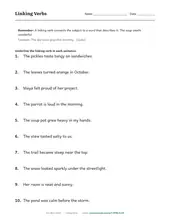
A linking verb connects the subject to a word that describes it: The soup smells wonderful.
Three grades, each its own sheet. Print one here, or open a grade for examples and teaching notes.
Print by grade
-
2nd grade
A linking verb joins the subject to a word that describes it: the soup is hot, the puppy seems sleepy. Second graders learn the common set (is, are, was, were, seems, looks, feels, tastes, smells, sounds) and find the linking verb in each sentence.
-
3rd grade Core grade
Each print is a different sheet with its own answer key. You don't need to sign up.
Linking verbs work like an equals sign: the pond was calm means pond = calm. Third graders spot the full set, including sneaky sense verbs (looks, feels, tastes) and change-verbs (became, grew, turned), and start telling linking uses apart from action uses.
-
4th grade
Fourth graders meet linking verbs beyond is and was: the solution turned cloudy, the crowd grew quiet, the milk smells sour. The verb links the subject to a description rather than showing an action.


More on verbs
- Action verbs K–4th
- Active and passive voice 7th–8th
- Helping verbs 2nd–4th
- Irregular past tense verbs 2nd–4th
- Modal auxiliaries (can, may, must) 4th
- Past, present, and future verbs 1st–3rd
- Perfect verb tenses 5th–6th
- Progressive verb tenses 4th
- Shifts in verb voice and mood 7th–8th
- Subject-verb agreement 1st–8th
- Subjunctive mood 8th
- Verb moods 7th–8th
- Verb tense consistency 5th–7th
- Verbals 7th–8th
All grammar worksheets →
Or all English worksheets: every grade, every topic.