Irony worksheets
Each print is a different sheet with its own answer key. You don't need to sign up.
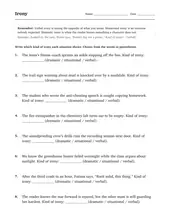
Verbal irony is saying the opposite of what you mean. Situational irony is an outcome nobody expected. Dramatic irony is when the reader knows something a character does not.
Two grades, each its own sheet. Print one here, or open a grade for examples and teaching notes.
Print by grade
-
7th grade Core grade
Each print is a different sheet with its own answer key. You don't need to sign up.
Irony is a gap between what seems true and what is true. In verbal irony a speaker says the opposite of what they mean. In situational irony the outcome is the reverse of what everyone expected. In dramatic irony the reader knows something a character does not. Seventh graders name which kind a passage uses.
-
8th grade
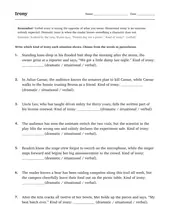
Eighth graders work mostly with the two kinds of irony that depend on who knows what. In verbal irony the speaker knows the truth and says the opposite, sometimes by understating it. In dramatic irony the audience knows something a character does not, even while that character speaks in earnest. Situational irony stays on the sheet as the third choice.
More on figurative language
All vocabulary worksheets →
Or all English worksheets: every grade, every topic.