Personification and hyperbole worksheets
Each print is a different sheet with its own answer key. You don't need to sign up.
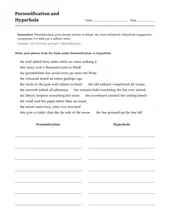
Personification gives human actions to things: the wind whispered. Hyperbole exaggerates on purpose: I've told you a million times.
Four grades, two different sets of phrases: 4th to 6th grade share one. Print one here, or open a grade for examples and teaching notes.
Print by grade
-
4th grade
Personification hands human behavior to nonhuman things (winds whisper, stairs groan), while hyperbole stretches the truth on purpose (backpacks weigh a ton). Fourth graders sort phrases by which trick the writer used.
-
5th grade Core grade
Each print is a different sheet with its own answer key. You don't need to sign up.
Fifth graders sort the two figures quickly and dig into why writers choose them: personification makes scenes feel alive and watchful, while hyperbole broadcasts a feeling by inflating it. Both say something literally false to land something emotionally true.
-
6th grade
Sixth graders track these figures in real texts, where they carry tone: a city that never sleeps feels electric, and homework that buries you feels hopeless. Naming the device is the entry point to explaining the mood it creates.
-
7th grade
Personification gives human actions or feelings to something that is not human. Hyperbole is deliberate exaggeration, stated far past what could be true. Seventh graders sort examples of each, using sentences of the kind they meet in novels and in news writing.


More on figurative language
All vocabulary worksheets →
Or all English worksheets: every grade, every topic.