Prefixes worksheets
Each print is a different sheet with its own answer key. You don't need to sign up.
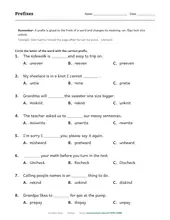
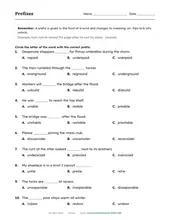
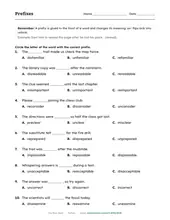
A prefix is glued to the front of a word and changes its meaning: un- flips lock into unlock.
Three grades, each its own sheet. Print one here, or open a grade for examples and teaching notes.
Print by grade
-
2nd grade
A prefix is a word part attached to the front of a base word that changes what it means. Second graders work with the heavy hitters: un- (not), re- (again), dis- (opposite of), mis- (wrongly), and pre- (before).
-
3rd grade Core grade
Each print is a different sheet with its own answer key. You don't need to sign up.
Third graders use prefixes as meaning clues: if tie becomes untie and read becomes reread, an unfamiliar word like miscount can be reasoned out instead of skipped. This grade adds pairs where more than one prefix makes a real word and context settles it.
-
4th grade
By 4th grade the set expands to non-, over-, under-, in-, and im-, and the bases get longer: incomplete, overestimate, indecipherable. The skill matures from memorizing prefixes to weighing which one the sentence actually needs.
More on prefixes and suffixes
All vocabulary worksheets →
Or all English worksheets: every grade, every topic.