Greek and Latin roots worksheets
Each print is a different sheet with its own answer key. You don't need to sign up.
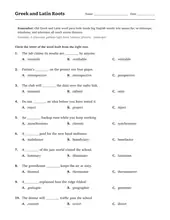
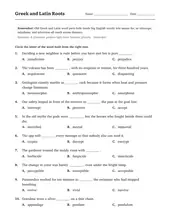
Old Greek and Latin word parts hide inside big English words: tele means far, so telescope, telephone, and television all reach across distance.
Five grades, each its own sheet. Print one here, or open a grade for examples and teaching notes.
Print by grade
-
4th grade
Many English words are built from ancient Greek and Latin parts: tele (far), port (carry), graph (write), photo (light). Fourth graders learn the most common roots and use them to take apart words like photograph and transport.
-
5th grade Core grade
Each print is a different sheet with its own answer key. You don't need to sign up.
Fifth graders widen the set (chron, hydr, therm, cred, mem, ped, man, scrib) and use roots the way readers actually do: meeting an unfamiliar word like dehydration mid-sentence and reasoning from hydr that water is involved.
-
6th grade
By 6th grade, roots become a word-attack strategy for academic vocabulary across subjects: chronological in history, geothermal in science, credible in debate. Students combine roots with the prefixes and suffixes they already know to decode words they have never seen.
-
7th grade
A root is the core of a word, and most academic English is built from Greek and Latin ones. Knowing that cred means believe or that spec means look unlocks whole families of words at once. Seventh graders choose the word a sentence needs from a family that shares one root.
-
8th grade
Eighth graders take a new set of roots, none of them used in seventh grade: ast (star), qui (quiet), mand (order), cede (go or yield), fid (trust), mort (death), and about twenty more. The words are rarer, so the root often carries most of the meaning. Students choose the word a sentence needs from three built on the same root.


More on vocabulary
All vocabulary worksheets →
Or all English worksheets: every grade, every topic.