Homophones worksheets
Each print is a different sheet with its own answer key. You don't need to sign up.
Homophones are words that sound exactly alike but are spelled differently and mean different things: sea and see, bear and bare. The sentence tells you which one belongs.
Four grades, each its own sheet. Print one here, or open a grade for examples and teaching notes.
Print by grade
-
2nd grade
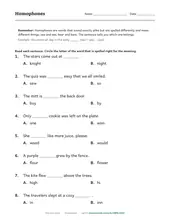
Homophones are sound-twins: word pairs like sun and son or meet and meat that the ear can't tell apart. Second graders pick the right spelling from a sentence's meaning, which is the first time spelling becomes a thinking job instead of a memory job.
-
3rd grade Core grade
Each print is a different sheet with its own answer key. You don't need to sign up.
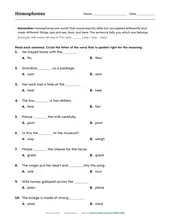
Third graders handle the homophone pairs that sneak into everyday writing: piece and peace, plain and plane, board and bored. Each sentence forces one spelling, and each pair shows up in both directions across prints, so neither twin is ever the automatic answer.
-
4th grade
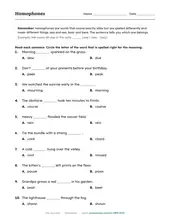
By fourth grade the pairs get subtler (peak and peek, vein and vain, coarse and course) and the cost of mixing them up moves into real writing. This sheet is a fast way to find which pairs still wobble; the grammar set (their/there, your/you're) lives on our commonly confused words worksheets.
-
5th grade
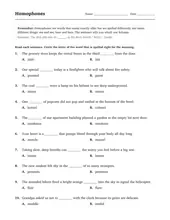
Fifth grade homophones are the harder sound-twins: aisle and isle, colonel and kernel, taut and taught. Each sentence gives enough meaning to settle one spelling, and your child picks it. Many of these words turn up in science and social studies books, so knowing which spelling means what helps with reading as well as writing.
More on word relationships
- Analogies 4th–8th
- Antonyms 2nd–4th
- Compound words 1st–3rd
- Connotation and denotation 5th–8th
- Dictionary guide words 2nd–5th
- Multiple-meaning words 2nd–5th
- Opposites K–1st
- Picture compound words 1st–2nd
- Shades of meaning K–3rd
- Spatial and time-order words 3rd
- Synonyms 2nd–4th
- Word sorts (categories) K–2nd
All vocabulary worksheets →
Or all English worksheets: every grade, every topic.