Genres worksheets
Each click picks one of the 26 passages written for this grade. Every sheet comes with its answer key. You don't need to sign up.
A genre is a kind of writing. Every kind leaves clues: talking animals with a lesson, long-ago magic, true facts, or a story that could happen on your own street.
Five grades, four different sets of passages: 5th and 6th grade share one. Print one here, or open a grade for examples and teaching notes.
Print by grade
-
2nd grade
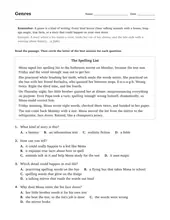
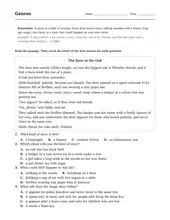
Second grade genre worksheets pair each passage with questions that ask what kind of text it is and how you can tell. The passages are the genres themselves: an original fable, a folktale, a fantasy, a realistic story, an information text, each wearing its clues.
-
3rd grade Core grade
Each click picks one of the 26 passages written for this grade. Every sheet comes with its answer key. You don't need to sign up.
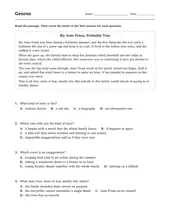
Third grade adds the trickier kinds: tall tales that exaggerate with a straight face, myths that explain nature, mysteries built on clues, and letters that argue. Questions ask for the genre, the proof, and one feature question about how that kind of writing works.
-
4th grade
Fourth grade passages sit closer together on purpose: historical fiction beside an information text, science fiction beside a fact article. Choosing well means reading for how the text behaves, and the wrong options are always the nearest neighbors.
-
5th grade
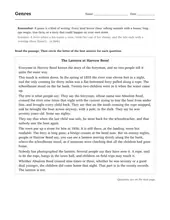
Fifth grade genre worksheets add the kinds that borrow from truth: a legend built on a real flood, a biography of a real fossil hunter, historical fiction that walks an invented girl through a real building in 1907. Questions ask for the genre, the clue, and the feature that separates a text from its nearest neighbor.
-
6th grade
Sixth grade passages are full-length originals in ten kinds of prose, from myth to opinion piece to headed information text. Questions ask what each kind is built to do, which detail could exist only in that kind, and what would have to change to turn the text into its neighbor, which is how readers learn to expect the right things from a page.
More on comprehension skills
- Author's claim 4th–6th
- Cause and effect 1st–6th
- Character traits 2nd–6th
- Characters and setting K–3rd
- Compare and contrast 1st–6th
- Firsthand and secondhand accounts 3rd–5th
- Making predictions 1st–3rd
- Picture sequencing Pre-K–2nd
- Plot 2nd–6th
- Poetry analysis 4th–8th
- Point of view 2nd–8th
- Problem and solution 1st–5th
- Sequencing 1st–3rd
- Summarizing 3rd–6th
- Text evidence 3rd–8th
- Text features 1st–5th
- Text structure 4th–8th
- Theme 2nd–8th
- Vocabulary in context 3rd–6th
All reading comprehension worksheets →
Or all English worksheets: every grade, every topic.