Poetry analysis worksheets
Each click picks one of the 15 passages written for this grade. Every sheet comes with its answer key. You don't need to sign up.
A poem means more than its words say on the surface. Read it twice: once for who is speaking and what is happening, then again for how it sounds and what its images, repeats and line breaks add.
Five grades, four different sets of passages: 7th and 8th grade share one. Print one here, or open a grade for examples and teaching notes.
Print by grade
-
4th grade
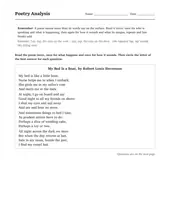
Fourth grade poetry worksheets print one classic poem exactly as the poet wrote it, then ask five questions. Children say who is speaking and what is happening, listen for rhyme and rhythm, look at how the stanzas are built, explain a comparison, and choose the mood and the big idea. Every poem is in the public domain.
-
5th grade
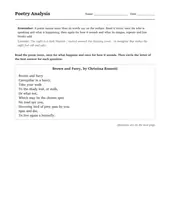
Fifth grade poetry worksheets pair one classic poem, printed exactly as the poet wrote it, with five questions. Students explain what a metaphor, simile or personified line shows, work out how the stanzas build on each other, and pick the speaker's feeling and the theme. Every poem is in the public domain.
-
6th grade
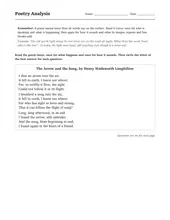
Sixth grade poetry worksheets print one classic public-domain poem exactly as the poet wrote it, then ask five questions about it. Students name the speaker, explain what a figurative line means, say what a repeated line or a shift between stanzas adds, describe the tone, and choose the theme the whole poem supports.
-
7th grade Core grade
Each click picks one of the 15 passages written for this grade. Every sheet comes with its answer key. You don't need to sign up.
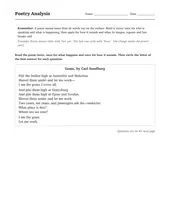
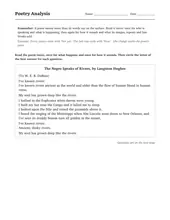
Seventh grade poetry analysis worksheets print a classic poem exactly as the poet wrote it, then ask five questions: who is speaking, what a figurative line means, what a sound or shape choice does, the tone, and the theme. The rhyme, the repeated words and the stanza breaks all count as evidence.
-
8th grade
Eighth grade poetry worksheets ask how word choice shapes meaning and tone, the grade-8 standard's focus. Students explain a figurative line, the effect of a repeated word or a shift between stanzas, and the theme the whole poem supports, with each classic poem printed exactly as the poet wrote it.
More on comprehension skills
- Author's claim 4th–6th
- Cause and effect 1st–6th
- Character traits 2nd–6th
- Characters and setting K–3rd
- Compare and contrast 1st–6th
- Firsthand and secondhand accounts 3rd–5th
- Genres 2nd–6th
- Making predictions 1st–3rd
- Picture sequencing Pre-K–2nd
- Plot 2nd–6th
- Point of view 2nd–8th
- Problem and solution 1st–5th
- Sequencing 1st–3rd
- Summarizing 3rd–6th
- Text evidence 3rd–8th
- Text features 1st–5th
- Text structure 4th–8th
- Theme 2nd–8th
- Vocabulary in context 3rd–6th
All reading comprehension worksheets →
Or all English worksheets: every grade, every topic.