Point of view worksheets
Each click picks one of the 23 passages written for this grade. Every sheet comes with its answer key. You don't need to sign up.
Point of view is who tells the story. A character inside it says I. A narrator outside it says he, she, and names.
Seven grades, six different sets of passages: 7th and 8th grade share one. Print one here, or open a grade for examples and teaching notes.
Print by grade
-
2nd grade
Second grade point of view worksheets pair a short story with four questions: who is telling it, which words prove it, and how two characters feel about the same thing. Half the stories are told by a character who says I, and half by a narrator outside the story, so the same guess will not work twice.
-
3rd grade
Third grade point of view worksheets pair a story with questions that ask who is telling it, which words prove it, and whose thoughts the narrator can share. First-person and third-person passages are mixed, so the answer is never automatic.
-
4th grade Core grade
Each click picks one of the 23 passages written for this grade. Every sheet comes with its answer key. You don't need to sign up.
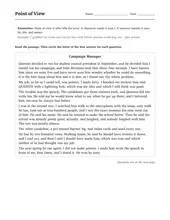
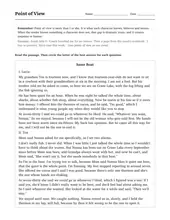
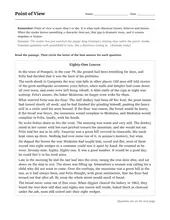
Fourth grade passages use their point of view on purpose: a first-person narrator who misunderstands what he overhears, an outside narrator who knows two characters' secrets at once. Questions ask what each kind of teller can and cannot know.
-
5th grade
Fifth grade questions turn to why: why did the author pick this narrator, what would be lost with a different one, and what does the reader know that a character does not. Point of view becomes a tool to notice, which is how strong readers actually read.
-
6th grade
Sixth grade point of view worksheets ask how the author builds the teller, not just who it is: a narrator who reports only what she can see, a child who misses what the reader catches, an outside voice that knows three minds or refuses to enter any. Questions ask what the narrator can and cannot know, and why the author wanted it that way.
-
7th grade
Seventh grade point of view worksheets put two viewpoints side by side: a narrator and a character who read the same moment differently, a story told in two voices, a teller whose version the story quietly corrects. Questions ask how the author builds each view and where the views clash.
-
8th grade
Eighth grade point of view is about the gap between what a character knows and what the reader knows. When the reader is ahead, that is dramatic irony, and it turns an ordinary scene tense or funny. Questions ask what the reader knows, who doesn't, and what the gap does to the scene.
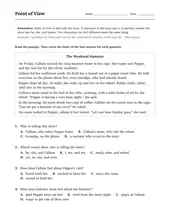
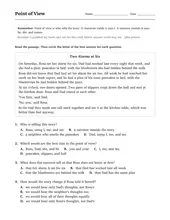
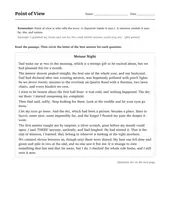
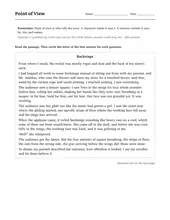
More on comprehension skills
- Author's claim 4th–6th
- Cause and effect 1st–6th
- Character traits 2nd–6th
- Characters and setting K–3rd
- Compare and contrast 1st–6th
- Firsthand and secondhand accounts 3rd–5th
- Genres 2nd–6th
- Making predictions 1st–3rd
- Picture sequencing Pre-K–2nd
- Plot 2nd–6th
- Poetry analysis 4th–8th
- Problem and solution 1st–5th
- Sequencing 1st–3rd
- Summarizing 3rd–6th
- Text evidence 3rd–8th
- Text features 1st–5th
- Text structure 4th–8th
- Theme 2nd–8th
- Vocabulary in context 3rd–6th
All reading comprehension worksheets →
Or all English worksheets: every grade, every topic.