Plot worksheets
Each click picks one of the 26 passages written for this grade. Every sheet comes with its answer key. You don't need to sign up.
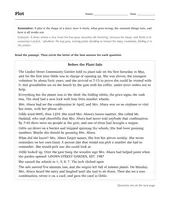
A plot is the shape of a story: how it starts, what goes wrong, the moment things turn, and how it all works out.
Five grades, four different sets of passages: 5th and 6th grade share one. Print one here, or open a grade for examples and teaching notes.
Print by grade
-
2nd grade
Second grade plot worksheets pair a short story with questions in story order: what happens at the beginning, what the problem is, how it gets solved, and how the story ends. Every passage is a complete arc, so every part is really there to find.
-
3rd grade Core grade
Each click picks one of the 26 passages written for this grade. Every sheet comes with its answer key. You don't need to sign up.
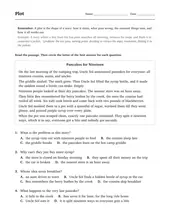
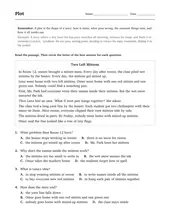
Third grade passages run longer, with failed tries and a real turning point, and the questions start asking which event turned the story. Wrong options are true events from the wrong part of the story, so ordering matters, and skimming shows.
-
4th grade
Fourth grade plots hide their hinges. The turning point can be a question someone asks or a small discovery, and questions ask how the ending answers the beginning. Choosing well means holding the whole shape of the story in mind at once.
-
5th grade
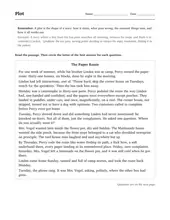
Fifth grade plot worksheets follow stories with real setbacks: a plan that fails twice before the third try, a search that looks everywhere except the right place. Questions ask for the problem, the turning point, and why the story keeps its failures in, with wrong options that are true events from the wrong part of the arc.
-
6th grade
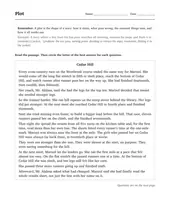
Sixth grade plots turn on a change in thinking rather than a lucky break: a character stops doing and starts looking, or remembers the one thing that matters. Questions ask how the ending answers the beginning and how the character has changed on the way, which is what the standard means by a plot that unfolds.
More on comprehension skills
- Author's claim 4th–6th
- Cause and effect 1st–6th
- Character traits 2nd–6th
- Characters and setting K–3rd
- Compare and contrast 1st–6th
- Firsthand and secondhand accounts 3rd–5th
- Genres 2nd–6th
- Making predictions 1st–3rd
- Picture sequencing Pre-K–2nd
- Poetry analysis 4th–8th
- Point of view 2nd–8th
- Problem and solution 1st–5th
- Sequencing 1st–3rd
- Summarizing 3rd–6th
- Text evidence 3rd–8th
- Text features 1st–5th
- Text structure 4th–8th
- Theme 2nd–8th
- Vocabulary in context 3rd–6th
All reading comprehension worksheets →
Or all English worksheets: every grade, every topic.