Reading fluency passages worksheets
Each click picks one of the 111 passages at this reading level. Every sheet comes with a scoring guide. You don't need to sign up.
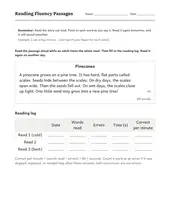
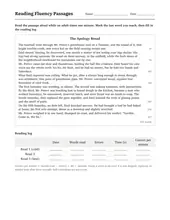
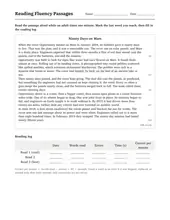
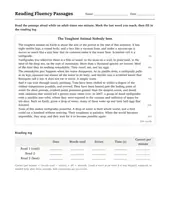
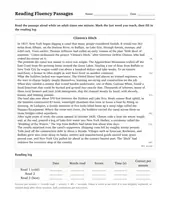
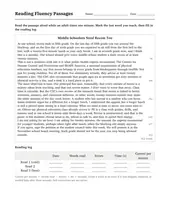
Read the passage out loud for one minute. Read it the way you would talk: smooth, at a steady pace, and with the feeling the sentences call for. Fast is not the goal; smooth and accurate is.
9 grades, each its own sheet. Print one here, or open a grade for examples and teaching notes.
Print by grade
-
Kindergarten
Kindergarten fluency passages are tiny stories and facts of 30 to 80 words, written in short sentences with the sight words children learn first. Your child reads the passage aloud to you while you follow the running word count in the margin. The Common Core sets no reading rate for kindergarten. RF.K.4 asks children to read emergent-reader texts with purpose and understanding, so the log here records rereading: the same passage, three tries, each one a little smoother.
-
1st grade
First grade fluency passages are short, familiar stories and facts with a running word count at the end of every paragraph. Your child reads aloud for one minute while you follow along; you mark where the minute ends and note the words correct. Three reads of the same passage, a day or two apart, show the gain that repeated reading brings.
-
2nd grade
Second grade is when reading becomes automatic for most children, and this is the sheet that shows it happening. A grade-level passage of 120 to 200 words, a running count in the margin, a three-read log underneath. The scoring guide on page two turns the stop point into words correct per minute without counting by hand.
-
3rd grade Core grade
Each click picks one of the 111 passages at this reading level. Every sheet comes with a scoring guide. You don't need to sign up.
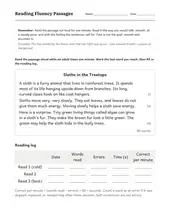
Third grade fluency passages run 140 to 240 words, long enough that a minute of reading never reaches the end. Fiction and nonfiction both appear, because expression and phrasing work differently in each. The log tracks three reads so your child can see their own number climb.
-
4th grade
Fourth grade passages carry longer sentences and more content words, so phrasing does real work: a fluent fourth grader groups words into meaning units and lets punctuation set the pauses. The one-minute read and three-read log stay the same; the text under them grows up.
-
5th grade
Fifth grade fluency sheets draw from the same passages the reading comprehension pages use, at 180 to 300 words, so a familiar text can be reread for rate and expression after it was read for meaning. A cold read, a practiced read, and a best read, each scored.
-
6th grade
Sixth grade has no fluency standard in the Common Core, but timed reading still earns its place for students who read accurately and slowly, and for anyone who reads aloud in class. Grade-level passages of 180 to 300 words with a running count and a three-read log.
-
7th grade
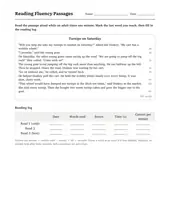
Seventh grade has no fluency standard in the Common Core, but timed reading still helps a student who reads accurately and slowly, and anyone who reads aloud in class. The passages run about 380 to 410 words and come from the 7th grade reading pages, mostly articles and essays with some stories. Each has a running count in the margin and a three- read log underneath.
-
8th grade
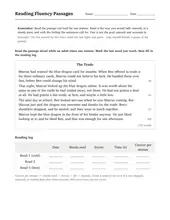
Eighth grade timed reading uses the longest passages on the site, 410 to 480 words, from the 8th grade reading pages. Most are stories full of dialogue, where expression does real work, and the rest are long articles. There is no fluency standard at this grade either, so the sheet is practice for pace and phrasing, scored with the same running count and three-read log.
More on reading passages
All reading comprehension worksheets →
Or all English worksheets: every grade, every topic.