Fact vs opinion worksheets
Each print is a different sheet with its own answer key. You don't need to sign up.
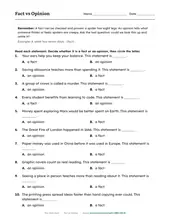
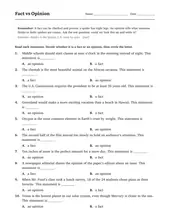
A fact can be checked and proven: a spider has eight legs. An opinion tells what someone thinks or feels: spiders are creepy. Ask the test question: could we look this up and settle it?
Six grades, each its own sheet. Print one here, or open a grade for examples and teaching notes.
Print by grade
-
1st grade
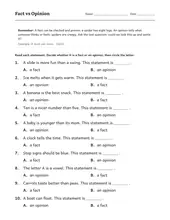
First grade fact and opinion worksheets give children short, simple sentences to sort. A fact is true, and you can check it by looking or by reading a book. An opinion tells what someone thinks or feels. Your child reads each sentence, decides whether it is a fact or an opinion, and circles the letter.
-
2nd grade
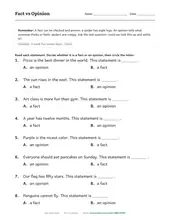
A fact is a statement that can be checked and proven true: bees make honey. An opinion says what someone thinks or feels: honey is delicious. Second graders sort statements with one question in hand: could we prove it, or could people disagree?
-
3rd grade Core grade
Each print is a different sheet with its own answer key. You don't need to sign up.
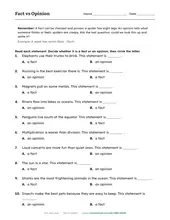
Third graders sharpen the test on statements where the opinion hides behind confidence: "Mondays are the worst" sounds firm but can't be proven. Spotting judgment words (best, boring, should) and asking "checkable?" turns a feeling-guess into a reading skill.
-
4th grade
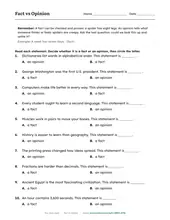
Fourth graders meet opinions in fact's clothing: "our town needs a bigger library" carries no feeling words yet can't be proven. Statements now pull from science and history, so the checkable test has real content to bite on.
-
5th grade
Fifth graders use the distinction the way readers of news and ads must: a persuasive paragraph mixes facts and opinions on purpose, and the reader's job is to un-mix them. This sheet keeps the reflex sharp one statement at a time.
-
6th grade
Sixth grade fact and opinion worksheets come down to one question: could this be checked? The statements come from science, history, geography and sports, and many are written to catch a quick reader. "Tallest mountain" is a fact because someone measured it. A confident sentence with a number in it can still be an opinion.
More on reading passages
All reading comprehension worksheets →
Or all English worksheets: every grade, every topic.