Author's purpose worksheets
Each click picks one of the 26 passages written for this grade. Every sheet comes with its answer key. You don't need to sign up.
Every writer has a reason for writing. The three big reasons are easy to remember as PIE: to Persuade (change your mind), to Inform (teach you facts), or to Entertain (tell you a fun story). To find the purpose, ask what the writer wants you to do after reading.
Seven grades, five different sets of passages: 6th to 8th grade share one. Print one here, or open a grade for examples and teaching notes.
Print by grade
-
2nd grade
Second grade author's purpose worksheets give your child one short passage to read: a letter, a class speech, a poster, a true piece about animals or weather, or a silly made-up story. Four questions follow. They ask why the author wrote it, what the author wants readers to learn or do, and which details show it.
-
3rd grade
Third graders learn the three main reasons authors write, remembered as PIE: to persuade, to inform, or to entertain. They read a short passage and decide which one fits, using clues like signal words and whether it states facts.
-
4th grade Core grade
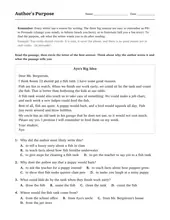
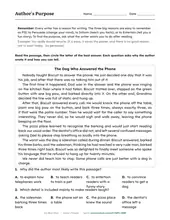
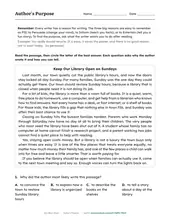
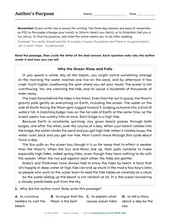
Each click picks one of the 26 passages written for this grade. Every sheet comes with its answer key. You don't need to sign up.
Fourth graders identify an author's purpose and point to the evidence for it: the sentence that argues a side, the fact that teaches, or the detail added only for fun.
-
5th grade
Fifth graders judge purpose from how a whole passage is built, including word choice and tone. They notice when an author informs in order to persuade and predict what the author wants the reader to do, feel, or understand.
-
6th grade
Sixth grade author's purpose worksheets ask what the author thinks, not only why the piece exists. Students read letters, reviews, how-to guides, humor columns and speeches, then find the author's point of view and the word choices, jokes and details that carry it, even when the author never states it.
-
7th grade
Seventh grade passages put the author's view next to someone else's: a reviewer who disagrees with most critics, a speaker asking for something narrower than what others want. Questions ask how the author sets that position apart, and what a reader gets wrong by lumping the two views together.
-
8th grade
Eighth grade questions follow what an author does with evidence that points the other way: a study, a survey or a critic's objection. Students decide whether the author admits it, answers it or brushes it aside, and what that choice does to the argument.
More on reading passages
All reading comprehension worksheets →
Or all English worksheets: every grade, every topic.