Fiction reading comprehension worksheets
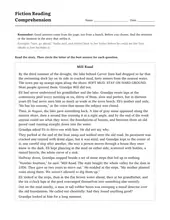
Each click picks one of the 13 passages written for this grade. Every sheet comes with its answer key. You don't need to sign up.
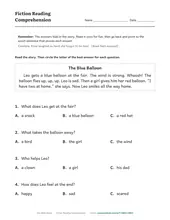
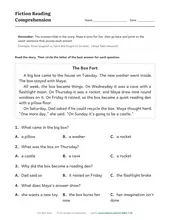
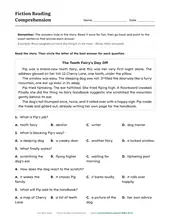
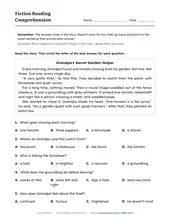
The answers hide in the story. Read it once for fun, then go back and point to the exact sentence that proves each answer.
Nine grades, six different sets of passages: 2nd and 3rd grade share one, so do 4th and 5th grade, and so do 7th and 8th grade. Print one here, or open a grade for examples and teaching notes.
Print by grade
-
Kindergarten
Kindergarten comprehension starts with listening and looking: an adult reads the tiny story aloud (or the child reads what they can), and the questions check who, what, and where.
-
1st grade
First graders read short stories mostly on their own and answer who, what, where, and how-did-they-feel questions. The habit to build is pointing back: every answer lives in a sentence the child can touch.
-
2nd grade
Fiction comprehension is reading a story and holding onto it. Second graders answer who, what, where, and why questions about short stories, learning to point back to the sentence that proves each answer.
-
3rd grade Core grade
Each click picks one of the 13 passages written for this grade. Every sheet comes with its answer key. You don't need to sign up.
Third graders read longer stories and reach past the literal: what a character feels, why they act, and what the story is mostly about. The proof-in-the-text habit stays central; the questions ask about things the author shows rather than tells.
-
4th grade
Fourth graders read longer fiction and answer questions that lean on inference: why a character chose what they chose, how the mood shifts, and which detail the author planted. Citing the exact line that proves an answer is now expected.
-
5th grade
Fifth graders handle passages with more than one thing happening at once: a surface story and an undercurrent, a narrator whose view colors the telling. Questions ask what the text says explicitly and what it implies.
-
6th grade
Sixth graders read fiction with layered machinery: narrators whose views slant the telling, details planted early that pay off late, and endings that ask to be interpreted. Questions require citing textual evidence for both the stated and the implied.
-
7th grade
Seventh graders read fiction where the parts act on each other: a setting that shapes what a character does, a choice that turns the plot. Questions ask what the story states and what it implies, and the grade-7 standard expects several pieces of evidence, so some answers rest on two lines, not one.
-
8th grade
Eighth graders read fiction for how it works: a line of dialogue that pushes the action, an incident that forces a decision, a reader who knows more than the character. The questions ask what the text implies, and the answer is the one the passage most strongly supports, which is the grade-8 standard's own phrase.
More on reading passages
All reading comprehension worksheets →
Or all English worksheets: every grade, every topic.