Nonfiction reading comprehension worksheets
Each click picks one of the 13 passages written for this grade. Every sheet comes with its answer key. You don't need to sign up.
Nonfiction is true information. Read to find out what the passage teaches, and be ready to point to the fact that answers each question.
Nine grades, six different sets of passages: 2nd and 3rd grade share one, so do 4th and 5th grade, and so do 7th and 8th grade. Print one here, or open a grade for examples and teaching notes.
Print by grade
-
Kindergarten
Kindergartners meet true information the same way they meet stories: read aloud together, with questions that check what the passage taught. Topics stay concrete, animals, weather, helpers, food, so the facts connect to things the child already sees.
-
1st grade
First graders read short true passages about how the world works and answer fact questions about them. After reading, a first grader should be able to say one new thing they learned.
-
2nd grade
Nonfiction comprehension is reading for real information: what a passage teaches about animals, science, or people, and which facts matter. Second graders answer fact questions about short passages and practice finding the sentence where the fact lives.
-
3rd grade Core grade
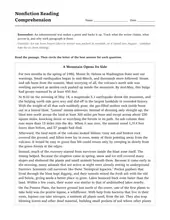
Each click picks one of the 13 passages written for this grade. Every sheet comes with its answer key. You don't need to sign up.
Third graders read denser informational text and work out the main idea, the meaning of new words from context, and why the author included a detail. The skill grows from finding facts to understanding what the facts add up to.
-
4th grade
Fourth graders read denser informational text with real structure: causes chained to effects, comparisons, and vocabulary defined by context. Questions ask for the fact, the main idea, and the why behind a detail, traceable to a line in the text.
-
5th grade
Fifth graders work with passages that argue quietly: an author choosing facts to make a point. The questions ask what the text states, what it implies, and how the pieces support the main idea, with evidence expected for all three.
-
6th grade
Sixth graders read informational text the way researchers do: tracking a central idea through paragraphs, weighing why the author chose these facts, and judging what the evidence supports. Citing the line is the entry fee for every answer.
-
7th grade
Seventh graders read informational text that tracks how people, events and ideas act on each other: a discovery that changes a law, a person whose choice shaped an event. Questions ask what the text says, what it implies, and how the author develops the central ideas, with several details as support.
-
8th grade
Eighth graders read informational text with judgment. They follow one central idea and the ideas that support it, notice the comparisons and categories an author uses to connect them, and choose the evidence that most strongly supports an answer instead of any line that fits.
More on reading passages
All reading comprehension worksheets →
Or all English worksheets: every grade, every topic.