7th grade punctuation worksheets
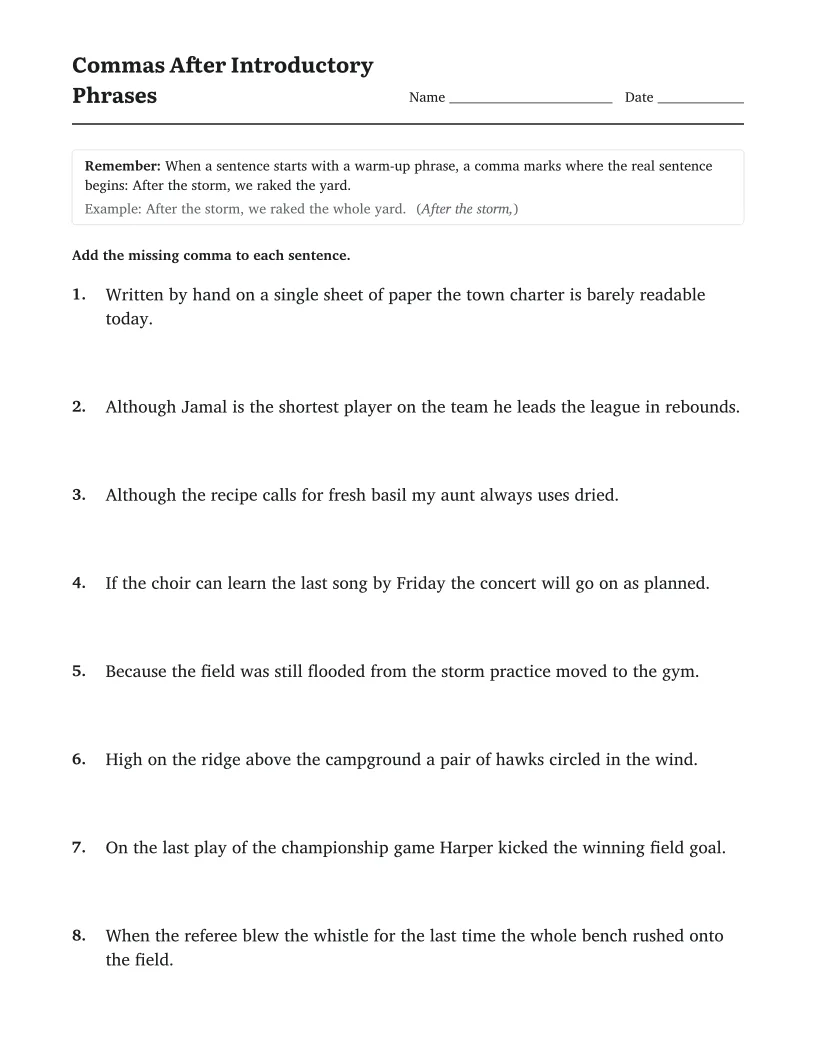
Seven punctuation skills at 7th grade, one sheet each, free with its answer key: commas after introductory phrases, commas between coordinate adjectives, commas for extra detail, and more.
Every sheet on this page was added on or after Sep 25. See what else is new
Nothing in 7th grade punctuation matches that. Search every grade
- Commas after introductory phrases When a sentence starts with a warm-up phrase, a comma marks where the real sentence begins: After the storm, we raked the yard.
- Commas between coordinate adjectives Two adjectives that could swap places, or that sound right with and between them, need a comma. Otherwise they do not.
- Commas for extra detail Extra information rides in the sentence wrapped in commas: My bike, which has a bell, lives on the porch. Lift it out and you still know which bike.
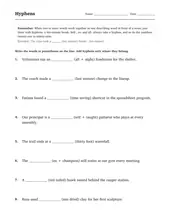
- Hyphens When two or more words work together as one describing word in front of a noun, join them with hyphens: a ten-minute break. Self-, ex- and all- always take a hyphen, and so do the numbers twenty-one to ninety-nine.
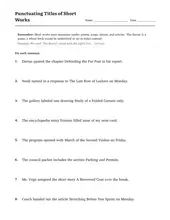
- Punctuating titles of short works Short works wear quotation marks: poems, songs, stories, and articles. 'The Raven' is a poem; a whole book would be underlined or set in italics instead.
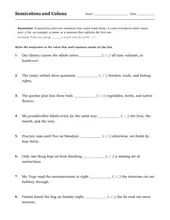
- Semicolons and colons A semicolon joins two sentences that could stand alone. A colon introduces what comes next: a list, an example, a name, or a sentence that explains the first one.
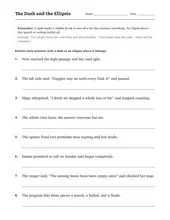
- The dash and the ellipsis A dash marks a sudden break or sets off a list that renames something. An ellipsis shows that speech or writing trailed off.
All 7th grade English worksheets →
More 7th grade English: Grammar · Sentence structure · Spelling · Vocabulary · Reading comprehension · Writing
Punctuation at other grades: 1st · 2nd · 3rd · 4th · 5th · 6th · 8th