Commas after introductory phrases worksheets
Each print is a different sheet with its own answer key. You don't need to sign up.
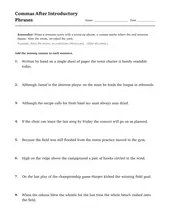
When a sentence starts with a warm-up phrase, a comma marks where the real sentence begins: After the storm, we raked the yard.
Three grades, two different sets of sentences: 5th and 6th grade share one. Print one here, or open a grade for examples and teaching notes.
Print by grade
-
5th grade Core grade
Each print is a different sheet with its own answer key. You don't need to sign up.
Many sentences open with a warm-up before the main event: a phrase (after the storm), a clause (if you finish early), or a transition (according to the survey). Fifth graders place a comma at the end of that introductory element.
-
6th grade
Sixth graders handle longer and layered openers (at the edge of the meadow, by the time we arrived) and place the comma at the true boundary, exactly where a natural reader takes a breath.
-
7th grade
Seventh grade openers are long: full dependent clauses (although the essay was due on Friday, as soon as the final bell rang) and phrases of five words or more, including participial and infinitive phrases (having finished the reading before lunch, to earn a spot on the honor roll). Seventh graders find where the opener ends and put the comma there.


More on commas
All punctuation worksheets →
Or all English worksheets: every grade, every topic.